What Is a CHW Digital Health Toolkit? Essential Components for Field Deployment
A research-based look at what belongs in a CHW digital health toolkit for field deployment, from offline workflows and decision support to data standards.
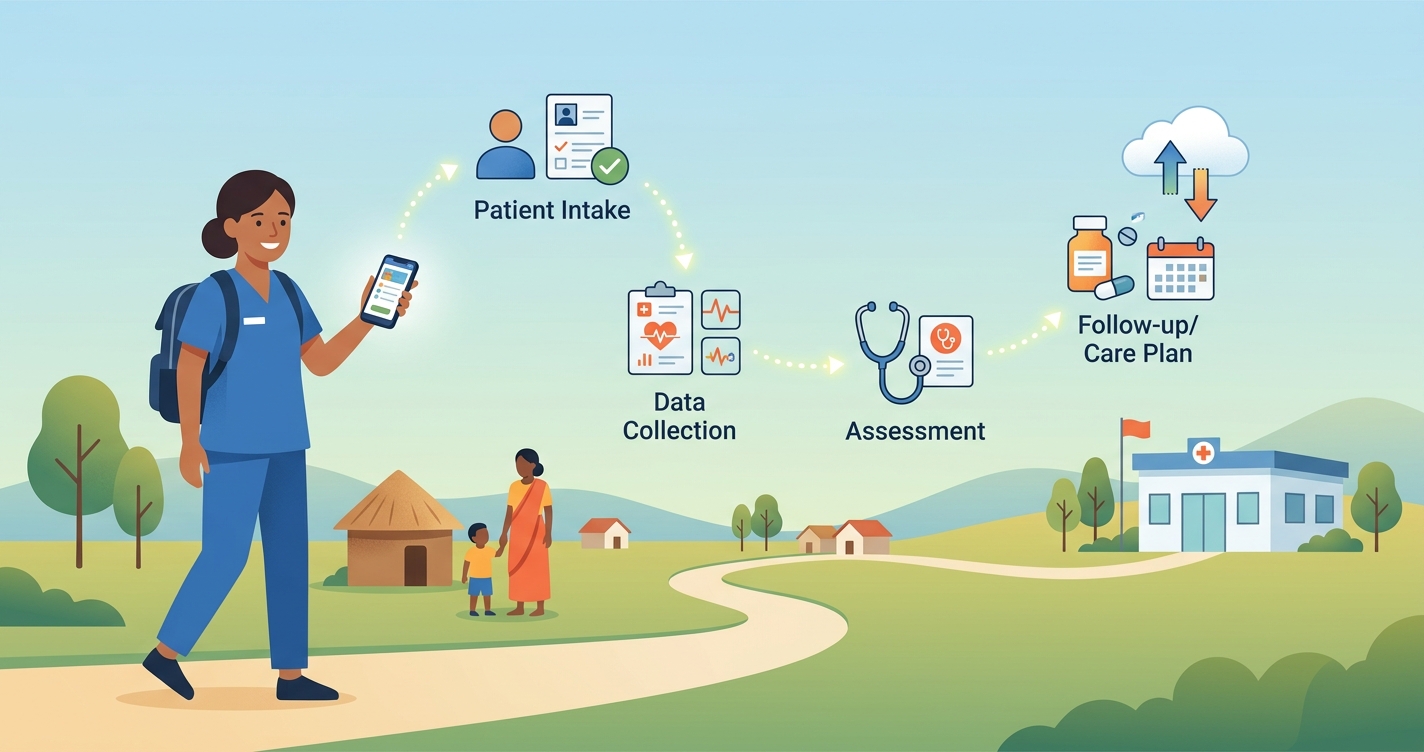
A CHW digital health toolkit is the operational stack that lets community health workers collect information, follow protocols, coordinate referrals, and stay productive when connectivity is weak or clinical infrastructure is thin. In low-resource deployment settings, that toolkit is rarely just “an app.” It usually combines workflow logic, offline data capture, supervision tools, and interoperability standards that keep community care connected to the rest of the health system.
“Digital health interventions can support community health workers in delivering services, but impact depends heavily on how tools fit real workflows, supervision, and the broader health system.” — Neha Agarwal, Alain Labrique, and colleagues, BMJ Global Health, 2020
CHW Digital Health Toolkit Components in Real Field Deployment
The phrase CHW digital health toolkit field deployment gets used loosely, but the strongest programs are surprisingly consistent in what they include. WHO’s SMART Guidelines and Digital Adaptation Kits break digital systems into concrete elements: workflows, data elements, decision-support logic, indicators, and functional requirements. The Community Health Toolkit ecosystem arrives at a similar answer from the implementation side: messaging, task management, longitudinal records, analytics, and offline operation.
That overlap matters. It suggests that effective field systems are not built around one flashy feature. They are built around repeatable operational components.
Comparison of core toolkit layers
| Toolkit component | What it does in the field | Why it matters for CHWs | Common failure if missing |
|---|---|---|---|
| Offline-first patient record | Stores visits, symptoms, referrals, and follow-up history locally | Keeps service delivery running during network outages | Data gaps and lost encounters |
| Decision support workflows | Guides screening, triage, and referral steps | Reduces protocol drift and training burden | Inconsistent care quality |
| Task and schedule engine | Generates reminders for revisit, follow-up, ANC, immunization, or adherence checks | Helps CHWs manage caseloads across dispersed households | Missed follow-ups |
| Messaging and escalation tools | Connects CHWs with supervisors, facilities, and patients | Speeds referrals and supervision | Delayed escalation |
| Stock and supply reporting | Tracks tests, medicines, and consumables | Prevents field teams from arriving empty-handed | Stock-outs at the point of care |
| Interoperability layer | Syncs with DHIS2, OpenHIE, EMRs, or national registries | Makes community data usable beyond the pilot | Data stays trapped in one app |
| Analytics and supervision dashboards | Shows coverage, performance, and quality trends | Supports coaching and program management | Weak accountability |
| Security and governance controls | Handles consent, roles, and data access | Protects patients and meets donor or ministry requirements | Trust and compliance problems |
A useful rule: if a platform only captures data, it is not a toolkit yet. A field-ready toolkit has to help workers act on that data.
Some evidence now backs that up. WHO Digital Adaptation Kit documentation describes digital systems in terms of business process flows, decision rules, indicators, and data requirements. UNICEF’s digital primary care work with community systems in countries including Rwanda emphasizes decision support, longitudinal follow-up, reminders, stock reporting, and supportive supervision. Medic’s Community Health Toolkit reports similar building blocks and says the platform supported more than 180,000 community health workers across 24 countries by the end of 2025.
What separates a toolkit from a pilot app
Field deployments usually break for ordinary reasons, not exotic ones. Devices go offline. Health workers change jobs. Supervisors cannot see what happened in yesterday’s visits. Data sits in a dashboard that ministries do not use.
That is why the strongest CHW digital stacks tend to share five design assumptions.
- Connectivity will fail often enough that offline mode is mandatory
- Training time will be limited, so workflows must be explicit
- Supervisors need visibility into task completion and data quality
- Referral pathways need to connect community screening to facilities
- National scale requires standards, not one-off custom integrations
This is also where many procurement conversations go wrong. Buyers sometimes ask for symptom questionnaires, vital signs capture, and dashboards. Those are important, but they are only one layer. The harder question is whether the toolkit helps a CHW finish a visit, queue the next task, trigger a referral, and sync the record when the phone reconnects two days later.
Industry Applications for CHW Digital Toolkit Deployment
Maternal and newborn programs
Maternal health programs often need strict protocol support, repeat visits, and referral escalation. WHO’s antenatal and postnatal Digital Adaptation Kits reflect that by specifying workflow logic, data fields, and scheduling requirements. In practical terms, a maternal toolkit needs gestational follow-up schedules, danger-sign prompts, escalation rules, and an auditable referral trail.
HIV, TB, and chronic disease programs
In HIV and TB programs, the toolkit has to handle longitudinal follow-up better than one-time screening apps. That means case lists, adherence reminders, symptom review templates, and status tracking that survives patchy connectivity. For chronic disease screening, the same toolkit logic supports repeat blood pressure review, medication refill follow-up, and missed-visit outreach.
Community-based surveillance and outbreak response
Surveillance deployments push different components to the front. Messaging, rapid form updates, and analytics become more important because protocols may change quickly. Here, interoperability matters too: community data only becomes useful for response planning when district and national systems can actually receive it.
Current Research and Evidence
Agarwal, Labrique, and colleagues wrote in BMJ Global Health in 2020 that digital health tools for community health workers show promise, but impact depends on how well interventions align with real service delivery and system constraints. That is a sober finding, and probably the right one. Good software helps, but it does not rescue a weak operating model.
WHO’s SMART Guidelines work adds another important insight. The organization’s Digital Adaptation Kit framework treats software requirements as a structured translation problem rather than a design free-for-all. Instead of telling implementers to “digitize community care,” WHO breaks the work into reusable pieces: user scenarios, workflows, data elements, decision-support logic, indicators, and functional requirements. That approach lowers the odds that a country program ends up with beautiful screens and poor clinical fidelity.
UNICEF’s digital health materials point to another consistent pattern: CHW systems work better when they include supervision and follow-up, not just form entry. In Rwanda, community electronic records on smartphones replaced paper registers for many frontline tasks, while also giving programs better continuity across visits. VillageReach and other implementation groups have made a similar case in practice: a toolkit should help with patient tracking, stock reporting, and supervisor review, because those are the functions that usually break first at scale.
The Community Health Toolkit ecosystem offers a useful implementation benchmark. Its published materials stress threaded messaging, workflow-driven tasks, decision support, analytics, and offline-first operation across phones and computers. Those details matter because they reflect the daily mechanics of field work rather than a lab ideal.
Why offline-first design is usually the deciding factor
If there is one component that most clearly separates field-ready systems from office-ready systems, it is offline-first behavior. Connectivity gaps are not edge cases in low-resource settings. They are the normal condition.
An offline-first toolkit changes the deployment math in several ways.
- CHWs can complete visits without waiting on sync
- Supervisors can review work later instead of losing encounters entirely
- Programs do not need to restrict deployment to areas with strong coverage
- Data quality improves because workers enter information once, in context
This is one reason open digital public goods have held attention in global health. They are often built for constrained settings from the start, which means local storage, delayed sync, and flexible device models are treated as core requirements rather than premium features.
The Future of CHW Digital Health Toolkit Design
The next generation of toolkits will probably become more modular, more standards-based, and less dependent on extra hardware. WHO’s DAK model already nudges countries in that direction by making requirements reusable across software vendors. That is important for procurement, but even more important for scale. Ministries do not want to rewrite clinical logic every time they change platforms.
At the same time, field deployments are moving toward richer mobile workflows. Camera-based screening, lightweight AI decision support, and on-device analytics are becoming more realistic. For sites like medhealthscan.com, that matters because zero-equipment or low-equipment screening fits the basic realities of dispersed care delivery. The practical question is no longer whether digital support belongs in community health. It is which toolkit components are solid enough to survive field conditions and national reporting demands at the same time.
Programs evaluating this space often end up looking beyond a single app and toward deployment architecture. That is also where solutions linked to Circadify are trying to push the conversation: not with broad claims, but by reducing the hardware and workflow burden attached to community screening. For readers tracking that transition, the broader global health case-study stream on Circadify’s blog is a useful place to watch.
Frequently Asked Questions
What is included in a CHW digital health toolkit?
A field-ready toolkit usually includes offline patient records, decision support, task scheduling, messaging, referral tracking, supply reporting, analytics, and interoperability with district or national health systems.
Why is offline-first design so important for CHW field deployment?
Because many community health programs operate with intermittent connectivity. If the system fails when the network fails, it is not ready for field deployment.
How do WHO Digital Adaptation Kits relate to CHW software?
WHO Digital Adaptation Kits translate clinical guidance into structured workflows, data elements, indicators, and functional requirements. They help implementers build or buy digital tools that stay aligned with evidence-based care pathways.
What makes a pilot app different from a deployable toolkit?
A pilot app may capture data, but a deployable toolkit also supports supervision, follow-up, referrals, sync, and integration with the broader health system.
Related reading: How Community Health Workers Collect Vital Signs in the Field, How Smartphone Screening Integrates with DHIS2, and What Is Offline-First Health Software? Apps for Rural Areas.