
What Is Offline-First Health Software? Apps for Rural Areas
A research-based look at offline first health software apps for rural care, covering sync models, field evidence, and why they matter in low-connectivity health systems.
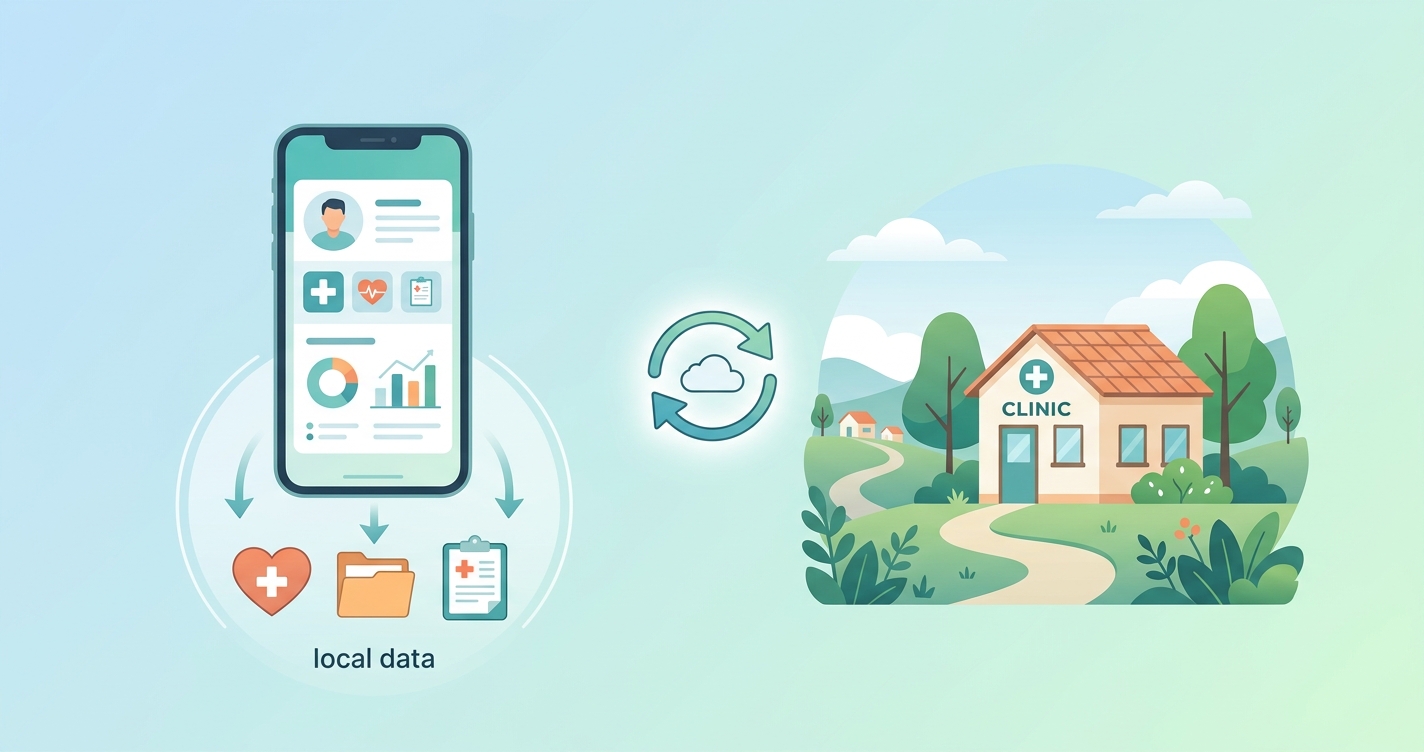
Offline first health software apps for rural care are built around a simple assumption: the nurse, community health worker, or outreach team should still be able to do the job when the signal drops. That sounds obvious, but it remains one of the sharpest dividing lines in global digital health. In many rural programs, the real constraint is not whether a team owns smartphones. It is whether the software keeps working when connectivity, power, and supervision are uneven. Offline-first design turns that reality from a failure state into the default operating model.
"The promise of digital health will not be realized if solutions are not designed with the realities of low-resource settings in mind." — Alain Labrique of Johns Hopkins and colleagues, writing on digital health scale-up in low-resource settings
Offline First Health Software Apps for Rural Care: What the Model Actually Means
Offline-first software stores the data, forms, and workflow logic on the device itself, then syncs when a connection becomes available. In rural health programs, that usually means a phone or tablet can register a patient, record a screening result, queue a referral, and continue through the visit without waiting on live internet access.
That is different from a cloud-dependent app with a temporary offline mode. In a true offline-first workflow, the local device is expected to carry the encounter until synchronization happens later. The app is designed around delayed connectivity, not rescued by it.
The distinction matters because the infrastructure picture has not suddenly become easy. GSMA Intelligence reported in its State of Mobile Internet Connectivity 2024 that 4.6 billion people were using mobile internet by the end of 2023, but 39% of the global population still lived inside mobile broadband coverage and did not use it, while another 4% remained outside coverage altogether. ITU's Facts and Figures 2024 made a related point: internet use continues to grow, but the urban-rural divide remains stubborn, especially in low-income settings. For rural health software teams, those are not abstract telecom statistics. They are product requirements.
Comparison of Rural Health App Architectures
| Dimension | Cloud-Dependent App | Offline-First App | Hybrid Edge App |
|---|---|---|---|
| Works during no connectivity | Often no | Yes | Yes |
| Primary data storage during visit | Remote server | Local device first | Local device plus selected edge processing |
| Sync pattern | Real-time only | Delayed, store-and-sync | Delayed sync with local rules engine |
| Best fit | Urban facilities with reliable data service | Rural outreach, field screening, CHW workflows | Mixed environments with facility and field use |
| Main operational risk | Workflow stops when network fails | Sync conflicts and device management | Higher implementation complexity |
| Training demand | Lower at first | Moderate, focused on sync discipline | Highest |
| Typical buyer | Centralized provider networks | Ministries, NGOs, CHW platforms | National programs with interoperability needs |
Three design choices usually separate strong offline-first systems from weak ones:
- They cache forms and reference data locally before the worker leaves the facility.
- They make sync status visible, so staff know what has and has not reached the server.
- They tolerate conflict resolution instead of pretending it will never happen.
If a platform misses those basics, it may still look good in a demo. It usually becomes painful in a district where field staff return to connectivity once a day, or once a week.
Where Offline-First Software Fits in Rural Health Programs
Community Health Worker Operations
This is the clearest use case. Community health workers rarely move through their day in places with stable bandwidth. They move through villages, schools, churches, farms, or temporary clinics. An offline-first app lets them register households, collect symptoms, capture risk flags, and continue to the next stop without babysitting a loading spinner.
That is why older open-source tools still matter. In the 2010 ACM/IEEE ICTD paper on Open Data Kit, Carl Hartung, Adam Lerer, Yaw Anokwa, Clint Tseng, Waylon Brunette, and Gaetano Borriello described a toolkit built for data collection in developing regions where field reliability mattered more than polished online behavior. The lesson has aged well: if the data pathway starts with delayed synchronization, the deployment is much more likely to survive outside a capital city.
Rural Clinics and Mobile Outreach
Offline-first design is not only for CHWs. Rural clinics often deal with intermittent service, shared devices, and unstable electricity. In those settings, the app has to preserve a clinical encounter even if the network disappears halfway through a visit.
A 2026 mixed-methods feasibility study in PLOS Digital Health examined Hikma Health's offline-first electronic health record in clinics serving displaced or rural populations in Lebanon and Nicaragua. Henry Ashista, Alanis Santiago Comas, Taylor Selby, Mohammad Yasir Essar, Jude Alawa, Samar Al-Hajj, and colleagues found that after about three hours of training and three weeks of use, staff were comfortable with the system, and patient interview times fell by roughly three minutes. That is the kind of operational result implementers care about. Not hype. Time back during a busy clinic day.
Referral and Longitudinal Follow-Up
Rural programs do not fail only because they cannot collect a record. They fail because follow-up disappears between the field encounter and the next facility touchpoint. Offline-first systems help here when they carry forward queued tasks, scheduled follow-ups, and referral status until sync happens.
This is particularly useful for:
- maternal risk screening where a field visit needs a facility follow-up
- hypertension or diabetes case finding where screening and confirmation happen in different places
- immunization catch-up and defaulter tracing
- refugee or displaced-population programs where continuity is fragile by default
Current Research and Evidence
The strongest argument for offline-first software is not that it sounds sensible. It is that the implementation literature keeps circling back to the same problems: sustainability, local workflow fit, and resilience under messy conditions.
In the Journal of Global Health in 2020, Jennifer McCool, Richard Dobson, Nelly Muinga, Chris Paton, Claudia Pagliari, Smisha Agarwal, Alain Labrique, Heather Tanielu, and Robyn Whittaker reviewed factors influencing the sustainability of digital health interventions in five low-resource countries. Their conclusion was not glamorous. Programs last when they fit existing systems, have realistic financing, and keep functioning inside routine operational constraints. Rural connectivity belongs squarely in that last category.
WHO's digital-health guidance has taken a similar line. The 2024 ITU snapshot notes that progress on the urban-rural divide remains limited. WHO and partner guidance on digital implementation has also pushed implementers toward workflows that match real service delivery conditions rather than idealized connectivity assumptions. In practice, that has favored store-and-sync designs, local data capture, and simpler mobile interfaces for frontline teams.
One of the more useful recent studies is the Hikma Health paper because it captures both the upside and the tradeoff. The platform worked well in offline-first settings, but the authors also reported friction when multiple clinicians needed repeated synchronization within a single patient encounter. That is worth saying out loud. Offline-first is not magic. It is a design decision that handles one class of problems very well, while still demanding discipline around syncing, shared records, and device stewardship.
What the Research Points To
- Rural health apps succeed more often when fieldwork can continue without live connectivity.
- Short training windows matter because many programs operate with high staff turnover.
- Time savings in documentation are operationally meaningful, even when they sound modest on paper.
- Sustainability depends as much on governance and workflow fit as on the app itself.
Industry Applications
Maternal and Child Health
In antenatal outreach, an offline-first app can hold visit history, danger-sign checklists, and referral prompts locally until a supervisor reaches connectivity. That makes more sense than forcing workers back to paper every time signal quality dips.
Disease Surveillance and Campaign Work
Campaigns often move faster than networks do. Outreach teams may screen dozens of people in a day and upload the data later from a district hub. Here, offline-first architecture protects throughput and keeps the campaign from fragmenting into paper notes and duplicate entry.
Smartphone-Based Vital Signs and Screening
For organizations interested in zero-equipment screening, the offline-first model is especially relevant. If the phone is also the sensor, the workflow only really works when capture, triage, and local storage can happen on the device. Uploading later is fine. Stopping the encounter because a tower is down is not.
That is part of the reason global-health buyers keep looking at software architectures, not just sensors. The more screening can happen on the phone in the field, the more the operational bottleneck moves to sync, supervision, and interoperability.
The Future of Offline-First Rural Health Software
The next phase will likely look less like standalone data-collection apps and more like offline-capable care workflows. A rural health app will increasingly be expected to do several things at once: capture data, guide triage, sync into national systems, and keep the worker moving when the environment is unpredictable.
A few shifts seem likely.
First, offline-first EHR and screening products will borrow more from consumer app design. Field teams do not want to think about databases. They want a visible sync badge, recoverable drafts, and forms that open fast.
Second, national programs will keep pushing for interoperability. That means offline-first cannot become offline-isolated. Systems still need to sync into platforms such as DHIS2, national registries, or partner dashboards once connectivity returns.
Third, on-device analytics will become more common. That matters for rural screening because it allows classification and decision support before any upload occurs. For low-resource deployments, that is a practical advantage, not a fancy add-on.
FAQ
What is offline-first health software?
Offline-first health software is software that lets clinicians or frontline workers complete core tasks on a device without needing live internet. The data are stored locally first and synchronized later when connectivity is available.
Why is offline-first important for rural health apps?
Rural teams often face intermittent signal, high data costs, shared devices, and power disruptions. Offline-first design keeps patient registration, screening, and follow-up workflows moving instead of freezing at the moment of care.
Is offline-first the same as a normal app with an offline mode?
Not really. In a true offline-first system, delayed connectivity is part of the core design. In a cloud-first app with a backup offline mode, offline use is often partial, fragile, or limited to a narrow part of the workflow.
What are the main risks of offline-first health software?
The biggest risks are sync conflicts, outdated local reference data, lost or damaged devices, and weak supervision around upload routines. Those risks are manageable, but only if the deployment plan treats them as normal rather than exceptional.
For teams exploring rural screening and field-ready vital-sign workflows, see our related analysis on mobile health in low-resource settings and smartphone screening integration with DHIS2. For broader deployment case studies, visit Circadify's global health research coverage.