How are aid workers in the field screening patients without a single piece of equipment?
How aid workers screen patients with no equipment: a research-based look at smartphone triage, CHW workflows, and low-resource field screening.
How are aid workers in the field screening patients without a single piece of equipment?
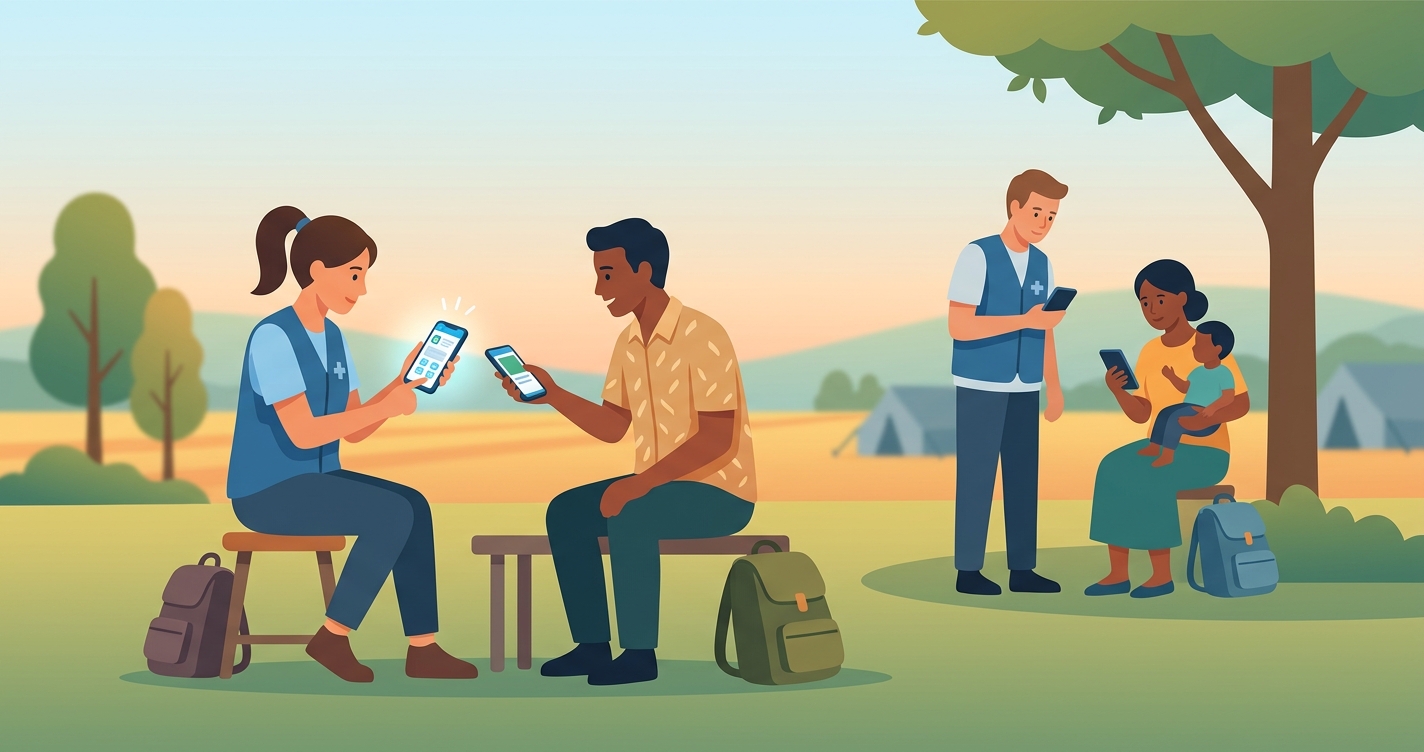
Aid workers screen no equipment is no longer a hypothetical search query. In refugee camps, rural outreach programs, and overstretched primary-care networks, field teams are increasingly using smartphones as the first screening layer when cuffs, pulse oximeters, or lab tools are unavailable. The point is not to replace clinics. It is to decide, quickly and with less friction, who needs escalation, who can be monitored, and where scarce equipment should go first.
“Digital health interventions are not a substitute for functioning health systems.” That line from the World Health Organization’s 2019 guideline, led by Alain Labrique with Pascale Allotey in a senior leadership role, still feels like the right starting point. In the field, smartphone screening works best as triage inside a larger care pathway.
Aid workers screening patients with no equipment usually rely on smartphones, protocols, and triage logic
When people imagine “screening without equipment,” they often picture guesswork. That is not what the better programs are doing. The real shift is toward software-led assessment: symptom intake, image capture, decision support, referral rules, and in some cases contactless physiological measurement using the phone’s camera or microphone.
Rebecca Braun, Caricia Catalani, Julian Wimbush, and Dennis Israelski wrote in their 2013 systematic review of community health workers and mobile technology that mobile tools were already being used for field data collection, alerts, reminders, health education, and person-to-person communication. That review covered 25 full-text articles. The interesting part is how normal this now sounds. What looked experimental a decade ago has become part of routine field operations in many programs.
A more recent signal came from Courtney T. Blondino, Alex Knoepflmacher, Ingrid Johnson, Cameron Fox, and Lorna Friedman. Their 2024 BMC Public Health study surveyed 1,141 community health workers across 28 countries and found that digital-device use was already widespread, while cost remained a major barrier. I keep coming back to that finding because it explains why “no equipment” matters so much. The constraint is often not clinical interest. It is logistics.
| Screening approach | What the aid worker uses | What it can do well | Main limitation | Best field role |
|---|---|---|---|---|
| Observation-only triage | Eyes, questions, paper checklist | Fast initial prioritization | Highly subjective | Queue management and danger-sign recognition |
| Smartphone intake workflow | Phone forms, symptom prompts, referral logic | Standardizes decisions and records data | Depends on training and app design | First-pass screening and follow-up |
| Smartphone camera or microphone screening | Built-in sensors only | Adds physiological signal capture without extra hardware | Sensitive to lighting, motion, and environment | Low-equipment triage before confirmatory measurement |
| Conventional device-based screening | BP cuff, oximeter, thermometer, glucometer | Stronger direct measurement | Shipping, calibration, breakage, battery burden | Facility confirmation and high-risk assessment |
The table is the real story. Field programs are not choosing between “technology” and “nothing.” They are choosing between layers of screening, each with different costs and tradeoffs.
- Smartphone-only workflows reduce what teams have to ship, charge, replace, and track
- Standardized forms matter almost as much as sensors because they reduce variation across workers
- Contactless screening is most useful when it helps programs decide who should receive scarce device-based follow-up
- Offline-first design matters in conflict zones and rural outreach more than flashy features do
Industry applications for zero-equipment field screening
Humanitarian intake and rapid triage
In displacement settings, the first screening problem is usually throughput. Teams may need to assess large numbers of people in a short period with limited hardware. A smartphone-based intake workflow can capture symptoms, age, pregnancy status, chronic-disease history, and visible danger signs before equipment ever appears. That alone can improve prioritization.
Community health worker household visits
For community health workers, the appeal is simpler. One device can handle registration, decision support, counseling prompts, referral flags, and follow-up records. Braun and colleagues described these mobile functions early on; today they are the backbone of many CHW apps. The less gear workers need to carry, the easier it is to extend coverage into difficult terrain.
Infectious-disease screening and surveillance
A smartphone may not diagnose every condition, but it can structure screening for respiratory symptoms, fever history, malaria-test workflows, and referral urgency. In Busia County, Kenya, a study of Audere’s HealthPulse malaria app found that 99.6% of participating health workers said the tool was useful and 90.1% said it was easy to use. Process-control data also showed that 89.2% of rapid diagnostic tests were photographed within the recommended 30-minute timeframe, and 91.4% passed quality check on first submission. That matters because many field failures are workflow failures, not science failures.
Remote and low-resource vital-signs collection
This is where the conversation gets more attention. Smartphone cameras can be used to estimate signals like heart rate and respiratory trends in some settings, especially when the workflow controls lighting and movement. That does not make every phone a medical device. It does make the phone a practical front-end for deciding who needs a second look.
Current research and evidence
The evidence base for field screening without equipment is really an evidence base for layered digital health.
First, the WHO’s 2019 guideline did not tell countries to replace health systems with apps. It argued for careful use of digital interventions after weighing benefits, feasibility, resource use, and equity. That is exactly the right lens for aid operations. A screening tool is only useful if it fits supervision, referral, and data systems.
Second, Braun and colleagues’ 2013 review showed that CHW mobile tools were already supporting data collection, reminders, education, and communication across multiple health areas. In other words, the field learned long ago that the phone’s value is not just sensing. It is coordination.
Third, Blondino and colleagues’ 2024 multi-country survey gives a better read on current adoption. Their sample of 1,141 CHWs across 28 countries found that training increased device use and belief in digital impact, while cost remained a barrier. That combination tells implementers where to focus. Not on speculative promise. On financing, training, and deployment discipline.
Fourth, the Busia County malaria study shows what “screening without extra equipment” looks like in practice. The app did not magically solve malaria care. It tightened a test workflow, improved adherence to process steps, and made supervision easier. Honestly, that is how a lot of useful global-health technology works: less cinematic, more operational.
For aid programs, the practical evidence points in four directions:
- Zero-equipment screening works best as a triage layer, not a final diagnosis layer
- Training and protocol adherence often matter more than the underlying algorithm
- The savings come from lower equipment burden, easier scale, and fewer supply-chain dependencies
- Programs still need referral pathways for confirmatory measurement and treatment
If you want adjacent examples, see our coverage of zero-equipment vital signs for frontline teams and mobile health in low-resource settings.
The future of aid-worker screening without equipment
The next phase is less about proving that a smartphone can capture a signal and more about deciding where that signal belongs in a real care pathway. I suspect the strongest deployments will combine three things: offline-first intake, low-burden physiological estimation when conditions allow, and simple escalation logic that a community worker can trust.
That is also why the buyer here is not a consumer gadget team. It is global-health researchers, USAID and PEPFAR implementers, and mobile-health platforms trying to reduce hardware dependence without losing oversight. In those environments, removing even one extra device from the field bag changes training, shipping, breakage rates, battery management, and replacement cost.
Circadify is addressing this broader zero-equipment screening direction with smartphone-based vital-signs capabilities designed for deployment-minded teams. For more on that context, see these deployment case studies from Circadify.
Frequently Asked Questions
Can aid workers really screen patients with no equipment at all?
They can perform first-pass screening with no separate medical equipment by using smartphones for symptom intake, decision support, image capture, and in some contexts contactless signal estimation. Confirmatory diagnosis still usually requires conventional clinical tools.
What makes smartphone screening useful in humanitarian settings?
It cuts hardware burden, speeds intake, standardizes triage questions, and makes it easier to capture records in places where equipment is scarce or hard to maintain.
Is no-equipment screening mainly about AI?
Not really. Some workflows use AI or camera-based estimation, but much of the value comes from structured protocols, supervision, referral logic, and better data capture.
What is the biggest barrier to scaling these tools?
Cost and implementation discipline. Blondino and colleagues’ 2024 survey found that CHWs saw value in digital tools, but cost remained a major barrier across countries.
For related reading, see how smartphone screening integrates with DHIS2, remote health monitoring for displaced populations, and how to deploy health technology in conflict-affected areas.