Remote Health Monitoring for Displaced Populations: How It Works
An evidence-based look at remote health monitoring for displaced populations, from offline triage and CHW workflows to telemedicine, governance, and scale.
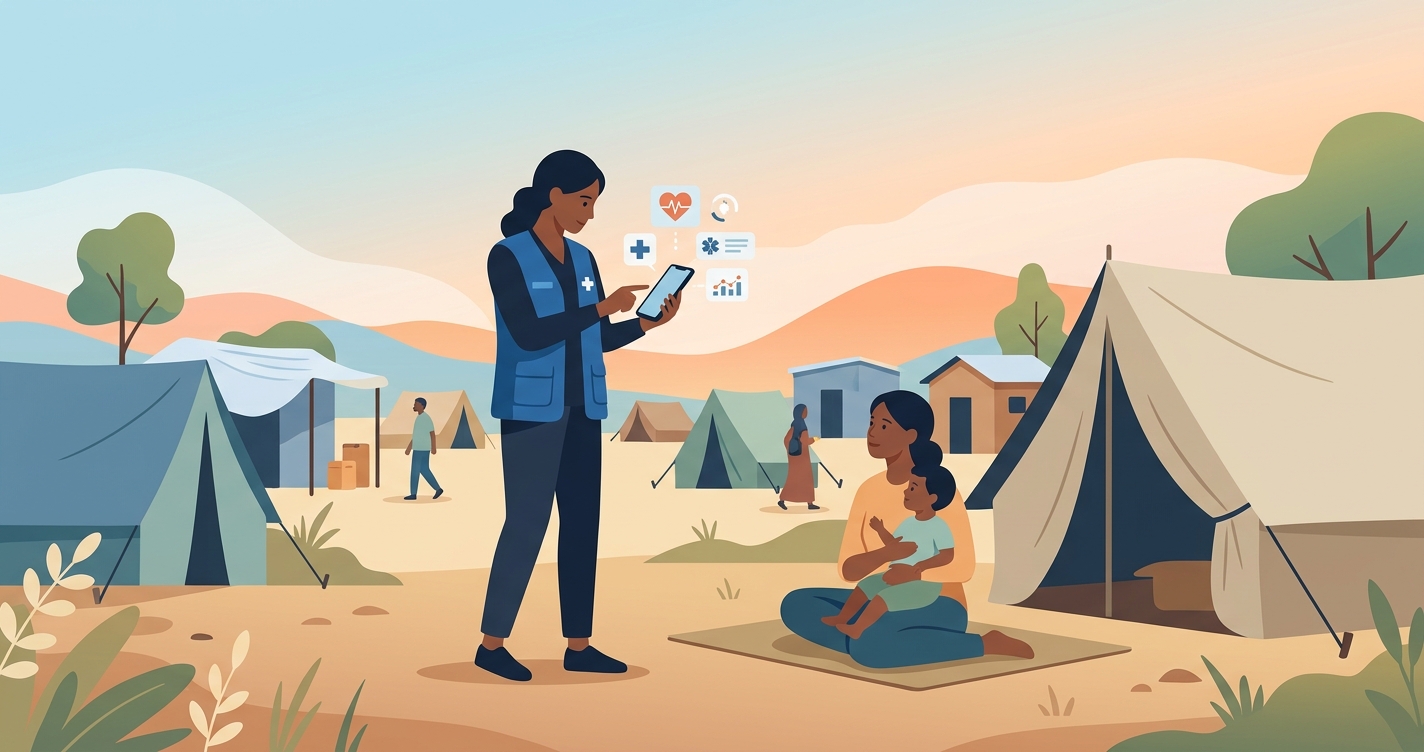
Remote health monitoring for displaced populations has become less of a niche digital-health discussion and more of an operating requirement for humanitarian health systems. When people are moving across borders, living in camps, or settling in informal urban communities, the core problem is continuity. Clinicians need a way to see risk earlier, follow people between encounters, and keep basic monitoring going even when clinics are crowded, understaffed, or physically far away. That is why remote monitoring in displacement settings now centers on low-friction tools: phones, offline-first records, community health workflows, and escalation pathways that do not depend on a fully equipped facility.
"The world is witnessing historically high levels of displacement, with more than 120 million people forcibly displaced worldwide." — UNHCR, Global Report 2024
Remote Health Monitoring for Displaced Populations in Practice
In humanitarian settings, remote monitoring rarely looks like a hospital-at-home model from a high-income market. It usually means a layered system: community health workers or outreach teams collect observations close to where people live, a digital record stays available on the phone when connectivity drops, and supervisors or clinicians review the signal later for triage, referral, or follow-up.
That architecture matters because the care environment is unstable by definition. Camps can expand quickly. Urban refugee populations may be hard to map. Mobile clinics may only visit certain zones on certain days. A monitoring model that assumes stable broadband, consistent power, and a fixed patient roster tends to fail early.
The stronger models share a few design features:
- They work offline during the clinical encounter.
- They rely on community-based teams rather than a facility-only workflow.
- They focus on triage, maternal risk, chronic disease follow-up, and infectious disease escalation.
- They treat data governance as part of patient protection, not an afterthought.
- They make escalation simple: who needs a call, a visit, a referral, or urgent transport.
Stephen A. Matlin, Johanna Hanefeld, and colleagues argued in The Lancet Regional Health – Europe (2024) that digital solutions for migrant and refugee health should be judged through a socio-technical lens, not just by whether the software works. That framing fits displacement settings well. A remote monitoring tool is only useful if it fits field realities, staffing models, legal protections, and referral systems.
Comparison of Remote Monitoring Models in Displacement Settings
| Dimension | Call Center / Hotline Model | CHW Smartphone Monitoring Model | Hybrid Telemedicine + Field Monitoring Model |
|---|---|---|---|
| Primary contact point | Patient or caregiver calls in | Community health worker visits or checks in | CHW captures data, clinician reviews remotely |
| Best fit | Acute advice and symptom triage | Routine follow-up in camps or host communities | Mixed-acuity programs with scarce clinicians |
| Connectivity needs | Continuous network access | Offline-first with periodic sync | Moderate; field can be offline, review can be remote |
| Clinical depth | Low to moderate | Moderate | Moderate to high |
| Continuity of care | Limited if identity records are weak | Strong if longitudinal records exist | Strongest when referral loops are defined |
| Typical bottleneck | Language and queue congestion | Training and supervision | Interoperability and staffing coordination |
| Good use cases | Fever triage, medication questions, mental health support | ANC follow-up, chronic disease checks, child wellness | Complex cases, specialist support, conflict-affected zones |
| Main scale risk | High volume, shallow data | Inconsistent supervision | Coordination complexity across teams |
The practical lesson is that remote monitoring is not a single app category. It is an operating model that combines capture, review, escalation, and record continuity.
Where These Systems Are Being Used
Community Health Work in Refugee Settlements
Some of the clearest field evidence comes from refugee community health worker programs in Uganda. Medic reported that more than 2,000 refugee CHWs now serve over 800,000 refugees across 13 settlements using the Community Health Toolkit adapted into the rCHMIS workflow. According to that program update, childhood immunization rates rose 34% over three years, full antenatal care coverage increased from 52% to 89%, and emergency response times fell by about 45 minutes.
Those figures matter because they show what remote monitoring looks like in reality. It is not passive dashboards. It is structured follow-up: households visited, records updated, danger signs flagged, and referrals triggered before a case becomes harder to manage.
Maternal and Child Health
Displacement amplifies routine risks in pregnancy and early childhood because care pathways break easily. Monitoring models that can track antenatal contact, symptoms, referral completion, and missed follow-up become especially valuable. In Kampala, a 2024 study of urban refugee adolescents found that antenatal contact was common, but completion of the full WHO-recommended visit schedule remained far lower. That gap is exactly where remote monitoring helps: not as a replacement for care, but as a way to find the people who are slipping out of the care pathway.
Conflict-Affected and Inaccessible Areas
Motti Haimi wrote in Frontiers in Medicine (2024) that telemedicine in war zones can support chronic disease care, mental health support, specialist consultation, and continuity for displaced people, but only when programs account for unstable electricity, weak communications infrastructure, language barriers, and privacy risks. In other words, the technology has value, but the implementation burden is real.
For displaced populations in conflict settings, remote monitoring often works best when it separates low-bandwidth data capture from higher-bandwidth clinical review. A frontline team can document risk on a phone, then a clinician can review later through telemedicine channels when conditions allow.
Current Research and Evidence
The research base is broad enough now to sketch a common operating pattern.
First, the policy pressure is unmistakable. WHO's 2023 global research agenda on health, migration, and displacement was built through consultation with more than 180 stakeholders and identified service access, emergency preparedness, and evidence translation as priority themes. That agenda did not focus narrowly on one device type or platform. It focused on building health systems that can actually respond to mobile and forcibly displaced populations.
Second, Matlin, Hanefeld, Ana Corte-Real, Luciano Saso, and co-authors made a useful point in their 2024 framework paper: migrant and refugee health tools succeed only when privacy, consent, equitable access, and governance are treated as core design questions. That is especially important for remote monitoring. A record that helps with continuity can also create risk if identity, movement, or health data are poorly protected.
Third, field programs keep pointing to the same workflow advantages:
- Digital records reduce the need to reconstruct histories after repeated displacement or referral.
- Offline-first mobile tools let outreach continue when networks fail.
- Structured monitoring helps teams prioritize scarce transport and clinician time.
- Community-based workflows extend reach beyond clinics and formal settlements.
- Remote specialist review can support local teams without relocating staff.
The strongest evidence is still operational rather than purely randomized. That is normal in humanitarian health. Programs are often designed around service delivery under difficult conditions, not clean experimental controls. Even so, the pattern across WHO, humanitarian implementers, and refugee-settlement digital health programs is consistent: remote monitoring works best when it is built around field workflows, not imported from consumer RPM assumptions.
Industry Applications for Humanitarian and Global Health Teams
NGO and Implementing Partner Operations
For NGOs and implementing partners, remote monitoring is usually a workforce multiplier. It helps supervisors prioritize which households need in-person follow-up, which maternal cases need referral review, and which chronic patients have gone quiet. The value is operational clarity, especially when staffing is thin.
Mobile Health Platform Design
For product and platform teams, the biggest takeaway is that displaced-population monitoring needs flexibility more than feature volume. Offline sync, multilingual workflows, low-data interfaces, and adaptable identity models matter more than polished dashboards. A technically impressive platform can still fail if field teams cannot use it during movement, congestion, or power interruptions.
Government and Interagency Coordination
For ministries, UN agencies, and national digital-health architects, the question is less whether remote monitoring is useful and more where it should connect. Should records feed national registries, parallel humanitarian systems, or a hybrid exchange layer? Programs that leave this unresolved often create islands of useful data that never become durable infrastructure.
The Future of Remote Health Monitoring for Displaced Populations
The next stage will likely move in three directions.
The first is lighter hardware dependence. Camera-based and sensor-light approaches are attractive in displacement settings because they reduce procurement, maintenance, and replacement pressure. The less a program depends on shipping specialized peripherals into fragile settings, the more resilient the workflow becomes.
The second is better identity and continuity models. Displaced patients may cross districts, camps, or borders. Monitoring systems that can preserve continuity without overexposing sensitive identity data will have an advantage.
The third is a stronger blend of field capture and remote review. That is where humanitarian remote monitoring appears headed: community health workers or outreach staff collecting structured information at the edge, with clinical escalation and specialist interpretation happening asynchronously when conditions permit.
That future is not fully here yet, but the direction is clear. Humanitarian programs are moving away from one-off digital pilots and toward workflow infrastructure that can survive mobility, instability, and limited equipment.
Frequently Asked Questions
What does remote health monitoring mean for displaced populations?
It usually means health data or symptom information is collected outside a formal clinic and reviewed later for triage, follow-up, or referral. In practice, this often happens through community health workers, mobile teams, or telemedicine-supported workflows.
Why is offline-first design so important in refugee and displacement settings?
Because connectivity, power, and facility access are often inconsistent. If the monitoring workflow only works online, it often breaks at the exact point where care is needed most.
Is telemedicine enough on its own for displaced populations?
Usually not. Telemedicine helps with specialist review and remote clinical support, but most successful programs still depend on field teams, outreach workers, or community health workers to collect information and maintain follow-up.
What are the biggest implementation risks?
Weak governance, poor privacy controls, language mismatch, unclear referral pathways, and systems that assume stable infrastructure are the biggest problems. Remote monitoring works best when the workflow fits the realities of displacement.
Remote monitoring is becoming part of the standard playbook for mobile, low-resource care delivery. Teams exploring field-ready vital-sign workflows can follow Circadify's broader global health research coverage, and continue with related analysis on mobile health in low-resource settings and how smartphone screening integrates with DHIS2.