When should I worry that my baby's fever needs a doctor we can't reach?
For health workers in low-resource settings, knowing the danger signs in a febrile infant is critical, especially when a doctor is not accessible. This is how mobile health tools can help.
For frontline health workers and program implementers in low-resource settings, a baby's fever is more than a clinical symptom; it is a critical indicator that demands immediate and accurate assessment. When the nearest clinic is hours away, the responsibility of distinguishing a mild, self-resolving illness from a life-threatening condition falls to the community health worker (CHW). The core challenge is clear: how to make a reliable judgment in the face of a baby fever no doctor nearby. This scenario is not an edge case but a daily reality in vast stretches of the global health landscape, where delayed care can have irreversible consequences. The ability to rapidly screen for danger signs using accessible technology is a pivotal development in addressing this gap.
"An estimated 4.9 million children under the age of five died in 2022, a devastating loss that is all the more tragic because many of these deaths were preventable. Infectious diseases such as pneumonia, diarrhoea, and malaria remain leading causes, with a disproportionate burden falling on Sub-Saharan Africa and Southern Asia, which together accounted for over 80% of these deaths." - UNICEF, 2023
Frameworks for analysis when there is a baby fever and no doctor nearby
The primary framework for assessing childhood illness in low-resource settings is the World Health Organization's (WHO) Integrated Management of Childhood Illness (IMCI) guidelines. This protocol is specifically designed for health workers with limited access to laboratory diagnostics. It provides a structured, signs-based approach to identify children who require urgent referral to a hospital. For a young infant (under 2 months), a fever is an automatic trigger for a "severe classification" because their immune systems are not fully developed, making them highly vulnerable to fast-progressing bacterial infections.
When confronting a potential baby fever no doctor nearby, the IMCI approach operationalizes the assessment by focusing on a specific set of "danger signs." A health worker, or even a trained caregiver, can use these signs to make a critical triage decision. The presence of any single sign indicates a need for immediate, advanced medical care. These signs include:
- Inability to feed or drink: A child who cannot breastfeed or take in fluids is at risk of dehydration and may be showing signs of severe systemic illness.
- Convulsions: Seizures in the context of a fever can indicate meningitis or other severe infections affecting the central nervous system.
- Lethargy or unconsciousness: A child who is difficult to wake, not responding to stimuli, or unusually drowsy is considered to have a very severe sign.
- Vomiting everything: While many illnesses cause vomiting, the inability to keep any fluids down points to a more serious condition.
- Fast or difficult breathing: For infants aged 0-59 days, a respiratory rate of 60 breaths per minute or more is a key danger sign. Severe chest indrawing, where the lower chest wall pulls in on inhalation, is another indicator of significant respiratory distress.
These signs are effective because they are observable and do not require equipment. However, their assessment relies on training, experience, and a calm, systematic approach, qualities that can be difficult to maintain in a high-stress situation. This is where mobile health (mHealth) tools are providing crucial support.
| Assessment Method | Key Characteristics | Equipment Required | Data & Integration |
|---|---|---|---|
| Parental/Caregiver Observation | Based on general impression and recall. Can be subjective and prone to anxiety or normalization of symptoms. | None | None; verbal report only. |
| CHW Assessment (IMCI Protocol, No Tools) | Follows a structured checklist of observable danger signs. Relies on manual counting (e.g., respiratory rate) and qualitative judgment. | Watch with a second hand. | Paper forms; manual data entry into systems like DHIS2 is slow. |
| CHW Assessment (mHealth Support) | Uses a smartphone app to guide the CHW through the IMCI protocol. Can include automated counters, video examples of danger signs, and decision support algorithms. | Basic smartphone. | Digital data captured instantly; can be synced with platforms like CommCare or DHIS2 for real-time surveillance. |
| Clinical Assessment (Facility-Level) | Performed by a nurse or doctor. Includes vital signs measurement with clinical devices (thermometer, pulse oximeter) and potential lab tests. | Thermometer, pulse oximeter, laboratory equipment. | Entered into an electronic medical record (EMR) or facility-level health information system. |
Industry applications: mhealth for pediatric screening
The application of mHealth in pediatric care is moving from pilot projects to scaled programs. Implementing partners for USAID and PEPFAR, along with ministries of health, are increasingly integrating these tools into their standard CHW toolkits.
Triage and referral systems
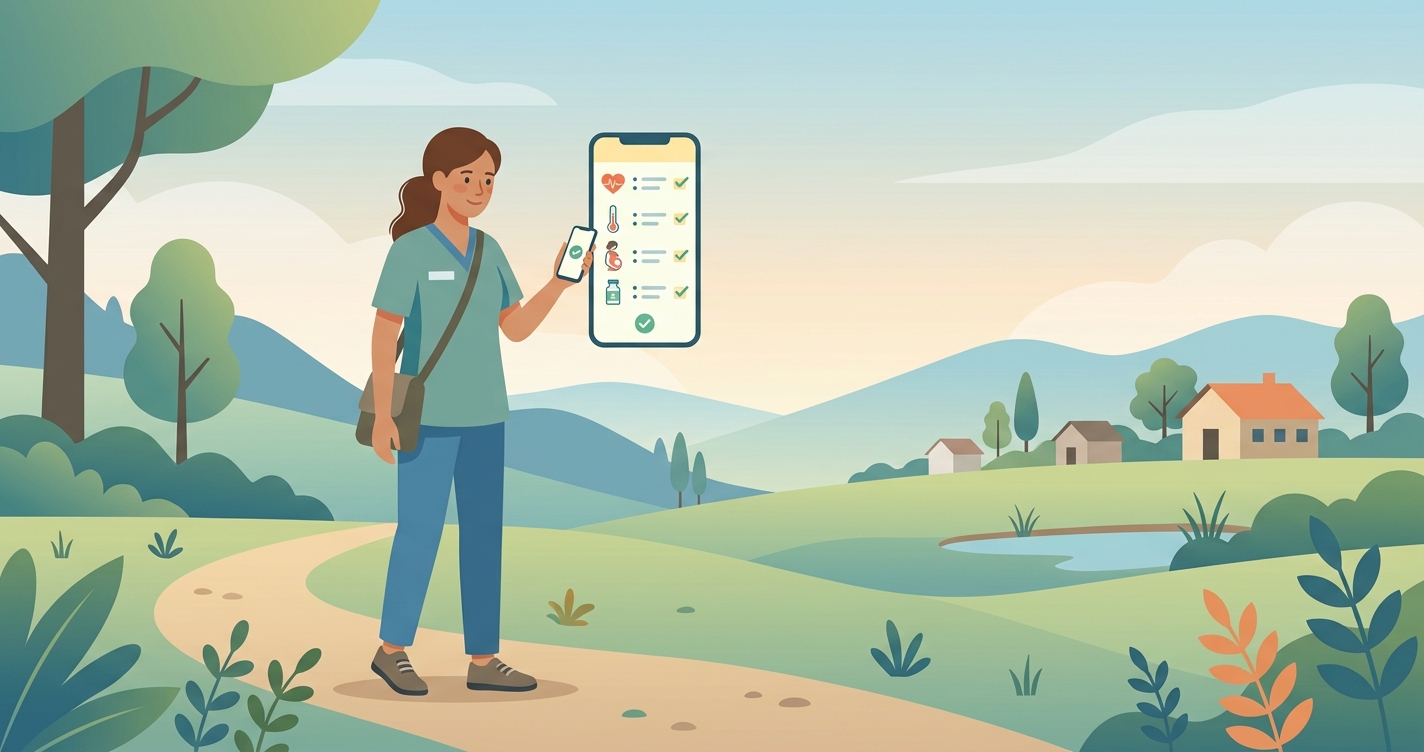
Digital tools are most effective at the point of triage. A CHW using a smartphone app can be guided through the IMCI checklist, ensuring no steps are missed. The app can use the phone's camera and microphone to assist in counting respiratory rate or use timers to guide the assessment. Based on the data entered, the app can provide an immediate classification (e.g., "Routine Care," "Urgent Referral") based on the IMCI algorithm. This removes guesswork and provides the CHW with the confidence to make a strong recommendation to the family.
Data for health system surveillance
When a CHW uses a mobile tool to assess a child, the data is captured in a structured format. This includes the child's age, symptoms, danger signs observed, and the final classification. This information, once synced to a central server, becomes invaluable for public health surveillance. Health officials can monitor for outbreaks of febrile illness in specific regions, track referral completion rates, and identify areas where CHWs may need additional training or support. This transforms a single home visit into a data point for strengthening the entire health system.
Training and quality assurance
One of the most significant challenges in large-scale CHW programs is ensuring consistent, high-quality care. mHealth tools can embed training directly into the application. Short videos can demonstrate how to spot severe chest indrawing. Pop-up reminders can prompt the CHW to check for fontanelle bulge or temperature. A 2021 study by researchers in Bangladesh demonstrated that CHW referrals for newborn danger signs, when supported by an mHealth tool, showed high sensitivity (93.3%) and specificity (96.2%) compared to physician assessments, showcasing the potential for technology to support high-stakes decision-making.
Current research and evidence
The evidence base for mHealth in improving pediatric outcomes is growing. A systematic review published in PLOS Global Public Health found that mHealth interventions can significantly improve caregiver knowledge and CHW performance across common childhood infections. Studies have consistently shown that CHWs supported by mobile decision-support tools adhere more closely to established protocols like IMCI.
For example, research conducted by the London School of Hygiene & Tropical Medicine (LSHTM) has explored how digital tools can improve the classification of sick children, reducing both over-referral (which burdens health facilities) and under-referral (which can lead to mortality). However, researchers also caution that the tool is only one part of the system. Effective implementation requires buy-in from health workers, robust training programs, and a health system capable of responding to the referrals generated. A 2022 study published in The Lancet Digital Health emphasized that for mHealth interventions to succeed, they must be co-designed with end-users and integrated seamlessly into existing workflows.
The future of remote pediatric assessment
Looking ahead, the integration of artificial intelligence (AI) and more sophisticated sensor technology holds the potential to further augment the capabilities of frontline health workers. Algorithms are being developed that can analyze a child's cry, breathing sounds, or even subtle changes in skin color from a simple smartphone video to flag potential signs of distress. As these technologies are validated and made accessible, they could provide an even more powerful layer of screening for situations where a baby fever no doctor nearby is the presenting problem.
The key will be ensuring these innovations are developed and priced for low-resource settings, integrated with national data systems like DHIS2, and governed by principles of data sovereignty. The future is not about replacing the health worker, but about equipping them with tools that amplify their reach and effectiveness, ensuring every child has a better chance at survival, no matter where they are born.
A critical part of this work involves building a robust evidence base. Circadify is actively contributing to this field by developing and validating zero-equipment vital signs monitoring to support frontline health workers. To learn more about how these technologies are being deployed in global health programs, explore our deployment case studies at circadify.com/blog.
Frequently asked questions
What are the most critical danger signs for a baby with a fever in a remote setting? According to WHO IMCI guidelines, any one of the following is a critical danger sign requiring immediate referral: inability to feed, convulsions (seizures), lethargy or unconsciousness, vomiting everything, or fast/difficult breathing. For an infant under 2 months, any fever is itself a reason for urgent assessment.
How can a mobile health tool help a CHW assess a child's fever? A well-designed mHealth app can guide the CHW through the IMCI checklist, ensuring all danger signs are checked systematically. It can provide timers for counting respiratory rate, visual aids to identify signs like chest indrawing, and automated decision support to classify the illness, reducing human error.
Does using a mobile tool replace the need for a clinical diagnosis? No. These tools are for screening and triage, not diagnosis. Their purpose is to identify children who are at high risk and need to see a clinician at a health facility urgently. They help bridge the gap when a doctor is not immediately available but do not replace them.