How do I track my pregnancy health without a single trip to a clinic?
For global health implementers, the challenge of how to track pregnancy without a clinic visit is a systems-level problem. This report examines the role of mobile health in remote maternal monitoring.
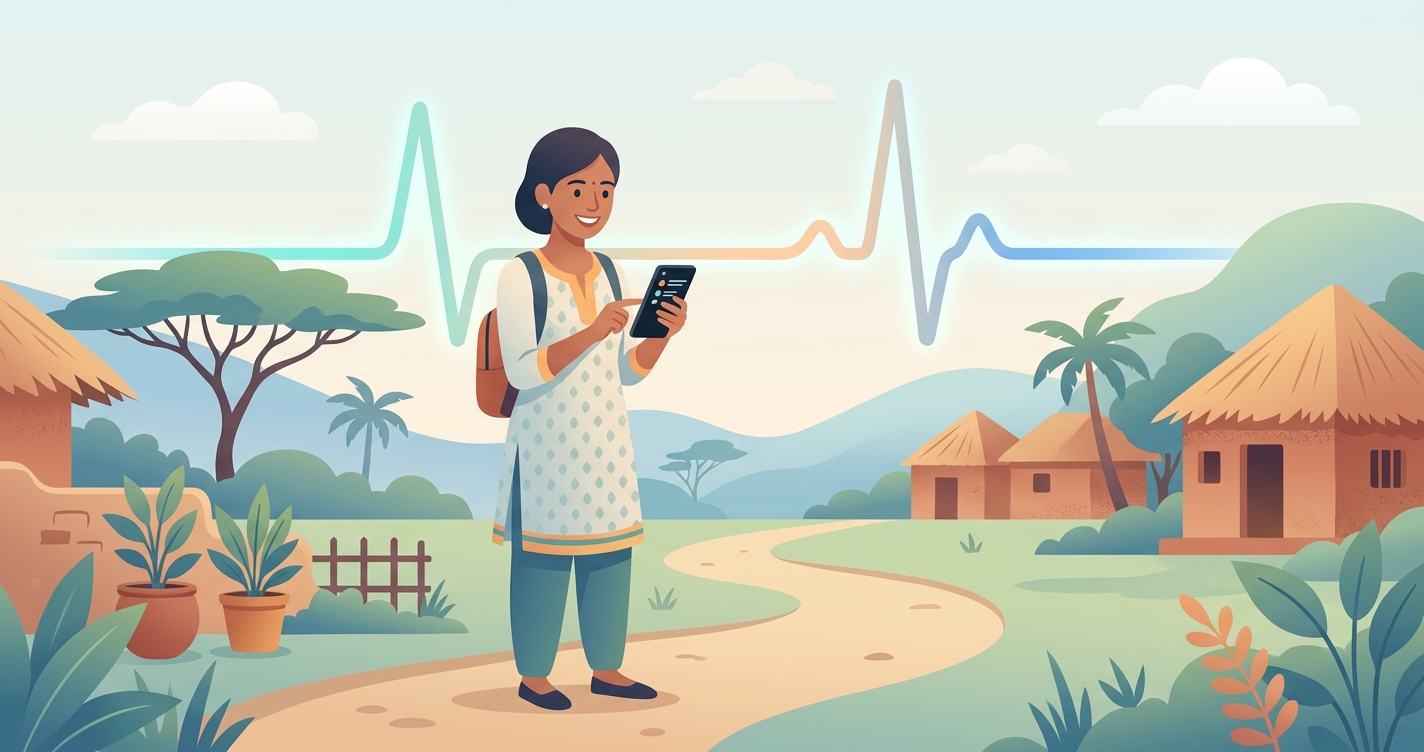
For hundreds of millions of women, the question "How do I track my pregnancy health without a single trip to a clinic?" is not a matter of convenience, but a life-or-death calculation based on distance, cost, and access. While high-income settings see an expansion of telehealth for patient preference, in many parts of the world, the absence of accessible clinical care is a baseline reality. This gap between need and access is a primary driver of preventable maternal mortality and represents a critical challenge for global health programs, ministries of health, and technology implementers. Addressing this isn't about individual convenience; it's about building scalable public health infrastructure where it's needed most.
"Every day in 2023, over 700 women died from preventable causes related to pregnancy and childbirth. A maternal death occurred almost every 2 minutes." - World Health Organization, 2024
The systems-level challenge to track pregnancy without clinic visit
The inability to track pregnancy without clinic visit access contributes directly to adverse maternal outcomes. The most significant risks during pregnancy, such as hypertensive disorders like preeclampsia, often develop without obvious early symptoms. Regular monitoring of vital signs, particularly blood pressure, is the standard of care for early detection. When a woman lives hours or days from the nearest facility, this regular monitoring becomes impossible. Research has shown that clinic usage for maternal health services drops to under 40% when the distance exceeds 10 kilometers. This creates a reliance on symptom-based care seeking, which is often too late for effective intervention.
The core of the challenge is shifting from a reactive, facility-based model to a proactive, community-based one. This requires solutions that can reliably collect and interpret key physiological data in low-infrastructure environments. The goal is not to replace clinicians, but to extend their reach through technology and trained local personnel, enabling risk stratification and timely referral for the women who need it most. Mobile health (mHealth) platforms are emerging as a central component of this new model.
| Feature | Traditional Clinic-Based Model | mHealth-Enabled Field Model |
|---|---|---|
| Location of Care | Centralized health facility or hospital | Patient's home or community setting |
| Primary Data Collector | Nurse, midwife, or doctor | Community Health Worker (CHW) or self-service |
| Required Equipment | Sphygmomanometer, pulse oximeter, thermometer | Smartphone or tablet with embedded sensors/apps |
| Data Transmission | Manual entry into paper or EMR | Automatic sync to cloud-based health platform |
| Patient Accessibility | Low for remote/rural populations | High, independent of distance to facility |
| Focus | Diagnosis and treatment | Screening, triage, and health promotion |
Industry Applications
For global health implementers, the focus is on deploying tools that can be used effectively by frontline health workers. The application of mHealth to track pregnancy without a clinic visit is not theoretical; it's being actively integrated into field programs.
Task-shifting to community health workers
Community Health Workers (CHWs) are the backbone of many primary health systems. Equipping them with validated mHealth tools allows them to perform essential screening tasks that were previously the domain of trained nurses. A CHW can use a smartphone-based tool to capture vital signs like heart rate, respiratory rate, and even screen for blood pressure changes during routine home visits. This "task-shifting" dramatically increases the number of women who can be monitored.
Early detection of hypertensive disorders
Hypertensive disorders of pregnancy, primarily preeclampsia, are a leading cause of maternal death. The condition's only definitive "cure" is delivery, but early detection and management can prevent the most severe complications. mHealth tools that enable regular blood pressure monitoring in the community can flag at-risk individuals far earlier than a model that waits for a woman to present at a clinic with symptoms like seizures (eclampsia).
Integration with national health information systems
Effective mHealth deployments do not create data silos. The data collected by CHWs in the field can be integrated with national health information systems like DHIS2. This allows for population-level risk monitoring, resource allocation, and a comprehensive view of maternal health trends, enabling ministries of health to make data-driven policy and programmatic decisions.
Current research and evidence
The evidence base for smartphone-based maternal health screening is growing rapidly. The primary technology involved is photoplethysmography (PPG), which uses a smartphone's camera and light to detect changes in blood volume in the skin.
- Heart Rate and Respiratory Rate: Validating heart rate via smartphone PPG has shown strong agreement with standard clinical devices, with research showing correlation coefficients of 0.90 or higher in resting adults.
- Blood Pressure Screening: Cuffless blood pressure is a more complex challenge. However, researchers are making significant progress. A 2022 study on the OptiBP algorithm published in JMIR mHealth and uHealth found that the smartphone-based solution met AAMI/ESH/ISO validation criteria for tracking blood pressure changes in pregnant women. Researchers noted mean errors of -1.78 ± 7.94 mmHg for systolic blood pressure. This level of accuracy is promising for screening and triage purposes.
- Personalized Models: Researchers from institutions including the University of Oxford are exploring personalized deep learning models. These models use an initial calibration with a standard cuff and then use PPG data for ongoing cuffless monitoring, which could dramatically improve accuracy for individual users over time.
It is critical to note that most of these tools are being developed for screening and triage, not for clinical diagnosis. They answer the question "Does this person need to be seen at a clinic?" rather than "What is the precise diagnosis?"
The future of contactless maternal screening
The trajectory of this technology is toward zero-equipment, contactless screening. The ultimate goal is a system where a simple smartphone, without any peripherals, can provide a reliable assessment of maternal risk. As algorithms become more sophisticated and are trained on larger, more diverse datasets, their accuracy and reliability will improve. The future involves not just collecting data, but using AI to interpret it in the context of a patient's history and risk factors, providing CHWs with clear, actionable recommendations. This will be pivotal in reaching the most isolated and vulnerable populations, truly enabling the ability to track pregnancy without clinic visits being a barrier to care.
Frequently asked questions
What are the most critical vital signs to monitor during pregnancy? Blood pressure is the most critical vital sign for identifying hypertensive disorders like preeclampsia. Heart rate, respiratory rate, and oxygen saturation are also important for assessing overall maternal wellbeing and identifying signs of distress or infection.
Can a mobile phone really replace traditional medical devices? For now, the goal is not replacement but augmentation and triage. In low-resource settings, a smartphone app that can reliably identify individuals at high risk for a condition like preeclampsia is a powerful tool. It extends the reach of the health system by enabling CHWs to screen thousands of people and refer the highest-risk individuals to clinics for formal diagnosis and care.
What is the role of a Community Health Worker (CHW) in remote pregnancy tracking? The CHW is the essential human link in the system. They operate the technology, ensure data quality, provide health education to the pregnant woman, and facilitate the referral process when the technology flags a potential issue. They contextualize the data and build the trust necessary for the system to work.
The challenges of remote maternal health monitoring are significant, but the potential of mobile health technology is transformative. For program implementers and researchers, building effective and scalable systems is the next frontier. Circadify is actively working in this space to empower frontline health workers with zero-equipment solutions. To learn more about successful mHealth deployments and field-tested strategies, explore our global health deployment case studies at circadify.com/blog.