Can my phone help my family stay healthy when clinics are too far to reach?
How smartphone diagnostics global health tools turn an ordinary phone into a frontline screening device for families far from any clinic.
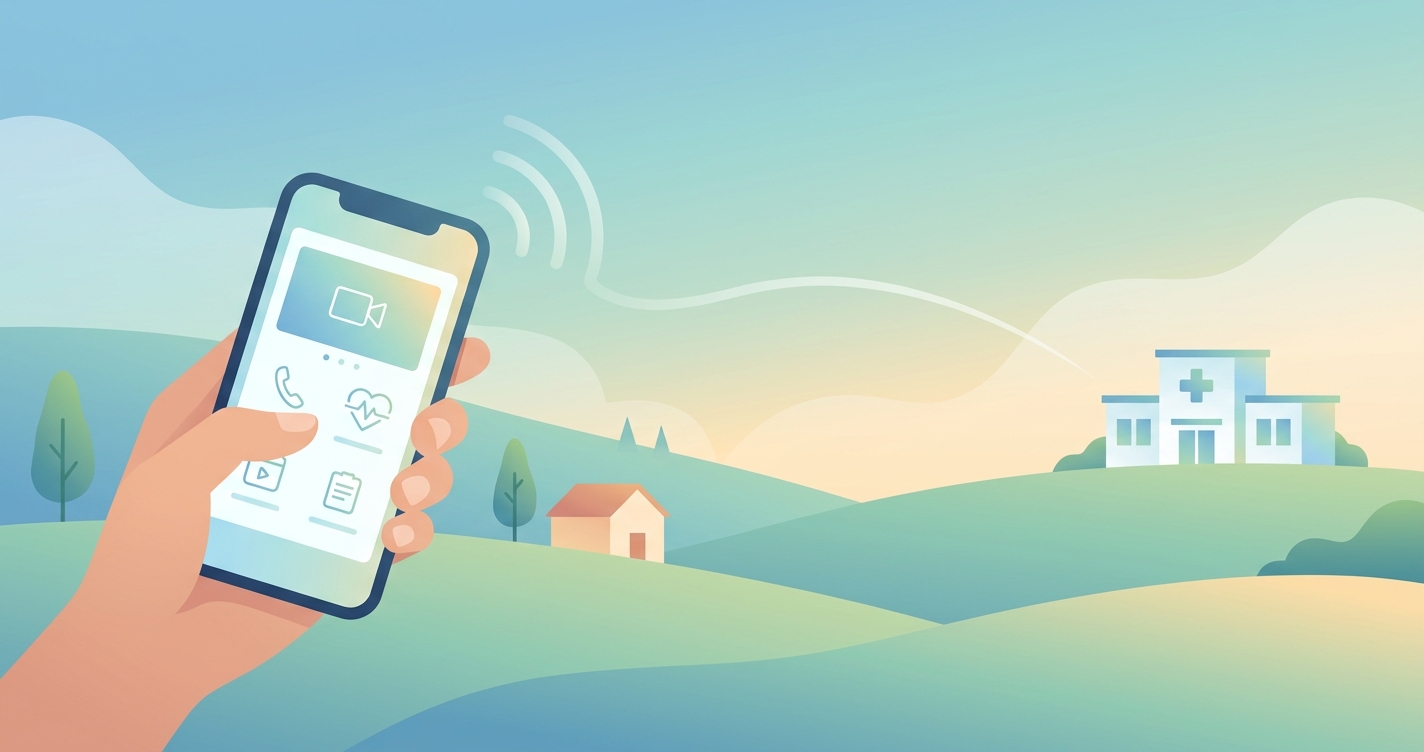
For a family living several hours from the nearest health post, the most useful medical device in the household may already be charging on the kitchen shelf. The phone that sends a message to a relative or checks a crop price is also a camera, a sensor platform, and a connection to a health system that is otherwise out of reach. The field of smartphone diagnostics global health work has grown around exactly this idea: that the device people already own and trust can carry a meaningful share of the screening burden when the clinic is too far to reach. For global health researchers focused on community-level empowerment, the question is no longer whether a phone can do this, but how reliably and at what scale.
The World Health Organization projects a global shortage of 10 million health workers by 2030, concentrated almost entirely in low- and middle-income countries. Over the same period, GSMA data show that 57 percent of people in those same countries already use mobile internet, with more than 4 billion mobile internet users worldwide.
That gap between a shrinking health workforce and a growing mobile base is the central tension this technology tries to resolve. Where there are not enough nurses, doctors, or fixed facilities, there is increasingly a phone in the hand of a caregiver or a community health worker who visits the household.
What smartphone diagnostics global health actually means at the household level
The phrase covers a wide range of capabilities, and it helps to separate them. At one end sit hardware add-ons: clip-on microscopes, rapid test readers, and attachments that turn a camera into a specialized instrument. At the other end sit pure software approaches that need no accessory at all, using the existing camera and processor to estimate physiological signals from a short video of a person's face or fingertip. For families far from clinics, the zero-accessory approach matters most, because it removes the supply chain, the breakage risk, and the cost that usually stops a tool from reaching the last household on the road.
The most studied of these software methods is remote photoplethysmography, or rPPG. It detects the tiny color changes in skin caused by blood flow with each heartbeat, then estimates heart rate, respiratory rate, and in some research settings blood pressure. A caregiver does not need to interpret the signal. The phone captures the video, the algorithm does the work, and the result is a number a community health worker can act on or escalate.
Here is how the main approaches compare for a family that lives far from any facility:
| Approach | Equipment needed | Cost per use | Skill to operate | Best fit for remote families |
|---|---|---|---|---|
| Camera-based rPPG (software only) | Existing smartphone | Near zero | Low | Routine vital-sign screening at home |
| Clip-on microscope or test reader | Phone plus attachment | Low to moderate | Moderate | Diagnosing specific infections |
| Wearable sensor paired to phone | Phone plus sensor | Moderate | Low | Continuous monitoring of known patients |
| Traditional clinic equipment | Cuffs, oximeters, lab | High plus travel | High | Confirmation and treatment |
The practical advantages of the software-only column are easy to list:
- No consumables to stock or replace, which removes a common reason field tools fail.
- Nothing to break, lose, or recalibrate in transit over rough roads.
- The same phone serves screening, record-keeping, and referral in one workflow.
- A caregiver can repeat a check as often as needed without added cost.
- Results can be logged and synced when a signal is available, even hours later.
None of this replaces a clinic. It changes who gets seen first, and how early a problem is noticed.
Industry applications for community-level health
Household screening by caregivers
A parent who can check a child's heart rate and breathing rate during an illness gains a simple way to know when concern should turn into action. The value is not a diagnosis. It is a threshold that tells a family whether the long trip to a facility is worth making today rather than next week.
Community health worker programs
For the community health worker who walks a route of dozens of homes, a phone-based vital signs tool turns each visit into a structured screening encounter without a bag of fragile equipment. Workers can triage who needs referral, capture readings against a patient record, and cover far more households in a day than a kit-dependent visit allows.
Outbreak and chronic disease surveillance
Hypertension and other chronic conditions often go unnoticed for years because they cause no symptoms. Contactless screening lets programs catch elevated readings during routine visits and feed anonymized data upward into systems that ministries already use, supporting both individual care and population-level surveillance.
Current research and evidence
The evidence base is maturing from proof-of-concept toward field validation. A comparative cross-sectional validation study conducted in New Delhi in 2022 and published in 2023 assessed a smartphone rPPG application against certified medical devices, reporting relative mean absolute percentage errors of roughly 6 percent for systolic blood pressure, 7 percent for diastolic, and under 3 percent for heart rate in normotensive participants. Respiratory rate was less precise, which is a candid reminder that not every parameter performs equally.
Broader reviews echo both the promise and the caution. A 2023 review in npj Digital Medicine on smartphone-based diagnostics for global health, along with systematic reviews indexed in the National Library of Medicine through 2024, document a rapid expansion of applications spanning infectious disease detection, microscopy, and physiological monitoring. The consistent theme across these papers is that accuracy varies by condition, by skin tone, by lighting, and by population, and that real-world validation outside controlled clinics remains the work that matters most. Researchers repeatedly stress that robust validation and clear referral pathways, not raw sensor capability, determine whether a tool helps a family or misleads one.
For global health teams, the honest reading of the evidence is this: smartphone tools are strong at sorting people into risk groups, weaker at standing in for confirmatory measurement, and most valuable when paired with a clear plan for what happens after a flagged result.
The future of smartphone diagnostics global health
Several trends point toward wider household use. Algorithms are being trained and tested on more diverse populations to reduce the performance gaps that early systems showed across skin tones and age groups. Integration with national data platforms is becoming standard rather than experimental, so a reading taken at a remote home can flow into the same system a ministry uses for everything else. And offline-first design is improving, which means a check can happen with no signal and sync later, matching the reality of the places that need it most.
The likely destination is not a phone that diagnoses, but a phone that screens, documents, and routes. In that model the family and the community health worker handle the first and most frequent layer of contact, and scarce clinical capacity is reserved for the people who genuinely need it. For researchers interested in community empowerment, that redistribution of the first touchpoint is the most consequential shift, because it moves the starting line of care from a distant building to the household itself.
Frequently asked questions
Can a phone really measure vital signs without any attachment? Yes, within limits. Camera-based methods such as remote photoplethysmography estimate heart rate and respiratory rate, and in research settings blood pressure, from a short video. Accuracy is best for heart rate and is strongest when used for screening and triage rather than as a final clinical measurement.
Is this a replacement for visiting a clinic? No. These tools help a family or community health worker decide when a clinic visit is needed and capture readings between visits. Confirmation, diagnosis, and treatment still require trained clinicians and, often, traditional equipment.
Does it work without internet? Many tools are built to run the measurement on the phone itself and store results offline, then upload when a connection becomes available. This offline-first design is important for households far from coverage.
How accurate is smartphone screening compared to medical devices? Validation studies report close agreement for heart rate and reasonable agreement for blood pressure in some populations, with wider error for parameters like respiratory rate. Accuracy depends on lighting, skin tone, and the specific population, which is why ongoing field validation matters.
Circadify is working on this exact space: zero-equipment vital signs designed for community health workers operating where clinics are far and supply chains are thin. To see how these tools perform in real deployments, explore the global health deployment case studies at circadify.com/blog.