
Smartphone Blood Pressure Check vs a Cuff: Accuracy
How smartphone blood pressure vs cuff accuracy holds up in the field, what validation studies show, and what it means for CHW screening in low-resource settings.
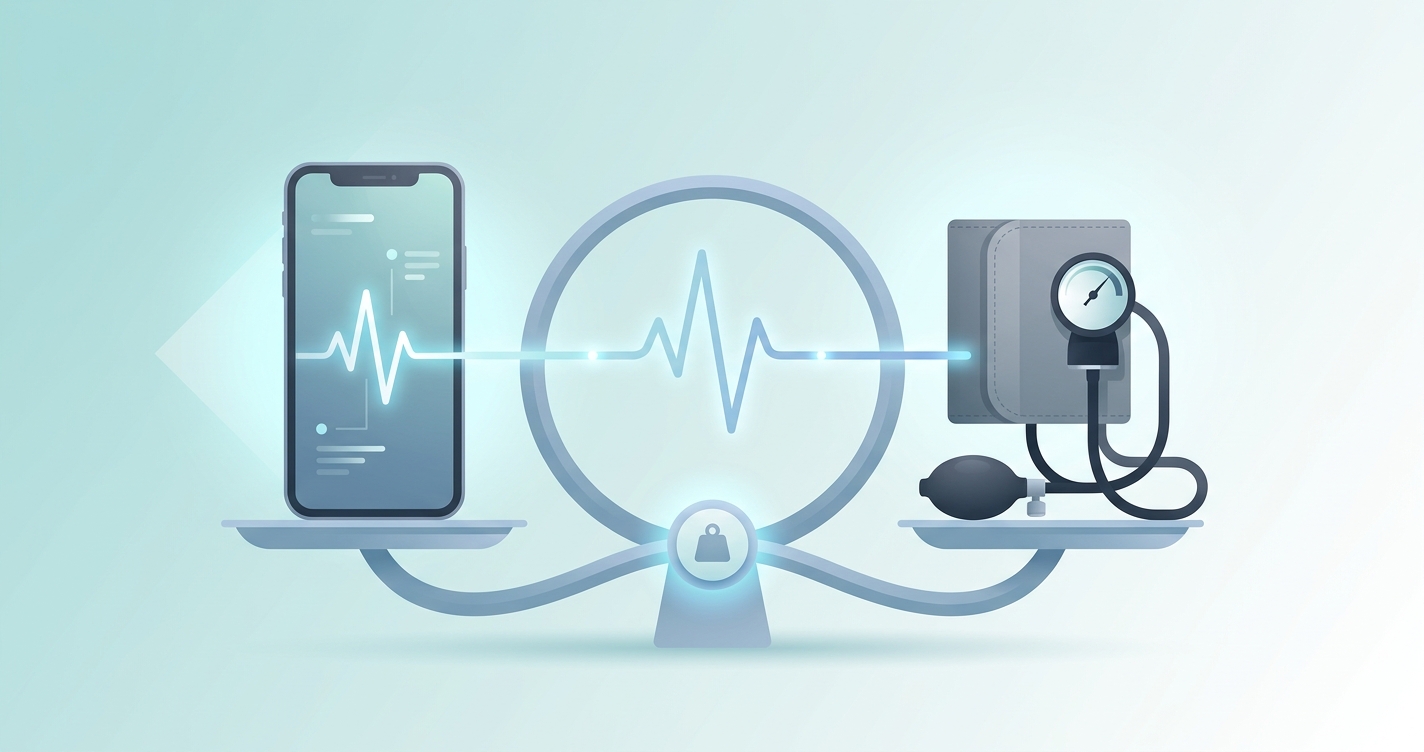
Procurement teams equipping frontline workers face a measurement gap before they face a treatment gap. In most rural districts, the limiting factor in hypertension programs is not the availability of drugs but the availability of a first reading. That is why the smartphone blood pressure vs cuff question has moved from a novelty discussion into a serious deployment decision for global health implementers. The promise is a vital sign captured from a phone already in a community health worker's pocket, with no consumables, no calibration drift, and no cuff to lose. The caution is that blood pressure is one of the harder signals to estimate optically, and the evidence base is uneven. This report compares the two approaches on the terms that actually matter in the field: accuracy, repeatability, throughput, and cost per screen.
A 2024 cross-sectional validation of a contactless, calibration-free smartphone monitor reported a mean systolic error of 6.5 mmHg (SD 12.9) and diastolic error of 0.4 mmHg (SD 10.6) in normotensive and stage-1 hypertensive patients, illustrating both the potential and the spread of phone-based blood pressure estimation.
Smartphone blood pressure vs cuff: how the methods differ
A traditional cuff measures pressure directly. An oscillometric automatic cuff inflates around the arm, detects the oscillations in arterial wall motion as it deflates, and reports systolic and diastolic values from a physical signal. The measurement is grounded in mechanics, which is why a validated cuff remains the reference standard against which everything else is judged.
Phone-based approaches infer pressure indirectly. Most rely on photoplethysmography (PPG), the same optical principle behind a fingertip pulse oximeter. Contact PPG uses the phone camera and flash against a fingertip. Contactless or remote PPG (rPPG) reads subtle color changes in facial skin from the front camera, the basis of contactless blood pressure screening and phone camera blood pressure tools. From the pulse waveform, an algorithm estimates blood pressure, often using machine learning trained on cuff-labeled data.
The critical distinction in cuffless BP measurement accuracy is calibration. Calibration-based models use a recent cuff reading per individual as an anchor and then track changes. Calibration-free models attempt a reading with no per-person reference, which is the model most relevant to a CHW vital signs tool deployed across a population the worker has never measured before.
| Factor | Validated automatic cuff | Calibration-based phone BP | Calibration-free phone BP |
|---|---|---|---|
| Measurement basis | Direct oscillometric | Optical PPG plus per-user anchor | Optical PPG, population model |
| Reported systolic error range | Reference standard | ~2 to 8 mmHg mean, SD 8-10 | ~6 to 14 mmHg mean, SD 10-13 |
| Per-person calibration needed | No | Yes, recurring cuff reading | No |
| Consumables and maintenance | Cuff wear, recalibration | Phone only | Phone only |
| Sensitivity to motion and light | Low | Moderate | High |
| Throughput per worker | Moderate | High | Highest |
| Best current role | Diagnosis and titration | Trend monitoring | Population screening and triage |
The table makes the trade clear. The cuff wins on raw accuracy. Phone methods win on logistics and scale. The right tool depends on whether the task is diagnosis or screening.
What the accuracy numbers actually say
Reported error figures vary widely because study populations and protocols differ. A few patterns hold across the literature:
- Calibration-based models perform best. A large-scale smartwatch validation reported systolic estimation error of 2.31 +/- 9.57 mmHg and diastolic error of 1.33 +/- 6.43 mmHg overall, tightening further for younger, normotensive participants.
- Calibration-free models carry wider spread. The same body of work reported calibration-free systolic error near -0.71 +/- 13.04 mmHg, where the standard deviation, not the mean, is the practical problem.
- Contactless camera-only methods are the most variable. One non-contact PPG application reported mean absolute errors of 14.24 mmHg systolic and 9.83 mmHg diastolic, accuracy the authors framed as suitable for preliminary screening rather than diagnosis.
- Accuracy improves when demographic inputs such as age, sex, and body mass index are added to the model.
The recurring theme is that a low mean error can hide a large standard deviation. The international AAMI and ISO benchmark expects roughly 5 +/- 8 mmHg. Several phone methods approach the mean but exceed the allowed spread, which means individual readings can miss by enough to misclassify a patient. For a screening program that is a tolerable risk if the workflow expects it. For diagnosis it is not.
Industry applications in low-resource settings
Population screening and triage
The strongest field case for phone-based BP is first-pass screening. WHO estimates roughly 1.28 billion adults aged 30 to 79 live with hypertension, and close to half are unaware of it. The binding constraint is finding undiagnosed people, not assigning a precise number to each. A phone tool that flags likely-elevated individuals for cuff confirmation can widen the screening funnel dramatically without shipping cuffs to every worker.
Remote and disconnected communities
Where a road floods or a clinic is hours away, a zero-equipment reading changes who gets checked at all. The comparison shifts from phone-versus-cuff to phone-versus-nothing. In that frame, a screening-grade reading that routes a subset to confirmation is a net gain in coverage.
HIV and TB Program Integration
PEPFAR implementing partners increasingly bundle noncommunicable disease screening into existing visit workflows. A phone-based vital sign captured during an HIV counseling contact adds a data point at near-zero marginal cost, supporting the kind of integrated screening that reduces friction at the first point of contact.
Current research and evidence
The evidence is promising but unsettled, and implementers should read it that way. Reviews of camera-based rPPG for blood pressure describe a field with real signal and no agreed validation protocol. There is currently no standardized procedure for validating smartphone-only BP technologies, and methodologies for reference measurement and data collection vary enough that head-to-head comparison across studies is difficult.
The American Heart Association, in its assessment of cuffless device evaluation led by researchers including Ramakrishna Mukkamala, has flagged that existing validation standards were not designed for devices that estimate rather than measure pressure, and has called for new protocols built around tracking change and challenging the device with induced pressure shifts. Independent work, including remote photoplethysmography evaluations such as the WellFie application study on medRxiv, continues to test these tools against simultaneous cuff references in larger and more diverse samples.
Two practical conclusions follow. First, accuracy is population-dependent: a model validated on a healthy cohort may degrade in older or hypertensive patients, who are exactly the people a program wants to catch. Second, environmental robustness against motion and lighting remains an open engineering problem for contactless methods in particular. Buyers should ask vendors for validation data on populations and conditions that match their deployment, not aggregate marketing figures.
The future of smartphone blood pressure screening
Three shifts will shape the next few years. Standardized validation protocols specific to cuffless and contactless devices are likely to emerge, which will let implementers compare claims on common ground. Model personalization using lightweight demographic inputs will narrow the error spread without requiring a cuff for every reading. And workflow design will mature so that phone screening and cuff confirmation operate as one referral pipeline rather than competing tools.
The most defensible position for now is layered. Use a phone tool to screen broadly and cheaply, then confirm flagged cases with a validated cuff before any treatment decision. That combination captures the coverage advantage of zero-equipment screening while keeping clinical decisions anchored to the reference standard. The cuff is not going away. It is becoming the second step instead of the only step.
Frequently asked questions
Is a smartphone blood pressure reading accurate enough to diagnose hypertension?
Not on its own with current evidence. Reported errors, especially the standard deviation, are too wide for a single phone reading to confirm a diagnosis. The appropriate role today is screening and triage, with a validated cuff used to confirm any elevated result before treatment.
What is the difference between calibration-based and calibration-free phone BP?
Calibration-based methods anchor to a recent cuff reading for each person and track changes, which improves accuracy. Calibration-free methods estimate pressure with no per-person reference, which is more practical for population screening but carries a wider error range.
Why use phone-based BP in low-resource settings at all?
Because the alternative is often no reading. Smartphones are already widespread, require no consumables, and let community health workers screen far more people per day. In disconnected communities the realistic comparison is phone-versus-nothing, where a screening-grade reading expands coverage.
How should buyers evaluate a phone BP tool?
Request validation data on populations and field conditions that match the deployment, including older and hypertensive patients. Check the standard deviation, not just the mean error, and confirm the tool is positioned for screening with a defined cuff-confirmation step.
Circadify is working on this exact gap, building zero-equipment vital signs for community health workers and documenting how phone-based screening performs against reference methods in real deployments. USAID and PEPFAR implementers evaluating a CHW vital signs tool can review validation data and field results in the global health deployment case studies at circadify.com/blog.