Reaching Refugee Camps: Mobile Screening for 10,000 People
How high-volume, phone-based mobile health screening reaches refugee camps and displaced populations where equipment and clinical staff are scarce.
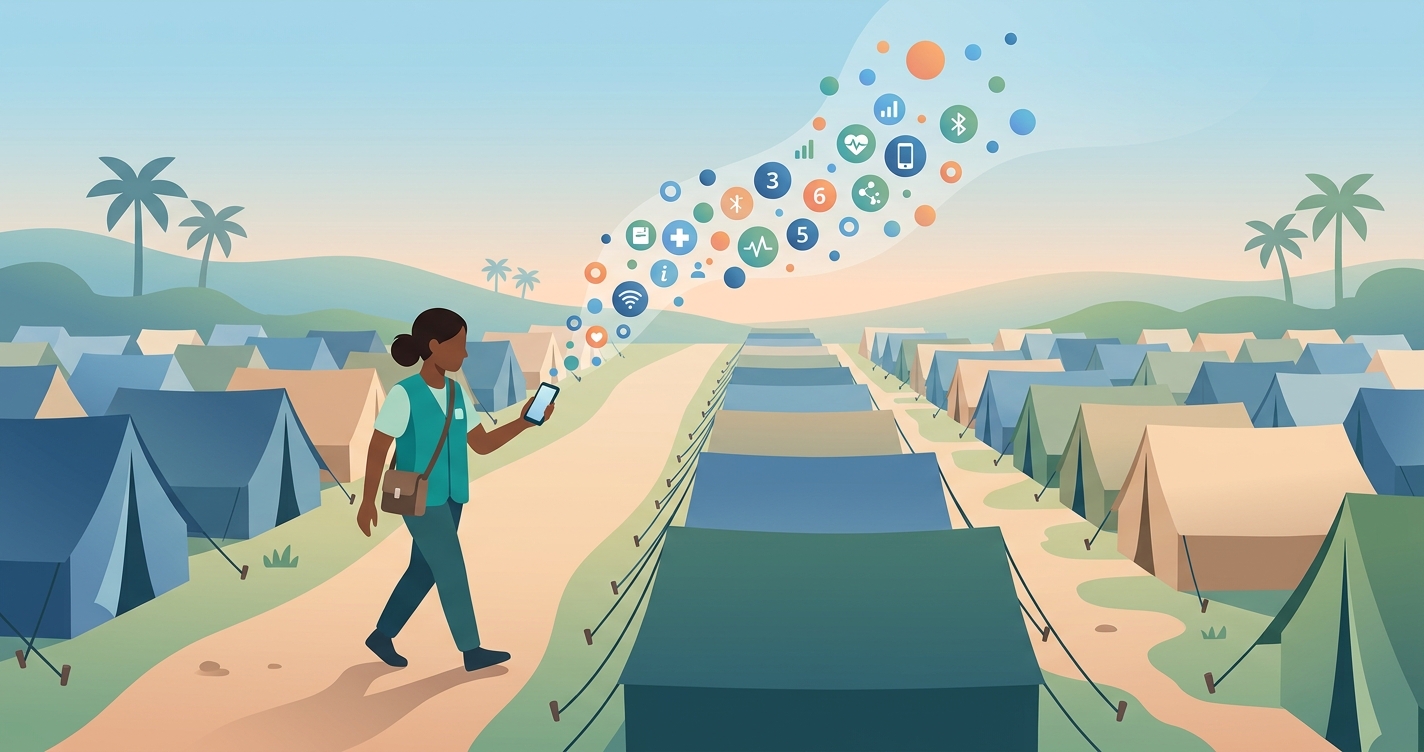
When a new arrival cohort reaches a camp of 10,000 people, the first health bottleneck is rarely treatment. It is measurement. Triage teams must decide who needs urgent referral, who carries an undiagnosed chronic condition, and who can wait, often with a handful of clinicians, a few blood pressure cuffs, and intermittent power. This is the operational gap that mobile health screening in refugee camps is built to close: a way to record vital signs and risk markers at population scale without depending on hardware that breaks, batteries that drain, or specialist staff who are not on the roster. For humanitarian and PEPFAR implementers, the question has shifted from whether phone-based screening can work in displacement settings to how to deploy it across tens of thousands of people in weeks rather than months.
"In 2024, UNHCR supported the screening of 2.5 million individuals across refugee settings, yet non-communicable diseases still accounted for only about 6% of recorded outpatient consultations, a figure widely understood to undercount true burden." - UNHCR Public Health reporting, 2024
Why mobile health screening in refugee camps outperforms fixed models
Displaced populations carry a chronic disease load that fixed-clinic models consistently miss. A 2024 study among Rohingya refugees in Bangladesh documented adult hypertension at 14.1% and diabetes at 11.0%, while a 2024 UNHCR health access survey among refugees in Egypt found 17% reporting a chronic disease, most commonly hypertension and diabetes. A 2025 systematic mapping review of non-communicable diseases among forcibly displaced people confirmed a steady rise in research since 2014, with hypertension and diabetes the most frequently studied conditions. The pattern is consistent: the conditions most common in camps are silent, which means they only surface through active screening, not patient self-presentation.
Fixed screening stations struggle here for structural reasons. They require people to travel to a point, queue, and pass through equipment-dependent stations one at a time. In a camp with shifting populations and language barriers, throughput collapses. High-volume field screening flips the model. A community health worker carries a phone, moves through shelters or sets up rotating points, and captures core vitals contactless or with minimal peripherals. The constraint becomes the worker's time, not the equipment inventory.
The economics matter to implementers operating under tightening budgets. UNHCR warned in 2024 that progress on refugee health was at risk from funding cuts, which makes zero-equipment approaches not just convenient but financially necessary. When a single smartphone replaces a cart of devices that each need calibration, consumables, and repair, the cost-per-person-screened drops sharply at scale.
Comparison: screening models for displaced populations
| Factor | Fixed clinic station | Mobile clinic (equipment-based) | Phone-based mobile screening |
|---|---|---|---|
| People screened per worker per day | 30-60 | 80-150 | 200-400+ |
| Equipment per worker | High (multiple devices) | Moderate (portable kit) | Minimal (smartphone) |
| Power dependency | Continuous | Periodic charging | Single device charge |
| Staff skill required | Clinical | Mixed clinical | Trained CHW |
| Setup time in a new camp | Days to weeks | Days | Hours |
| Data capture | Often paper | Mixed | Digital, real-time |
| Cost per person at scale | High | Moderate | Low |
The throughput figures reflect a recurring finding in field operations rather than a single trial, but the direction is well supported: removing equipment handling and manual transcription is what frees a worker to move from dozens to hundreds of encounters per day.
Key operational advantages that recur across deployments:
- Faster cohort coverage, so a 10,000-person camp can be baseline-screened in a defined campaign window rather than over a rolling year.
- Lower training burden, because the workflow lives in an app rather than in device-specific technique.
- Built-in data capture that feeds reporting systems directly, reducing the paper-to-database lag that delays decisions.
- Resilience to supply chain failure, since there are no cuffs, strips, or probes to run out of.
Industry Applications
Rapid baseline screening for new arrival cohorts
When a displacement event pushes thousands of people into a camp at once, implementers need a baseline health picture fast. Phone-based screening lets triage teams flag elevated blood pressure, abnormal heart rate, and self-reported chronic conditions during intake, routing the highest-risk individuals to scarce clinical capacity first. This is where high-volume field screening earns its name: the goal is not diagnosis, it is rapid sorting at population scale.
Camp health monitoring over time
Displacement is rarely brief. The average protracted refugee situation lasts years, which makes camp health monitoring a longitudinal problem. Repeat phone-based screening at intervals lets programs track whether hypertension control is improving, whether new arrivals are raising baseline risk, and where chronic disease clusters are forming. Because each encounter is digital, the data accumulates into a trend line rather than a stack of forms.
Integration With HIV and TB Programs
For PEPFAR implementers, displaced population health screening is a natural front door to disease-specific programs. A high-volume screening pass can capture vitals while also recording symptoms and risk factors that warrant TB or HIV testing referral. The screening event becomes the moment of contact that pulls people into the treatment cascade, addressing the first-contact friction that limits case finding in camps.
Maternal and child surveillance
Community health worker mHealth approaches have shown value for managing common childhood infections and supporting caregivers, as documented in a systematic review of CHW-based mHealth interventions. In camps, the same phone-based workflow can layer maternal and child vital sign checks onto routine household visits, extending surveillance into shelters that no fixed station would reach.
Current research and evidence
The evidence base for humanitarian mHealth has matured from anecdote to structured review. A systematic review of mobile clinics in humanitarian emergencies (published on PubMed) found that mobile delivery extends reach into underserved areas and can handle high consultation volumes, though it noted persistent gaps in standardized outcome reporting. A scoping review of community health workers in humanitarian settings reached a parallel conclusion: CHWs are central to service delivery in camps, and digital tools amplify their reach when training and supervision are adequate.
On the disease side, the 2025 systematic mapping review of NCDs among forcibly displaced people established that hypertension and diabetes dominate the chronic burden, the exact conditions that benefit most from frequent, low-cost screening. UNHCR's own 2024 reporting that NCDs make up only 6% of outpatient consultations is widely read as evidence of undercounting, since population studies in the same settings find chronic disease prevalence several times higher. The gap between recorded consultations and measured prevalence is precisely the gap that high-volume screening is designed to surface.
What the literature still lacks is large-scale, standardized evidence on phone-based vital sign capture specifically in camp conditions. Most published work covers mobile clinics with conventional equipment or CHW programs using digital forms. The contactless, zero-equipment layer is newer, and rigorous field evaluation of its accuracy and throughput in displacement settings remains an open research priority. Implementers adopting these tools should treat them as triage and surveillance instruments and pair early deployments with their own monitoring data.
The future of mobile health screening in refugee camps
Three shifts are likely to define the next phase. First, screening will move from campaign events to continuous monitoring, as repeat low-cost encounters make it feasible to follow chronic conditions rather than just count them once. Second, interoperability will become non-negotiable: screening data that does not flow into national and donor reporting systems will not survive procurement review, so direct integration with established health information platforms will be a baseline expectation. Third, funding pressure will accelerate the move toward zero-equipment models, because every device removed from the field kit is one less line of consumables, repair, and replacement to fund.
The structural logic favors phone-based screening in displacement settings. The populations are large, mobile, and equipment is the first thing to fail. As evidence accumulates and platforms mature, the practical question for implementers becomes one of deployment design: how to train, supervise, and route referrals so that screening 10,000 people actually changes who gets care.
Frequently asked questions
How many people can phone-based screening realistically cover in a camp? Throughput depends on workflow and staffing, but removing equipment handling and manual transcription lets trained community health workers move from dozens of encounters per day toward several hundred. At that rate, a 10,000-person camp can be baseline-screened within a defined campaign window rather than over a rolling year.
Is mobile health screening accurate enough to rely on in refugee camps? Phone-based screening is best treated as a triage and surveillance tool that sorts people by risk and routes the highest-risk individuals to clinical confirmation. It does not replace diagnostic assessment. Implementers should pair early deployments with their own monitoring to validate performance in local conditions.
Which conditions does displaced population health screening prioritize? Hypertension and diabetes dominate the chronic disease burden in displacement settings according to 2024 and 2025 studies, and both are largely silent, so they only surface through active screening. Screening campaigns also commonly flag candidates for TB and HIV testing referral.
How does screening data connect to existing reporting systems? Digital capture is the main advantage over paper. Modern screening tools are built to export into national health information and donor reporting platforms, which removes the paper-to-database lag that delays decisions in fast-moving camp operations.
Circadify is working on this space directly, developing zero-equipment vital signs capture designed for community health workers operating in exactly these conditions. Humanitarian and PEPFAR implementers planning a high-volume field deployment can review deployment case studies and request a field consultation through the global health section at circadify.com/blog.