When can my community get regular health checks when doctors are so few?
How mobile health low resource settings tools extend regular community health checks where doctor-to-patient ratios are critically thin and clinics are far.
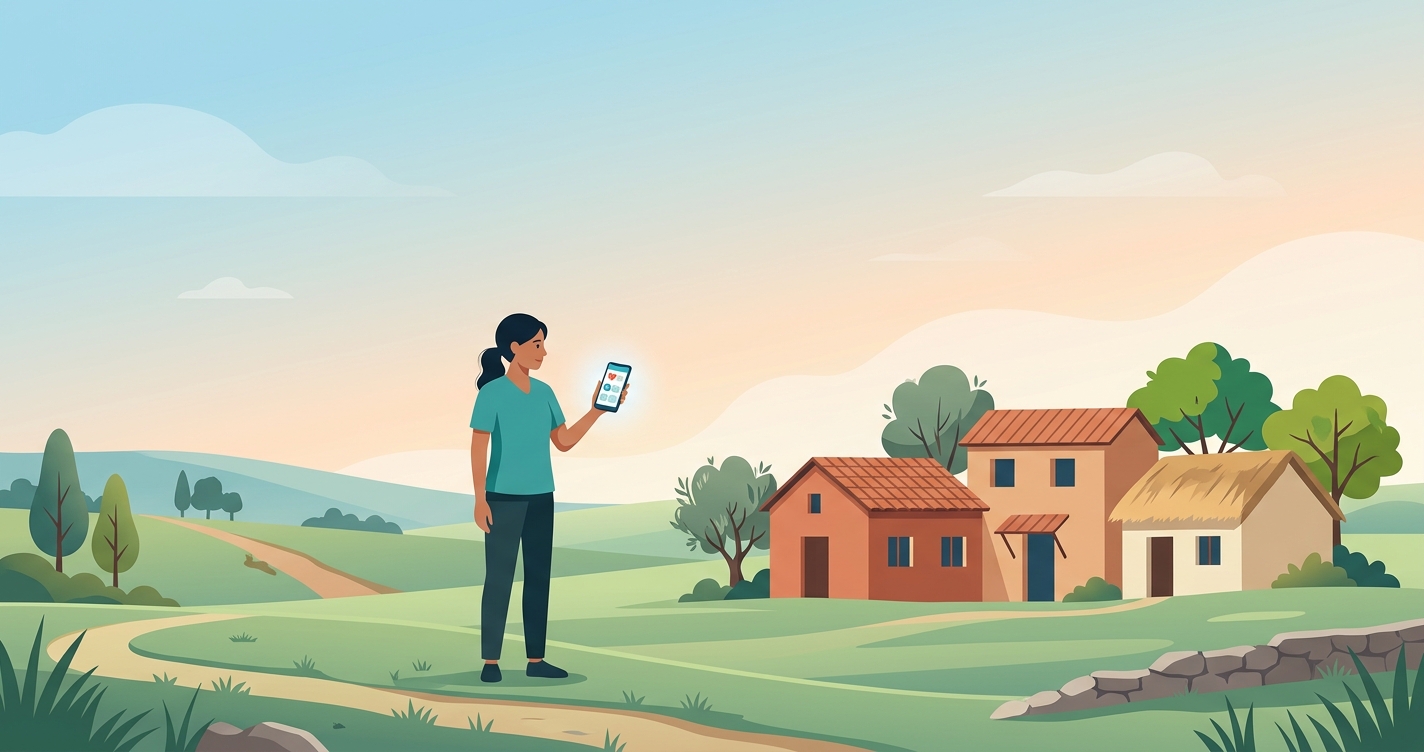
The question of when a community can expect regular health checks rarely comes down to medicine. It comes down to arithmetic. When a single physician serves tens of thousands of people spread across roads that flood and villages a day's walk from the nearest health post, routine screening stops being a clinical decision and becomes a scheduling impossibility. This is the practical starting point for any serious discussion of mobile health low resource settings: not whether screening works, but how often it can reach people who are not standing inside a clinic. For program designers and implementers, the shift in thinking is from building more facilities to extending the reach of the workforce that already exists.
The World Health Organization estimates the African Region holds only 3 percent of the world's health workers while carrying 24 percent of the global disease burden, and needs roughly 6.1 million additional health workers to meet its goals. (WHO Regional Office for Africa, 2023)
That gap explains why the doctor-led model cannot deliver routine checks at population scale in much of the world. In 2020 the average density of physicians across Sub-Saharan Africa sat near 0.23 per 1,000 people, far below the WHO benchmark of 4.45 doctors, nurses, and midwives per 1,000 needed for essential services (World Bank, 2020). Waiting for that ratio to close is not a plan. The realistic path runs through community health workers (CHWs) equipped to do first-line screening close to home, with clinicians reserved for diagnosis and treatment of the people screening flags.
How mobile health low resource settings tools change the math
Mobile health low resource settings deployments work by separating two tasks that traditional systems bundle together: finding people who need attention, and treating them. Screening is high-volume, repetitive, and protocol-driven. Treatment is lower-volume and requires clinical judgment. When a CHW with a phone can perform the first task in the field, the scarce physician is freed to concentrate on the second. The community does not wait for a doctor to appear before anyone gets checked. They get checked first, and the doctor sees the subset that matters.
The reach multiplier is the point. A clinic check requires the patient to travel, often losing a day of wages and bus fare for a reading that takes two minutes. A CHW visit reverses the geography. The worker moves; the household stays. When the screening tool needs no cuff, no battery-powered analyzer, and no consumables, the cost per additional person screened drops sharply, which is what makes a monthly or quarterly rhythm financially plausible rather than aspirational.
| Approach | People reached per worker-day | Equipment burden | Travel cost to patient | Realistic check frequency |
|---|---|---|---|---|
| Facility-based, doctor-led | Low (clinic capacity bound) | High (fixed infrastructure) | High (patient travels) | Rare, often only when symptomatic |
| CHW with portable devices | Moderate | Medium (devices, calibration, power) | Low | Periodic, limited by supplies |
| CHW with zero-equipment mobile screening | High | Minimal (phone only) | Low | Routine, repeatable |
| Campaign or outreach days | High in bursts | Variable | Low during campaign | Intermittent, hard to sustain |
The bottom two rows are where regular checks become realistic. A phone-only workflow removes the parts of a screening program that usually break in the field:
- No consumables that run out mid-route and stall a visit.
- No calibration drift or device repair that pulls a tool out of service.
- No dependence on reliable electricity, which a scoping review flagged as a core barrier to CHW mHealth scale.
- No specialized training to operate a single-purpose machine.
- Lower per-unit cost, so adding the next 1,000 people screened is an incremental rather than capital decision.
Industry applications
National CHW programs
Ministries of health planning a standardized CHW toolkit want a screening layer that works the same way in every district regardless of local supply chains. A zero-equipment approach standardizes the first touchpoint, so a reading taken in one province is comparable to one taken in another, and the data flows into national systems rather than sitting in paper registers.
Donor-funded disease programs
Implementers working under USAID or PEPFAR mandates increasingly need to screen for cardiovascular and metabolic risk inside HIV and TB workflows, where patients already have regular contact. Adding a vitals check at an existing visit costs almost nothing when no new device is required, which is why integration, not new infrastructure, is the prevailing design logic.
Outreach and crisis response
In displacement settings and after climate-driven disruptions, equipment is exactly what cannot be guaranteed. A screening method that travels in a worker's pocket survives conditions that defeat clinic-grade hardware, letting teams maintain a check rhythm even when supply lines are cut.
Current research and evidence
The research base has matured past the question of whether CHWs will use these tools. Studies in Malawi (2022) and Rwanda (2023) evaluating integrated smartphone-based mHealth tools for CHWs reported high usability and acceptability among frontline workers, suggesting adoption is rarely the limiting factor. Scoping reviews of mHealth use among CHWs globally consistently identify the same benefits: improved access and quality of services, more efficient training and supervision, and better data for program management.
The honest counterweight is sustainability. Reviewers repeatedly describe "pilotitis," the pattern where promising pilots never expand beyond their initial site. The cited barriers are structural rather than clinical: unreliable connectivity, limited device access, inconsistent power, and uneven digital literacy. Researchers emphasizing scalable, human-in-the-loop models argue that scale has to be designed in from the start rather than bolted on after a successful demonstration. This is precisely why equipment minimization matters. Every piece of hardware a program removes is one fewer failure point standing between a pilot and a permanent service. The evidence does not say technology alone fixes the workforce gap. It says the tools that survive are the ones with the fewest dependencies.
The future of mobile health low resource settings
The direction of travel is toward screening that disappears into routine community work rather than existing as a separate event. A few shifts are likely to define the next several years:
- Screening folded into visits people already have, so the marginal cost of a check approaches zero.
- Interoperability by default, with readings flowing into national health information systems rather than parallel apps.
- Stronger local evidence requirements, as ministries demand validation against clinical-grade references before national adoption.
- Data sovereignty moving to the center of procurement, with programs insisting that community data stay under national control.
None of this replaces doctors. It rearranges the workflow so that the doctor's scarce time is spent on the people who genuinely need it, while everyone else gets the regular check that geography and ratios have long denied them. The answer to "when can my community get regular checks" stops being "when more doctors arrive" and becomes "when the first touchpoint moves to where people already are."
Frequently asked questions
When can a community realistically expect regular checks if there are almost no doctors?
Regular checks become feasible once first-line screening is shifted to community health workers who do not need to wait for a physician to be present. With a phone-based, zero-equipment workflow, a CHW can establish a recurring screening rhythm, and the doctor only needs to see the people that screening flags as higher risk.
Does mobile screening replace seeing a doctor?
No. Screening sorts people into risk groups and identifies who needs clinical attention. It extends the reach of diagnosis rather than substituting for it, which is what lets a small number of clinicians serve a much larger population.
What usually stops these programs from scaling?
Research points to structural barriers more than clinical ones: unreliable power and connectivity, limited device access, and digital literacy gaps. Programs that minimize hardware and design for scale from the outset tend to survive past the pilot stage.
Why does zero-equipment matter so much for low-resource settings?
Every device adds consumables, calibration, repair, and power requirements that fail in the field. Removing equipment removes failure points, lowers the cost of reaching each additional person, and makes a sustained check frequency financially realistic.
Circadify is working on this specific bottleneck, building zero-equipment vital signs screening designed for community health workers operating where clinics and devices are scarce. To see how this plays out in real deployments, explore the global health deployment case studies at circadify.com/blog.