Mobile Health in Low-Resource Settings: 9 Tools That Work Offline
A field guide to 9 proven offline mHealth tools for low-resource settings, with connectivity data, deployment scale, and what each tool does without a signal.
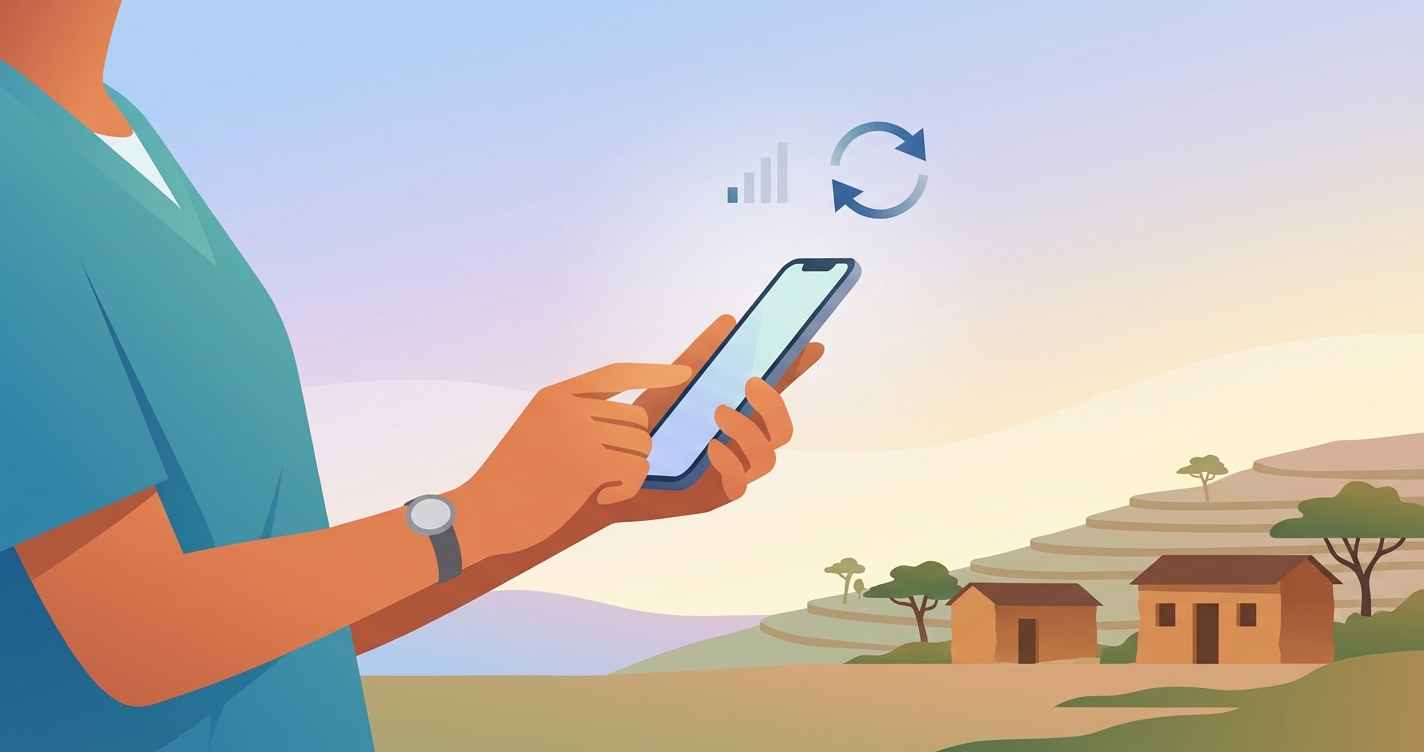
Connectivity is the quiet assumption baked into most digital health products, and it is the first assumption to break in the field. Teams planning mobile health in low resource settings rarely fail because a tool lacks features. They fail because the tool stops working the moment a community health worker walks past the edge of cellular coverage, which in many districts is the moment they leave the health post. The practical question for global health implementers is not whether an app is impressive on a demo tablet in a capital city. It is whether the app still captures, stores, and queues data when there is no signal for three days, and syncs cleanly when the worker returns to range.
According to the GSMA State of Mobile Internet Connectivity 2024 report, 43 percent of the global population, roughly 3.45 billion people, still do not use mobile internet, and 95 percent of the unconnected live in low- and middle-income countries. Adults in rural areas of these countries are 28 percent less likely to use mobile internet than their urban counterparts.
That gap is the design constraint. The tools below have earned attention because they treat offline operation as the default state, not an error condition.
Why offline matters for mobile health in low resource settings
The phrase offline-first describes software architecture that assumes no connection and treats syncing as an occasional, opportunistic event. Data is written to local device storage first, then transmitted when a network appears. This is the opposite of cloud-native consumer apps, which assume constant bandwidth and degrade badly without it.
The distinction matters more than it sounds. A multi-country survey of community health workers conducted between November 2022 and May 2023, published in the Journal of Global Health, found that limited internet connectivity was not always reported as a top barrier to digital device use. The likely reason is that the tools workers were given already handled offline operation, so the connectivity problem had been engineered out of their daily experience.
Field-proven offline mHealth tools tend to share a set of traits:
- Local-first data capture that survives days without a signal
- Background sync that resumes automatically and resolves conflicts
- Low storage and battery footprint for entry-level Android devices
- Support for feature phones or SMS fallback where smartphones are scarce
- Form logic and case management that run entirely on the device
Nine offline tools that work in the field
Below is a comparison of nine widely deployed low connectivity health apps and platforms, focused on what each does when the signal disappears.
| Tool | Offline model | Best for | Feature phone / SMS | Reported scale |
|---|---|---|---|---|
| CommCare | Full offline case management | Longitudinal client tracking | Limited, app-first | 130+ countries, 1M+ frontline workers |
| Open Data Kit (ODK) | Offline forms and entities | Surveys, surveillance | No, smartphone-first | ~250M form submissions/year (2024) |
| KoboToolbox | Local capture, deferred submit | Humanitarian needs assessment | Limited | Widely used across UN and NGO response |
| Community Health Toolkit (Medic) | Offline-first apps plus SMS | CHW workflows and messaging | Yes, SMS supported | 180,000+ CHWs across 24 countries |
| OpenSRP | Fully offline, low bandwidth | Smart registers, MNCH | App-first | Multiple national MNCH deployments |
| DHIS2 Android Capture | Offline data entry and sync | National HMIS field entry | App-first | National HMIS in 80+ countries |
| SurveyCTO | Offline forms, encryption | High-integrity field research | No | Research and M&E programs globally |
| RapidPro | SMS and USSD flows | Reminders, reporting on any phone | Yes, core design | National scale in several countries |
| Offline smartphone screening | On-device capture, deferred upload | Zero-equipment vital signs | App-first | Emerging field deployments |
A few notes on how to read this table. CommCare and OpenSRP lean toward case management, meaning they track the same individual across multiple visits, which is what maternal and child health and chronic disease programs need. ODK, KoboToolbox, and SurveyCTO lean toward structured data collection, which suits surveys, surveillance, and research. The Community Health Toolkit and RapidPro extend reach to feature phones through SMS, which still matters where smartphone penetration is thin. The last row points to an emerging category that this site follows closely: screening tools that capture vital signs on the phone itself, store readings locally, and upload later.
Case management platforms
CommCare, built by Dimagi, is the reference point for offline case management. Its core strength is tracking an individual over time and transferring cases between workers without an internet connection, which is exactly what a CHW supervising hundreds of households needs. OpenSRP, designed as a mobile-first smart register, runs completely offline in remote, low-bandwidth locations and has anchored several national maternal and newborn health programs.
The Community Health Toolkit, stewarded by Medic, is offline-first by design and adds SMS support so that apps can reach feature phones. Medic reports supporting more than 180,000 community health workers across 24 countries, which makes it one of the most field-tested rural health technology stacks available.
Survey and surveillance tools
Open Data Kit is the workhorse of offline data collection. As of 2024 it processes roughly 250 million form submissions a year and is used by the World Health Organization for disease surveillance. Its 2024 releases improved offline entities, allowing records to be created, updated, and deleted on the device without a connection. KoboToolbox, born in the humanitarian sector, stores data locally and submits it once a connection returns, which is why it is a default choice in refugee and emergency settings. SurveyCTO adds encryption and quality controls that research teams need when data integrity is non-negotiable.
Messaging and national systems
RapidPro reaches the hardest-to-cover populations through SMS and USSD, working on any phone rather than requiring a smartphone. DHIS2, the national health management information system used in more than 80 countries, ships an Android Capture app that supports offline data entry and later sync, letting frontline workers feed national systems even from places without coverage.
Current research and evidence
The evidence base for offline mHealth tools has matured past the pilot stage. A 2024 implementation case study in JMIR describing a digital health center app for malaria surveillance in Cambodia reported resilient data transmission under low-bandwidth conditions alongside high user satisfaction, a useful real-world test of offline architecture rather than a controlled trial.
Qualitative work matters too. A study of community health workers adopting mHealth in rural Malawi, published in PLOS and indexed in PubMed Central, found that the impact of these tools depends heavily on social context: health system support, community trust, training, and ongoing mentorship. In other words, offline capability is necessary but not sufficient. A tool that syncs perfectly but is never properly trained on will still underperform.
The connectivity data reinforces the design priority. The GSMA 2024 figures show a coverage gap of 350 million people, about 4 percent of the global population, who live entirely outside mobile network reach, concentrated in rural and sparsely populated areas. For those communities, an offline-first tool is not a convenience feature. It is the only thing that works.
The future of offline mobile health
Three shifts are worth watching. First, on-device intelligence is moving more decision support onto the phone itself, so risk scoring and triage logic run without a server round trip. Second, the line between data collection and measurement is blurring. Tools that once only recorded what a worker typed are starting to capture physiological signals directly, including contactless and zero-equipment vital signs that require nothing more than the phone a worker already carries. Third, interoperability is becoming a procurement requirement, with ministries expecting offline tools to feed national systems like DHIS2 rather than create parallel data silos.
The common thread is reducing what a frontline worker must carry, charge, calibrate, and connect. The fewer dependencies in the field, the more screenings actually happen.
Frequently asked questions
What does offline-first actually mean for an mHealth tool?
Offline-first means the app assumes there is no internet connection and writes all data to local device storage immediately. Syncing to a server happens later, automatically, whenever a network becomes available. This is different from apps that need constant connectivity and simply fail or lose data without it.
Which offline tools support feature phones and not just smartphones?
The Community Health Toolkit and RapidPro are the strongest options for feature phones because they use SMS and USSD, which work on any mobile phone. Most other tools on this list, including CommCare, ODK, OpenSRP, and DHIS2 Android Capture, are smartphone-first and need an Android device.
Can offline tools still feed national health information systems?
Yes. DHIS2 Android Capture is built specifically for offline entry into a national HMIS, and several other platforms can export or integrate with DHIS2. The key is to confirm the integration path during procurement so field data does not end up trapped in a separate silo.
Do offline mobile health tools work without any cellular coverage at all?
For data capture, yes. They store everything on the device and hold it until the worker returns to coverage to sync. The limit is real-time communication: features that need a live connection, such as instant referral confirmation, will queue until a signal returns.
Circadify is working on this last category directly, building offline-capable, zero-equipment screening that lets community health workers capture vital signs on a standard phone and sync when coverage returns. Global health researchers and implementers evaluating field deployments can review deployment case studies and the broader global health work at circadify.com/blog.