What if my health worker could check my vitals from their phone today?
How mHealth field deployment lets community health workers check vital signs from a phone today, with research, comparison data, and deployment evidence.
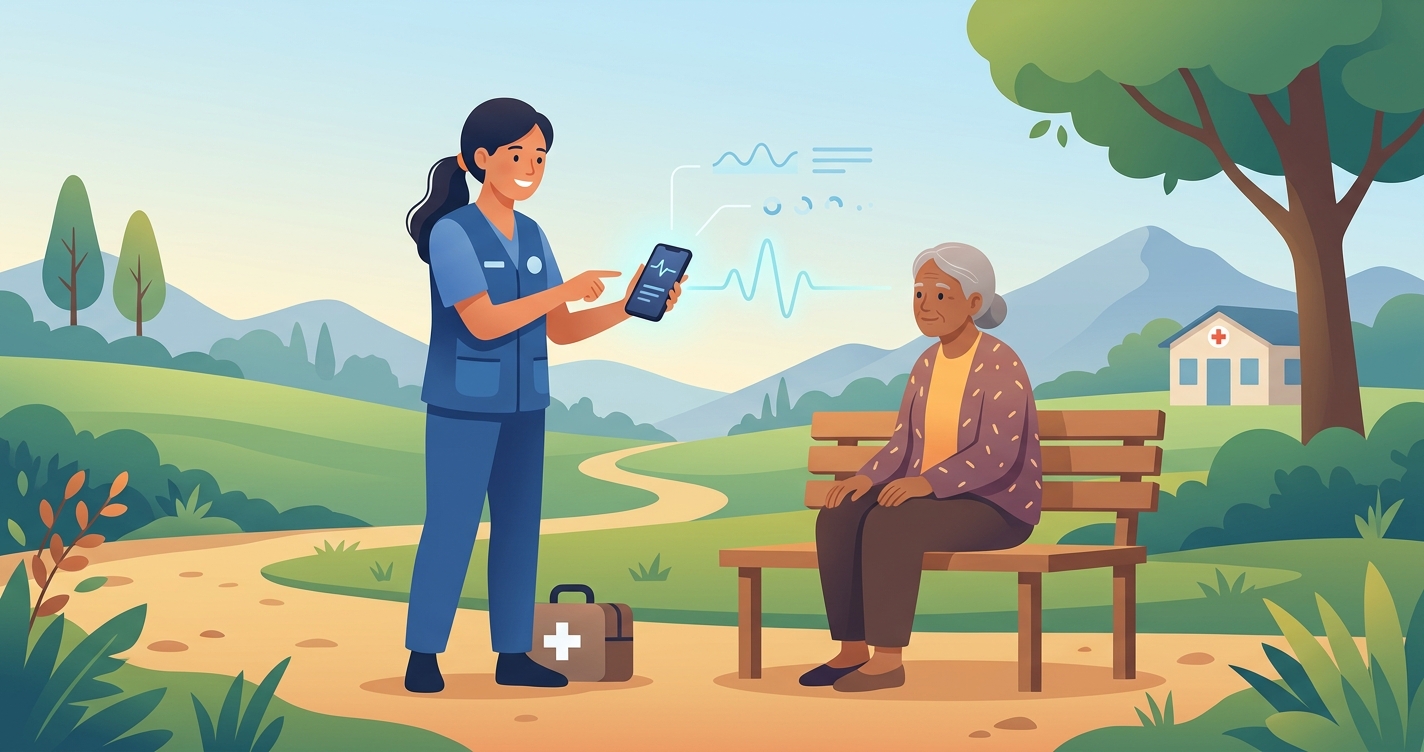
The question sounds almost too simple for a sector used to procurement cycles, cold-chain logistics, and battery-powered devices that break in the field: what if a community health worker could check a patient's vital signs using only the phone already in their pocket? For program managers weighing how to expand coverage without expanding equipment budgets, mHealth field deployment is moving this question from a research curiosity to an operational planning decision. The appeal is speed. A worker who can capture heart rate and respiratory signals at the point of contact, then route a flagged patient onward, compresses a referral chain that often takes days into a single household visit.
A July 2024 review of smartphone-camera photoplethysmography methods reported heart-rate error rates under 5 percent, blood-pressure error under 10 percent, and oxygen-saturation error at or below 3.5 percent across the studies surveyed, signaling that camera-based vital-sign capture has matured well beyond proof of concept.
Why mHealth field deployment changes the first point of contact
The traditional model assumes the patient travels to the equipment. A blood-pressure cuff, a pulse oximeter, and a thermometer live at a health post, and screening happens only when someone makes the trip. In low-resource settings, that assumption quietly excludes everyone for whom the trip is the barrier. mHealth field deployment inverts the model: the measurement tool travels with the worker, because it is software running on a device that is already widely distributed.
This matters for three operational reasons that show up repeatedly in program planning:
- Zero incremental hardware. A phone-based screening flow does not add a device to the supply chain, which removes calibration, replacement, and theft risk from the cost model.
- Immediate triage. A reading captured in the home can be acted on in the home, rather than waiting for a return visit or a referral that may never happen.
- Data capture by default. A digital reading is timestamped, geolocated, and ready to sync, which is the part that most equipment-based workflows handle poorly.
The technical engine behind much of this is remote photoplethysmography (rPPG), which estimates physiological signals from subtle color changes in skin captured by a camera. Validation work in 2023 and 2024 has pushed the accuracy of these methods into ranges that program designers can reason about, even as field conditions remain the harder test.
How phone-based screening compares to the alternatives
No single approach fits every program. The choice depends on what a worker is expected to detect, how far they travel, and how reliable the supply chain is. The table below compares the realistic options a deployment team evaluates.
| Approach | Equipment per worker | Setup time per patient | Field durability | Data capture | Best fit |
|---|---|---|---|---|---|
| Phone-based contactless screening | None beyond the phone | Under a minute | High (no peripherals to break) | Automatic, digital | High-volume household screening and triage |
| Phone plus paired sensor | One Bluetooth device | One to two minutes | Medium (pairing, charging, loss) | Automatic, digital | Programs needing a confirmatory measure |
| Standalone clinical devices | Cuff, oximeter, thermometer | Two to five minutes | Low to medium (calibration, batteries) | Manual transcription | Fixed health posts |
| Paper-based manual workflow | Basic devices | Several minutes | Variable | Manual, error-prone | Settings without connectivity or devices |
The pattern that emerges is not that one method is universally better. It is that phone-based screening removes the failure points that most often stall field programs: missing hardware, dead batteries, and transcription errors. A confirmatory sensor still has a role where a program needs a second measure, but the first pass can happen with nothing but the phone.
Industry applications
Antenatal and maternal outreach
Maternal programs were among the earliest to test phone-led vital-sign capture in the community. A feasibility trial registered in 2023 paired community health workers with a smartphone-synced device to monitor blood pressure and vital signs during antenatal outreach, reflecting growing interest in catching pre-eclampsia risk before a woman reaches a facility. A 2023 systematic review and meta-analysis of mHealth interventions for antenatal care in low- and middle-income countries found measurable improvements in care monitoring, which strengthens the case for moving screening upstream into the home.
HIV and TB program integration
Programs that already run large field workforces gain the most from removing equipment friction. Screening at the door, before a patient is asked to travel for testing, reduces the number of people lost between the first contact and the clinic. Phone-based vital capture slots into these existing visit workflows without adding a procurement line.
Disaster and outbreak response
When roads flood or a surge overwhelms fixed sites, the ability to screen with whatever device a responder is carrying becomes decisive. A workflow that needs no calibrated peripherals can be stood up in hours rather than weeks, which is the timescale outbreak response actually runs on.
Current research and evidence
The evidence base for phone-based vital signs has shifted from "is it possible" to "how well does it hold up." The ReViSe framework, described in arXiv work on remote vital-signs measurement, reported a mean absolute error of 2.49 beats per minute for heart-rate estimation in daily-living conditions, and other 2023 validation work on rPPG applications such as WellFie found high agreement with certified medical devices for blood pressure, heart rate, and respiratory rate in a cross-sectional study.
At the same time, the literature is honest about limits. Researchers consistently flag motion artifacts, ambient lighting, and skin-tone variation as the conditions that degrade accuracy, and they note that most validation has happened in controlled environments rather than dusty, bright, unpredictable field settings. The 2023 wearable photoplethysmography roadmap, a multi-author effort published through the NIH library, frames this gap directly: laboratory performance is necessary but not sufficient evidence for field deployment.
The macro context supports the urgency. The Global Digital Health Monitor's State of Digital Health Report 2023 documented participation from 67 countries, up from 22 in 2018, with 40 percent of participating countries at maturity Phase 3 and none remaining at Phase 1. That trajectory tells deployment teams the surrounding digital infrastructure is catching up to what phone-based screening assumes.
What the research does not yet provide is a deep library of large-scale field outcomes. That is the evidence gap the next wave of deployments will either close or expose.
The future of mHealth field deployment
Three shifts are likely to define the next phase. First, the burden of proof moves from device accuracy to workflow outcomes. Funders and ministries increasingly ask not whether a reading is accurate in a lab, but whether deploying it changes referral completion, time-to-treatment, or coverage. Second, integration becomes the differentiator. A reading that does not flow into a national data system is a reading that creates work rather than removing it, so interoperability with established field-data platforms will shape adoption more than raw measurement performance.
Third, the conversation around equity in measurement will sharpen. Skin-tone bias in optical methods is a known limitation, and programs serving diverse populations will demand validation that explicitly covers their patients rather than a generic sample. The deployments that earn trust will be the ones that report performance transparently across the populations they actually serve.
The direction of travel is clear even where the data is thin. The combination of widespread phone ownership, maturing rPPG methods, and field workforces already making household visits points toward a model where checking vitals from a phone is the default first step, not the exception.
Frequently asked questions
Can a phone really measure vital signs without any attached device?
For several signals, yes. Smartphone cameras can estimate heart rate, respiratory rate, and related signals through remote photoplethysmography, and 2024 review data reported heart-rate error rates under 5 percent across surveyed studies. Accuracy depends on lighting, patient stillness, and the specific method, and confirmatory measurement is still advised for clinical decisions.
Is this accurate enough for field deployment?
It is accurate enough for screening and triage, which is the role most field programs need filled first. Validation studies report strong agreement with reference devices in controlled settings, while researchers caution that field conditions like motion and bright sunlight can reduce performance. The practical model treats a phone reading as a fast first filter, not a final diagnosis.
What makes phone-based screening attractive for low-resource settings?
It removes the hardware from the supply chain. There is no peripheral to calibrate, charge, lose, or replace, which eliminates the failure points that stall many equipment-based programs. Readings are also captured digitally by default, reducing transcription error and easing data reporting.
What are the main limitations teams should plan for?
Motion artifacts, ambient light, and skin-tone variation are the most cited technical limits, and large-scale field outcome data is still emerging. Teams should plan for population-specific validation, clear escalation paths for flagged patients, and integration with their existing data systems rather than treating the reading as a standalone product.
Circadify is building toward this exact space: zero-equipment vital-sign capture designed for community health workers operating where the nearest device is hours away. For implementers evaluating whether phone-based screening fits their program, our deployment case studies and global health analysis are collected at circadify.com/blog, where we document what works, what fails, and what the evidence still needs to prove.