
How to Reach the Last Mile With Mobile Health Tools
How phone-only screening and zero-equipment vital signs are transforming last mile health delivery for USAID and PEPFAR implementers in low-resource settings.
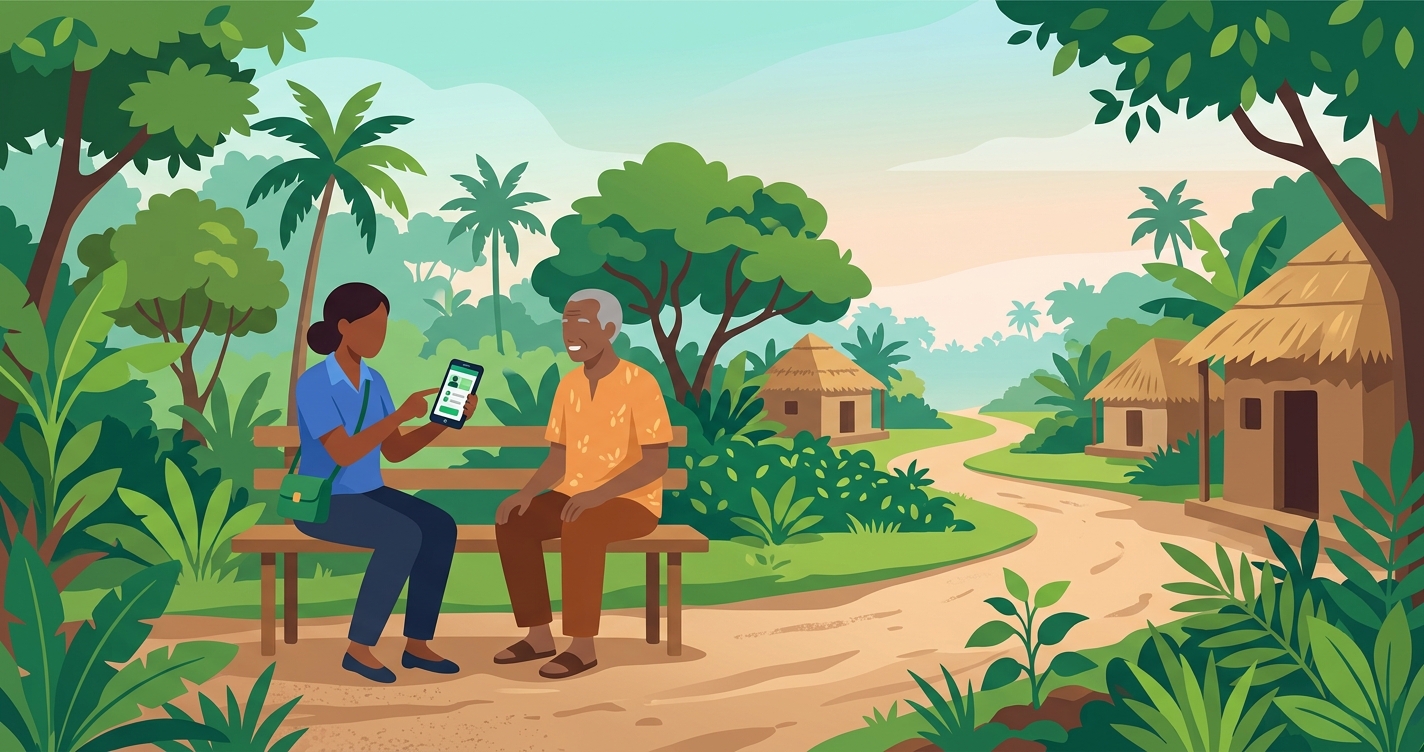
Geography has long been the harshest dictator of human health outcomes. For decades, extending care to the hardest-to-reach villages meant moving physical equipment over unpredictable, unpaved roads. Trucks carried monitors, community health workers lugged heavy backpacks filled with diagnostic cuffs, and supply chains buckled under the strain of maintenance, calibration, and battery replacement. Implementing mobile health low resource settings requires fundamentally rethinking this model. Rather than trying to shrink the clinical environment to fit inside a backpack, global health implementers are realizing that the smartphone itself must become the diagnostic instrument. Phone-only screening is completely removing the need for auxiliary hardware, allowing community health workers to capture vital signs and triage patients using only the device they already carry in their pocket.
"Digital health tools have the potential to overcome historical deficits in infrastructure, extending the reach of the formal health system directly into rural households through the devices already in people's pockets."
Alain Labrique, Founding Director of the Johns Hopkins University Global mHealth Initiative (2018)
The hardware burden in mobile health low resource settings
When ministries of health and implementing partners plan an mHealth field deployment, the budget is rarely consumed by the software itself. The hidden, often crippling costs lie in the hardware logistics. Traditional field kits require an array of equipment to be useful. Community health workers are frequently given blood pressure cuffs, clinical grade pulse oximeters, portable scales, spare batteries, and replacement parts.
In a low-resource environment, this equipment degrades rapidly. Dust, extreme humidity, and the sheer physical toll of rural transport destroy delicate sensors and compromise wiring. When a blood pressure cuff breaks in a remote village, it does not get repaired. The community health worker simply stops screening for hypertension, effectively leaving that specific population without preventive care. The logistics of replacing single-use accessories and calibrating hardware across a distributed network of thousands of health workers often paralyze otherwise well-funded programs.
The challenge is often referred to as pilotitis. A mobile health project might work perfectly when rolled out to fifty health workers near a capital city where supply chains are relatively short. However, when the program attempts to reach the true last mile, the physical supply chain breaks down. Trucks cannot navigate flooded roads to deliver replacement batteries. Technicians cannot travel five days to calibrate an oximeter. Implementing mobile health low resource settings successfully means accepting that the infrastructure to support hardware simply does not exist.
The new paradigm is completely software-driven. By moving the diagnostic capability entirely into the smartphone, programs bypass the supply chain entirely. A phone-only setup transforms a fragile logistical web into a simple software download.
| Deployment Factor | Traditional Hardware Kits | Phone-Only Screening (Zero-Equipment) |
|---|---|---|
| Upfront Cost | High (Requires purchasing phones plus multiple medical peripherals) | Low (Requires only a standard smartphone) |
| Supply Chain | Complex (Dependent on continuous distribution of batteries and replacement parts) | Simple (Requires only digital software distribution and updates) |
| Maintenance | Continuous (Calibration and physical repairs required) | Zero (Updates pushed over cellular networks when available) |
| Scalability | Linear (Each new worker requires a physical kit of equipment) | Exponential (Any authorized user with a smartphone can download the tool) |
| Failure Rate | High (Cables tear, cuffs leak, and batteries fail in harsh climates) | Low (Dependent only on the functionality of the smartphone itself) |
To successfully shift from hardware-dependent kits to software-first screening, a CHW vital signs tool must meet specific operational realities. Ministries of health and implementing partners must look for solutions that:
- Function entirely without secondary monitors, Bluetooth cuffs, or specialized physical attachments.
- Operate reliably offline, syncing screening data only when the health worker returns to an area with stable cellular coverage.
- Consume minimal battery power, recognizing that frontline workers may only have access to charging stations sporadically.
- Require minimal technical training, utilizing intuitive interfaces that seamlessly guide the health worker through the physiological measurement process.
- Store data securely on the device to protect patient privacy in shared community environments.
Industry applications for last mile health delivery
Organizations like the United States Agency for International Development (USAID) and the U.S. President's Emergency Plan for AIDS Relief (PEPFAR) manage massive, complex health interventions across dozens of countries. According to 2024 reports, PEPFAR supports over 20.6 million people on antiretroviral therapy globally. Reaching these individuals, monitoring their ongoing health, and screening for co-morbidities requires a robust network of community-based services that can operate far from central clinics.
When these global health organizations look to scale their impact, the primary bottleneck is screening capacity. Traditional models relied on bringing the patient to the clinic, which is often a day's journey. By deploying remote screening developing nations can multiply their clinical reach and flip the model to bring the clinic to the patient. A village health worker equipped with a zero-equipment vital signs tool can assess a patient for cardiovascular risks, respiratory distress, or basic physiological anomalies without waiting for a mobile clinic to arrive or requesting specialized diagnostic gear.
This shift changes the basic arithmetic of global health delivery. Instead of allocating massive portions of a grant to procure, transport, and secure thousands of physical monitors, program managers can invest that budget directly into human capital. Training more community health workers and equipping them with a single app on their standard-issue smartphone creates an exponentially wider safety net.
Current research and evidence
Research into mobile health technology consistently points toward the necessity of extreme simplification. Studies evaluated by the World Health Organization and leading academic institutions demonstrate that interventions fail when they add logistical burdens to already over-worked frontline staff.
Alain Labrique and his colleagues at the Johns Hopkins University Global mHealth Initiative have extensively studied the application of mobile technology to strengthen health systems. Their findings suggest that the most successful digital tools are those that integrate seamlessly into the existing daily workflows of community health workers, rather than forcing the worker to adapt to the technology. When a worker has to pair a Bluetooth device in a setting with high interference, troubleshoot a connection error, and manage multiple charging cables for different devices, the technology becomes a barrier rather than a bridge.
The World Health Organization's 2024 Compendium of Innovative Health Technologies for low-resource settings specifically highlights the urgent need for appropriate, affordable, and maintenance-free solutions. Software-based contactless screening aligns perfectly with these global mandates. By using the standard smartphone camera to detect subtle physiological signals, these tools provide a pragmatic, highly scalable alternative to conventional physical monitors. The evidence shows that removing the hardware dependency dramatically increases the likelihood of a program surviving past its initial funding cycle.
The future of mobile health tools
The future of last mile health delivery is undeniably asset-light. As mobile network penetration continues to deepen across rural Africa, Southeast Asia, and Latin America, and as smartphone cameras become increasingly sophisticated, the reliance on external diagnostic hardware will decrease to near zero. Global health funding is already shifting to reflect this new reality. The USAID 2024-2029 Digital Health Position Paper emphasizes sustainable scaling and interoperability, pointing toward a future where digital tools are the primary interface for care.
Implementing partners are increasingly prioritizing an mHealth field deployment that can be distributed via an enterprise app store or a direct offline download over one that requires a shipping container of medical peripherals. This shift will democratize health screening on a scale previously thought impossible.
When the only physical requirement for a basic clinical assessment is the smartphone itself, ministries of health can scale their national screening programs precisely as fast as they can train personnel. The hardest-to-reach populations will no longer be excluded from routine, life-saving health monitoring simply because a supply truck cannot navigate the roads.
Frequently asked questions
What makes a mobile health deployment successful in rural areas?
Success depends on removing friction for the frontline worker. Tools must work completely offline, require minimal battery consumption, and eliminate the need for carrying, charging, or repairing secondary hardware attachments.
How do zero-equipment vital signs tools function in the field?
These tools use the existing sensors on a smartphone, such as the camera, to measure physiological parameters. By analyzing light reflection and micro-movements on the skin, the software can extract data without requiring a physical cuff or clip.
Why is hardware scaling a problem in low-resource settings?
Hardware is vulnerable to harsh environmental conditions, requires constant battery replacement, and is difficult to repair. When a single component breaks, the entire screening process stops because replacement parts are rarely available in remote villages.
How does phone-only screening reduce program costs?
By eliminating the need to purchase, ship, store, and maintain physical medical devices, programs can drastically reduce their capital expenditures and supply chain overhead. This allows implementers to redirect funds toward training more community health workers.
For global health organizations working to extend care to the most remote populations, scaling software is infinitely more practical than scaling hardware. Circadify is addressing this space by building frictionless, phone-only health tracking solutions tailored for the realities of the field. To see how these asset-light approaches are being utilized by global health implementers, explore our Deployment case studies.