
How to Measure the Impact of Digital Health Interventions
A research-based framework for measuring the impact of digital health interventions across reach, quality, equity, cost, and implementation outcomes.
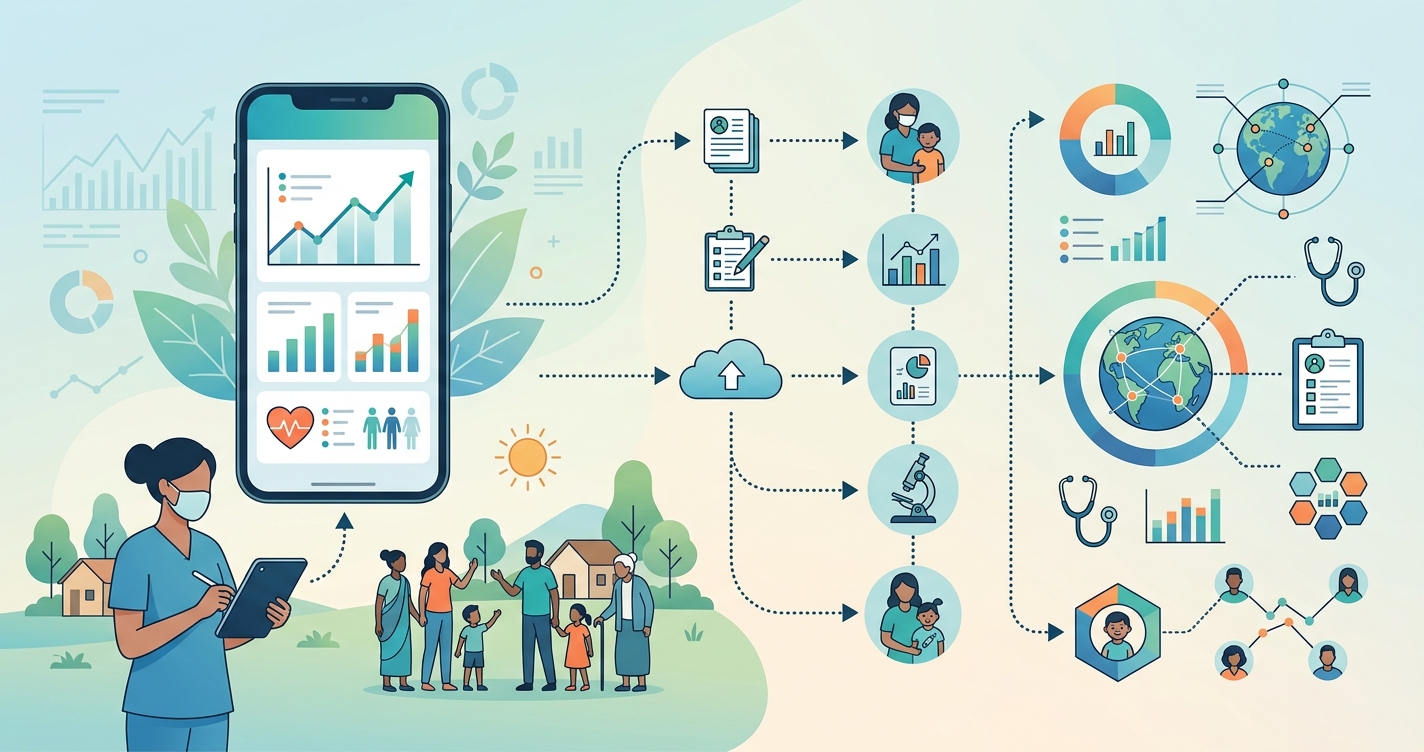
Measure impact digital health interventions well, and a program can defend funding, improve implementation, and scale with confidence. Measure them badly, and even a promising intervention turns into a pile of dashboard metrics with no clear link to outcomes. That tension shows up everywhere in global health: ministries want evidence that a tool changes service delivery, implementers want proof that staff actually use it, and funders want to know whether the gains justify the cost.
"Implementation outcomes" such as acceptability, adoption, feasibility, fidelity, penetration, and sustainability are distinct from clinical outcomes and often determine whether a digital health intervention succeeds in the real world. — Enola Proctor and colleagues, Administration and Policy in Mental Health (2011)
How to Measure the Impact of Digital Health Interventions in Practice
The strongest evaluation plans do not rely on a single metric. The World Health Organization's 2016 guide Monitoring and Evaluating Digital Health Interventions was written for exactly this reason: digital programs need stepwise monitoring of implementation fidelity as well as evaluation of downstream impact. In other words, it is not enough to ask whether a tool exists or whether people downloaded it. The real question is what changed in care delivery, access, quality, speed, and decision-making after the intervention was introduced.
A useful way to think about impact is to separate measurement into four layers:
- Reach: who was exposed to or used the intervention
- Implementation quality: whether the program was used as intended
- Service effects: what changed in workflow, timeliness, coverage, or referral completion
- System value: whether the intervention improved equity, cost, or sustainability
That layered view matters because digital health programs often look strong on top-line adoption and weak on operational follow-through. A screening app may register thousands of encounters, for example, while still failing to improve referral completion or supervisor response time.
Comparison Table: Common Ways to Measure Impact
| Measurement lens | What it asks | Useful indicators | Main risk if used alone |
|---|---|---|---|
| Reach | Who used the intervention? | Enrollment, active users, geographic coverage, staff participation | Confuses usage with value |
| Effectiveness | Did outcomes improve? | Detection rates, follow-up completion, wait-time reduction, adherence, health outcomes | Misses why performance changed |
| Adoption and implementation | Did facilities and staff integrate it into routine work? | Adoption by site, workflow completion, fidelity, training completion, sync rates | Can ignore patient benefit |
| Cost and efficiency | Was the intervention worth the operational investment? | Cost per screen, cost per referral completed, staff time saved, avoided repeat visits | Hard to compare across settings |
| Equity | Who benefited and who was left out? | Uptake by sex, age, language, geography, income proxy, device access | Often measured too late |
| Sustainability | Will it last after pilot funding? | Retention, local ownership, maintenance burden, budget integration | Slow to observe in short pilots |
Dawn D'Lima, Thomas Soukup, and Louise Hull's 2021 systematic review of the RE-AIM framework found that reach was the most frequently reported domain, appearing in 92.9% of included studies, while maintenance was less consistently covered. That pattern is familiar in digital health. Teams often get good at reporting who touched the tool, then struggle to show whether it held up over time.
Which Metrics Matter Most
The answer depends on the intervention, but most serious evaluations in global health need a balanced scorecard rather than a vanity dashboard.
Core metrics usually include:
- Coverage metrics such as screened population, facilities onboarded, or percentage of target users reached
- Process metrics such as completion rates, sync delays, referral turnaround times, and data quality errors
- Outcome metrics such as earlier risk identification, improved follow-up, reduced no-show rates, or faster escalation
- Implementation metrics such as acceptability, feasibility, and fidelity
- Equity metrics showing whether rural, low-connectivity, displaced, or lower-literacy groups were actually served
- Economic metrics showing cost per useful action rather than cost per account created
The Proctor implementation outcomes framework remains useful because it forces teams to look at operational reality. Acceptability asks whether users and staff think the intervention is workable. Adoption asks whether sites and providers actually start using it. Fidelity asks whether it is being used the way the program intended. Sustainability asks whether usage survives beyond launch enthusiasm.
Industry Applications
Community Health and Frontline Programs
For field programs, impact usually means more than clinical change. A ministry or implementing partner may care just as much about whether community health workers can complete a screening workflow offline, whether supervisors receive actionable alerts, and whether referrals happen sooner. In these settings, measuring impact digital health interventions often starts with service continuity rather than narrow clinical endpoints.
That is one reason WHO's practical guide still holds up. It was designed for implementers who need to monitor operational fidelity while also assessing real-world outcomes.
National and Donor-Funded Digital Health Programs
Large programs are usually judged on scale, interoperability, and budget logic. Here, evaluation should include:
- facility-level adoption
- integration with reporting systems
- repeat use after the pilot phase
- differences in uptake across districts
- cost per meaningful outcome, not just software deployment cost
A systematic review on the cost-effectiveness of digital health interventions published in 2022 found 35 eligible studies from 2016 to 2020 and concluded that evidence was growing but highly heterogeneous. That is a useful warning for buyers and funders. Cost claims are hard to compare unless teams use standardized methods and clear outcome definitions.
Equity-Focused Deployments
If a digital tool works mainly for connected, literate, urban users, it may widen the gap it was meant to close. Sarah Wilson and colleagues wrote in npj Digital Medicine (2024) that digital exclusion remains a major barrier for underserved groups, especially when access, language, disability, or digital literacy are not addressed early. For global health teams, this means equity should be built into impact measurement from day one, not added after rollout.
Current Research and Evidence
Several sources point to the same conclusion: impact measurement needs to connect implementation science with public-health evaluation.
First, the World Health Organization's 2016 monitoring and evaluation guide makes a practical distinction between ongoing monitoring and formal impact assessment. Programs need both. Monitoring tells teams whether the intervention is functioning. Evaluation tells them whether it changed services or outcomes.
Second, Enola Proctor and colleagues argued in 2011 that implementation outcomes are preconditions for later service and clinical outcomes. That point is still easy to miss. When a digital health program disappoints, leaders need to know whether the intervention itself was weak or whether implementation broke down.
Third, the RE-AIM literature is useful because it widens the frame beyond effectiveness. D'Lima, Soukup, and Hull found that all five RE-AIM dimensions were not consistently reported even in studies using the framework. In practice, that means many evaluations still under-report maintenance, context, or setting-level adoption.
Fourth, economic evidence is improving but still uneven. The 2022 systematic review of cost-effectiveness studies reported substantial heterogeneity in intervention type, reporting perspective, and methods. That matters because digital health buyers often want a simple business case, while the underlying literature is still methodologically mixed.
The broader lesson is straightforward: a credible impact model should combine outcome metrics with implementation metrics, equity checks, and cost logic.
The Future of Measuring Digital Health Impact
The next phase will probably look less like isolated pilot evaluations and more like continuous evidence systems. Programs are moving toward routine dashboards that connect usage logs, workflow outcomes, and service data instead of treating evaluation as a one-time donor report.
Three shifts are especially important.
- More implementation-aware evaluation: teams are getting better at tracking fidelity, adoption, and sustainability alongside outcomes.
- Stronger equity measurement: digital-health evidence is under pressure to show who benefits, not just average performance.
- Better economic framing: cost per meaningful action is becoming more useful than broad claims about savings.
For low-resource and mobile-health deployments, the practical future is a blended model: routine operational monitoring, periodic outcome evaluation, and explicit equity review. That is how teams move from anecdote to evidence.
Frequently Asked Questions
What is the best way to measure the impact of digital health interventions?
The best approach is a mixed framework that combines reach, effectiveness, implementation outcomes, cost, and equity. A single adoption metric rarely tells the whole story.
Why are implementation outcomes so important?
Because a digital intervention can fail even if the underlying idea is sound. Poor adoption, weak fidelity, and low sustainability can block clinical or service gains before they appear.
Should every digital health program prove clinical outcomes?
Not immediately. Early-stage programs may first need to prove feasibility, workflow fit, and service improvements. But mature programs should connect operational performance to stronger outcome evidence over time.
How do global health teams avoid vanity metrics?
They focus on measures tied to decisions: referral completion, supervisor response, data quality, equitable reach, and cost per useful action. Raw downloads or registrations are rarely enough.
Impact measurement gets more useful when it is tied to frontline decisions, not just reporting obligations. Circadify follows this shift closely through its global health coverage. For related context, see our analysis of mobile health in low-resource settings and how smartphone screening integrates with DHIS2.