How do researchers measure vitals in a refugee camp?
A research-style analysis of the methods, challenges, and technologies used for refugee camp vitals measurement in humanitarian settings.
Measuring vital signs in a refugee camp is a complex operational challenge that goes far beyond the simple act of taking a reading. For researchers, aid agencies, and frontline health workers, the environment itself dictates the available methods. Overcrowding, inadequate infrastructure, and a constant influx of new arrivals demand tools and processes that are Accurate. Highly scalable, durable, and easy to use. The logistics of deploying and maintaining traditional medical equipment in these settings often prove unsustainable, pushing organizations to explore new models for health surveillance and screening. Effective refugee camp vitals measurement is therefore less about a single device and more about a system that can function under severe constraints.
"Inadequate sanitation, water supply, and overall poor living conditions increase the risk of disease outbreaks... Displaced populations frequently experience high rates of infectious diseases, mental health issues, and chronic conditions." - (EBSCO, "Refugee Health")
Analyzing vitals measurement in humanitarian crises
The core of refugee camp vitals measurement revolves around overcoming logistical and environmental barriers. Traditionally, this process relies on manual measurements taken by clinicians or community health workers using standard portable devices: thermometers, sphygmomanometers (blood pressure cuffs), and pulse oximeters. While familiar and trusted, this approach presents significant hurdles in a crisis setting.
A 2021 study by researchers at the Aga Khan University highlighted that even in established hospitals, intermittent vital sign checks can miss patient deterioration. In a chaotic field environment, these gaps are magnified. Equipment can be lost, damaged, or stolen. The need for regular sterilization between uses to prevent cross-contamination adds another layer of complexity, consuming time and resources that are in short supply. Furthermore, the reliance on trained personnel to operate these devices creates a bottleneck, limiting the number of people who can be screened in a timely manner. Data collection is often done on paper, leading to transcription errors, delays in analysis, and difficulty in tracking population-level health trends.
This is where mobile health (mHealth) and contactless technologies are beginning to change the paradigm. By using the ubiquity of smartphones, health organizations can equip local staff or even community health workers with powerful screening tools that require minimal hardware. These new methods offer a path to more efficient, scalable, and data-driven health interventions in the world's most challenging environments.
| Feature | Traditional Measurement | Smartphone-Based Measurement |
|---|---|---|
| Primary Equipment | Blood pressure cuff, thermometer, pulse oximeter | Smartphone with specialized application |
| Personnel Requirement | Trained clinician or health worker | Non-clinical staff or CHW with minimal training |
| Scalability | Low; limited by equipment and personnel | High; uses existing mobile phone infrastructure |
| Data Management | Manual (paper forms), slow, error-prone | Digital, real-time, easily integrated with health platforms |
| Patient Experience | Requires physical contact, can be slow | Contactless, fast, less intrusive |
| Upfront Cost | Moderate to high per kit | Low; uses existing or low-cost devices |
Industry Applications
The shift toward digital and contactless tools for refugee camp vitals measurement opens up several key applications for humanitarian health programs.
Triage and mass screening
In a mass casualty event or a disease outbreak, rapidly sorting individuals by risk is critical. Traditional methods are too slow. Smartphone-based tools that can capture vital signs in 30-60 seconds without contact allow a single health worker to screen dozens of people in the time it would take to handle a few with cuffed devices. This enables faster identification of individuals who need immediate clinical attention.
Longitudinal health monitoring
Refugee populations have a high burden of chronic diseases like hypertension.
- Regular monitoring is essential for managing these conditions.
- Deploying enough cuff-based devices and trained staff for this is often impossible.
- Smartphone-based solutions allow community health workers to conduct regular checks during home visits, with data syncing automatically to a central health record. This supports continuity of care for conditions that are often neglected in crisis settings.
Maternal and child health
Monitoring the vital signs of pregnant women and newborns is a core function of primary healthcare. Contactless methods reduce the risk of infection transmission and are less likely to cause distress to infants or expectant mothers. They provide a quick, safe way to check for signs of fever, respiratory distress, or pre-eclampsia.
Current research and evidence
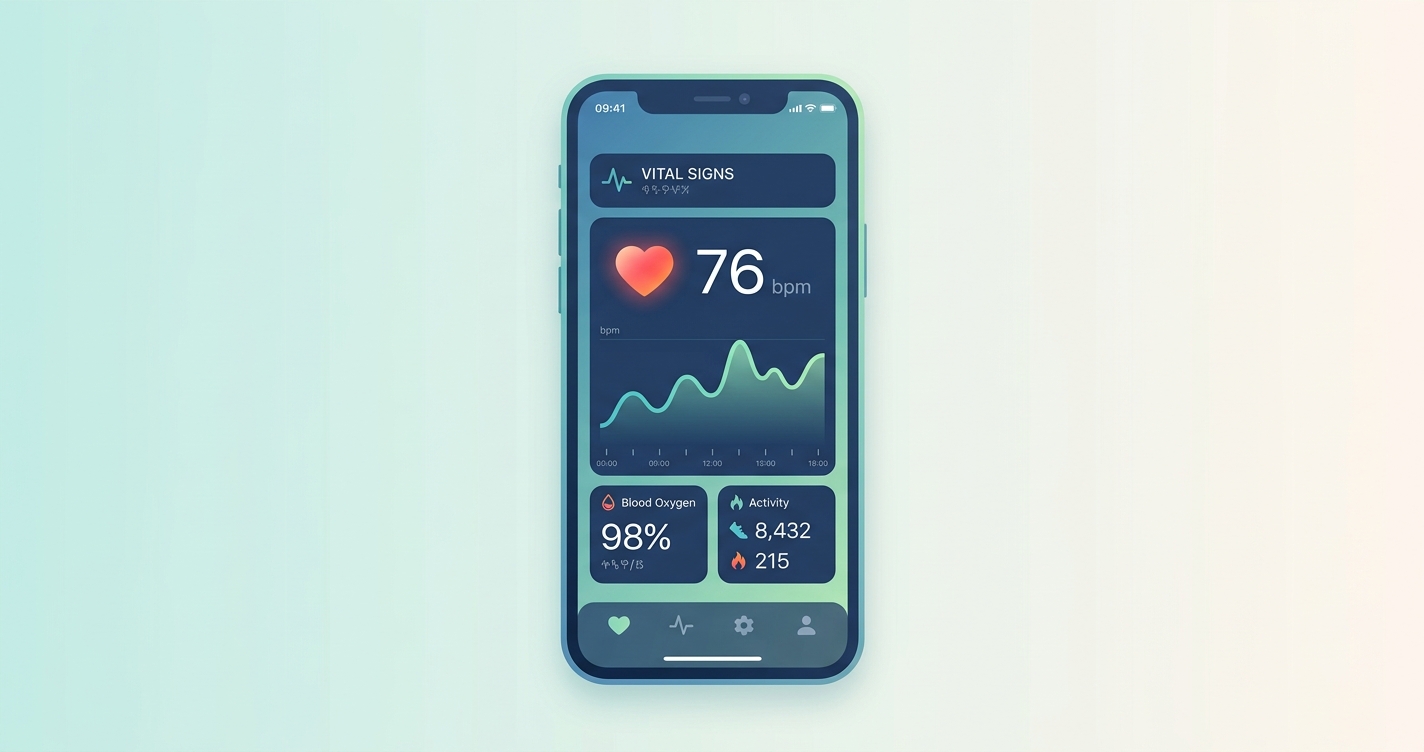
The evidence base for new refugee camp vitals measurement technologies is growing rapidly. Much of the foundational research focuses on remote photoplethysmography (rPPG), a technique that uses a standard smartphone camera to detect subtle changes in light reflected from the skin, which correspond to blood flow. From this video signal, algorithms can derive heart rate, respiratory rate, and even blood pressure and oxygen saturation.
Researchers from institutions like Johns Hopkins University have explored the use of wireless networks to track patient data in disaster scenarios, demonstrating the feasibility of integrated systems (APL, 2011). More recently, studies published in journals like PMC have validated the reliability of contactless vital sign measurement from drones, which could one day be used to assess casualties in inaccessible or dangerous areas. A 2020 study explored the use of wearable sensors for real-time monitoring in emergency settings, noting their ability to facilitate early detection of patient deterioration.
However, the most scalable solutions for low-resource settings are those that eliminate the need for any dedicated hardware beyond a standard smartphone. Validating these software-based solutions against clinical-grade devices is a critical step, and research in this area is maturing. The goal is not necessarily to replace diagnostic-grade equipment but to provide a highly effective tool for risk stratification and triage at scale.
The future of refugee health screening
The future of vitals measurement in humanitarian settings lies in the integration of contactless screening with digital health platforms. Imagine a system where a community health worker uses a single smartphone app to:
- Register a new family in the camp.
- Capture baseline vital signs for each member in under a minute.
- Answer a customizable health questionnaire (e.g., for TB or HIV risk).
- Sync the data in real-time to a platform like DHIS2 or CommCare.
This creates a powerful, longitudinal health record that can be used for individual case management and population-level epidemiology. As AI and machine learning models become more sophisticated, these systems could even provide real-time decision support, helping a minimally trained health worker identify warning signs they might otherwise miss. The technology exists today; the work ahead involves navigating the operational and policy challenges to make it a standard part of every humanitarian response toolkit.
Frequently asked questions
Q: What are the most critical vital signs to measure in a refugee camp? A: While all vital signs are important, heart rate, respiratory rate, and temperature are often prioritized in initial screenings. They are key indicators of fever, infection (like pneumonia), and distress. Blood pressure is also critical for identifying risks like pre-eclampsia in pregnant women and managing chronic hypertension.
Q: How accurate is a smartphone for measuring vital signs? A: The accuracy of smartphone-based vital signs measurement, particularly using rPPG technology, has been validated in numerous studies against clinical-grade devices. While not intended to replace medical-grade diagnostic tools, they are highly effective for screening and triage, allowing health workers to quickly identify individuals who require further assessment.
Q: What are the biggest barriers to deploying new health technology in refugee camps? A: The primary barriers are often not technical but operational. They include a lack of reliable electricity and internet connectivity, the need for robust training and support for health workers, concerns about data privacy and security, and the challenge of integrating new tools into existing health information systems and workflows.
The challenges of providing healthcare in refugee camps and other low-resource settings are immense, but new technologies are creating possibilities that were unthinkable a decade ago. Circadify is actively working in this space, developing zero-equipment solutions to empower frontline health workers. To learn more about how these tools are being used in the field, explore our deployment case studies at circadify.com/blog (global health section).