How can I get screened before the next clinic visit that's three months away?
Long intervals between clinic appointments present a major challenge in managing chronic conditions in low-resource settings. Mobile health technology offers a scalable solution for screening between distant clinic visits.
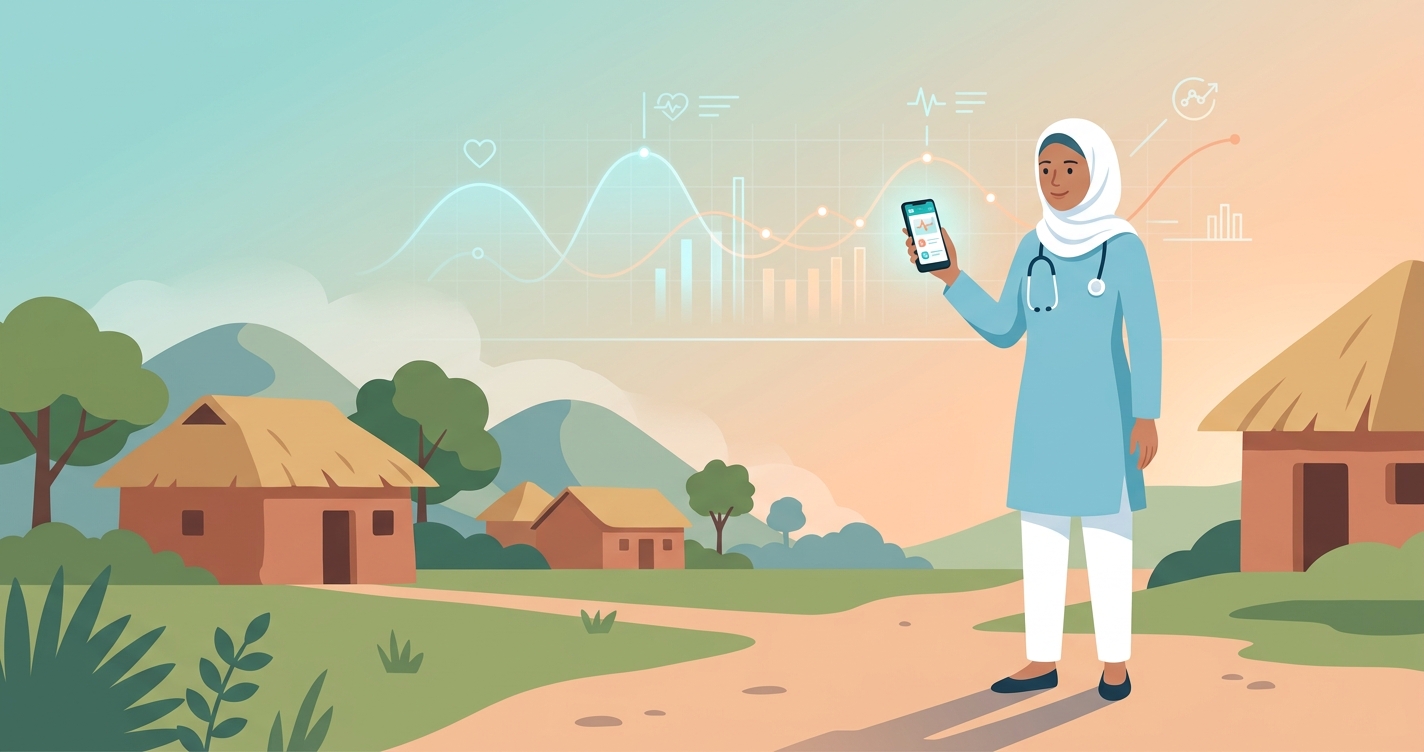
For a health program manager in a low- or middle-income country (LMIC), a three-month gap between patient appointments is not a theoretical problem, it is an operational reality that carries significant risk. Patients with chronic conditions like hypertension, diabetes, or HIV require consistent monitoring to manage their health and prevent complications. Yet, logistical barriers, from transportation costs and distance to overloaded clinical staff, make frequent follow-ups an impossibility for a large portion of the population. This gap in care continuity is where many of the gains made at the clinic are lost, leading to poor health outcomes and increased long-term costs for the health system. The core challenge becomes how to maintain a level of vigilance on a patient's condition when the next formal assessment is a quarter of a year away.
"Noncommunicable diseases (NCDs) now cause 74% of deaths globally, and 77% of all NCD deaths are in low- and middle-income countries." - World Health Organization (2022)
The challenge of screening between distant clinic visits
The period between scheduled clinical consultations is a high-risk void in many health systems. For patients, the inability to get a simple check-up can lead to anxiety and the progression of an otherwise manageable condition. For health systems, this lack of interim data means that problems are often caught too late, turning a primary care issue into an emergency. The fundamental challenge of screening between distant clinic visits is rooted in a resource mismatch: the need for continuous data versus the reality of episodic, facility-based care.
Traditional models require patients to travel to a physical location with trained personnel and specific medical equipment. This model is untenable for routine, high-frequency checks in most low-resource settings. The costs associated with patient travel, lost wages, and clinic resources are prohibitive. Furthermore, overburdened clinics often cannot accommodate additional visits for simple screenings, creating a bottleneck that delays care for everyone. Mobile health (mHealth) interventions, particularly those leveraged by Community Health Workers (CHWs), present a new paradigm to address this structural deficiency by decentralizing the screening process.
| Feature | Traditional Facility-Based Screening | mHealth-Enabled Community Screening |
|---|---|---|
| Location | Centralized clinic or hospital | Patient's home or community |
| Personnel | Nurses, clinical officers | Community Health Workers (CHWs) |
| Equipment | Sphygmomanometer, pulse oximeter, etc. | Smartphone with diagnostic software |
| Data Flow | Manual entry into paper or EMR; delayed | Instant digital capture; real-time sync |
| Patient Cost | High (transport, lost wages) | Low to none |
| System Scalability | Low; limited by physical infrastructure | High; limited by CHW network & phone access |
| Frequency | Low (e.g., quarterly, annually) | High (e.g., weekly, monthly) |
This shift does not aim to replace clinical visits but to make them more effective. By using validated, equipment-less screening tools on a smartphone, CHWs can identify at-risk individuals who need to be prioritized for a clinical follow-up, while providing reassurance and health education to those who are stable.
- Enables risk stratification at the community level.
- Reduces the burden on higher-level health facilities.
- Provides timely data for public health surveillance.
- Empowers patients and CHWs with actionable health information.
Industry Applications
The model of using CHWs for screening between distant clinic visits is not just a concept; it is being actively deployed in various public health programs to bridge the care gap.
Non-communicable disease (ncd) management
For conditions like hypertension, regular blood pressure monitoring is critical. A study by researchers at the University of Ghana (2021) highlighted how CHW-led home blood pressure monitoring programs significantly improved control compared to standard care. Using simple mobile applications, CHWs can capture readings, transmit them to a central platform, and receive alerts for high-risk patients, triggering a referral to the nearest clinic. This transforms NCD management from a reactive, clinic-based model to a proactive, community-based one.
Hiv/tb program support
In HIV and TB programs, adherence to treatment is critical. Contactless screening tools can be used to monitor for signs of side effects or disease progression during the long intervals between clinical appointments. A CHW can conduct a quick check of vital signs and symptoms during a home visit, with the data instantly available to a supervising nurse or program manager. This allows for early intervention and supports patient retention in care, a critical factor in programs funded by PEPFAR and the Global Fund.
Maternal and child health
Antenatal and postnatal care schedules often involve long waits. Mobile screening allows for more frequent checks on both mother and child. For example, a CHW can use a smartphone tool to assess a newborn's respiratory rate, a key indicator of pneumonia, or monitor a mother's blood pressure for signs of post-partum pre-eclampsia. This creates a safety net that extends far beyond the clinic walls.
Current research and evidence
The evidence base for mHealth interventions in community settings is growing. A systematic review published by CHW Central noted that mobile technology enhances CHW effectiveness by improving the quality of data collection, facilitating supervision, and streamlining communication with the broader health system. Researchers like Leanne M. West and her colleagues have analyzed the implementation of mHealth tools, finding that success is often tied to how well the technology integrates into existing CHW workflows and the level of support and training provided. While early studies focused on feasibility, current research is increasingly looking at clinical outcomes and cost-effectiveness. The consensus is that when properly implemented, these tools can significantly improve the efficiency and reach of community-based health programs. However, validation of these technologies against clinical-grade devices remains a critical and ongoing area of research to ensure safety and accuracy in various populations and environments.
The future of remote screening
The future of screening between distant clinic visits lies in the further development and integration of contactless, equipment-less technologies. As smartphone sensor technology improves and machine learning algorithms become more sophisticated, the range and accuracy of what can be measured will expand. The next frontier involves integrating this field-level data directly into national health information systems like DHIS2. This would provide ministries of health with real-time, population-level data to guide policy, resource allocation, and emergency response. The goal is to create a seamless flow of information from the patient's home to the national health dashboard, with the CHW serving as the critical link in this new digital health infrastructure.
Frequently asked questions
What are the main barriers to frequent health screening in remote areas? The primary barriers are distance to clinics, the cost of travel and lost work time for patients, and the limited capacity of health facilities, including shortages of trained staff and medical equipment.
How can mobile technology help bridge the gap between clinic visits? Mobile technology empowers community health workers (CHWs) or even patients to perform basic health checks using a smartphone. This allows for frequent, low-cost risk assessment and data collection, enabling the system to prioritize individuals who need urgent clinical care.
Is screening without clinical equipment accurate enough? The goal of mobile, equipment-less screening is not to provide a final diagnosis but to perform risk stratification. These tools are designed to identify individuals who may be at high risk for a condition and require a follow-up visit with a clinician for a formal diagnosis using standard medical devices. Their accuracy is validated for this specific purpose.
The challenge of monitoring health between distant clinic appointments is a critical bottleneck in global health. As health systems grapple with a rising burden of chronic disease under tight resource constraints, new models of care are essential. By empowering community health workers with validated, zero-equipment mobile screening tools, implementing partners and ministries of health can create a more continuous, proactive, and equitable system of care. Circadify is at the forefront of developing these technologies, and you can learn more about their real-world impact by exploring deployment case studies in the global health section at circadify.com/blog.