Why is it so hard to get a health check-up when I live far from the city?
Why distance still blocks routine health check-ups, and how mobile health in low-resource settings is reaching remote populations with smartphone vital signs.
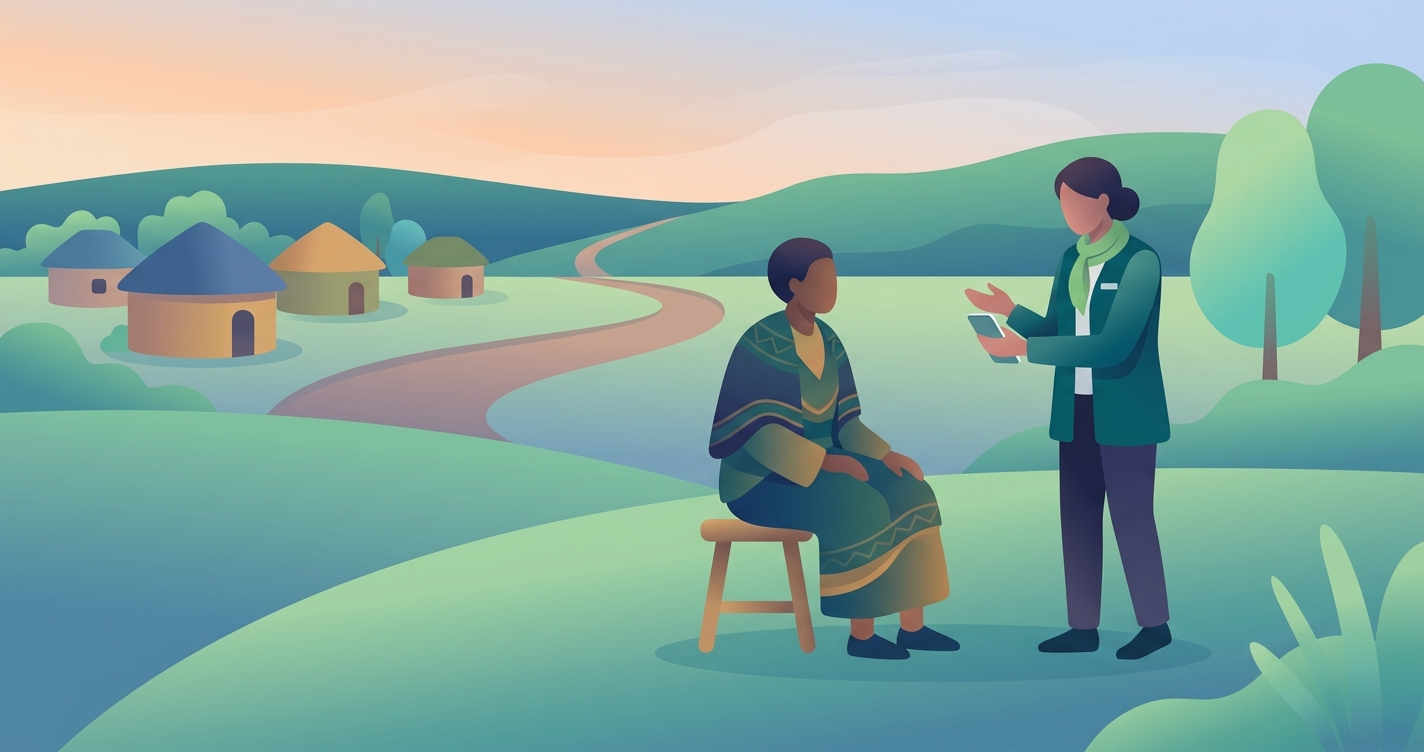
The question sounds simple, but it sits on top of one of the most stubborn problems in global health: geography decides who gets checked and who gets missed. For a household three hours from the nearest clinic, a routine blood pressure reading is not a quick errand. It is a lost day of work, a transport fare that may exceed the cost of the consultation, and often a journey that produces no result because the clinic ran out of staff, power, or supplies. This is where mobile health low resource settings work becomes less of a buzzword and more of a practical answer, because it changes where the first measurement can happen.
Longer distances to health services are consistently linked to lower utilization rates, higher out-of-pocket expenditure, and worse outcomes. The World Health Organization estimates that roughly 2 billion people in rural areas lack access to basic healthcare, and in 2015 about 56 percent of the global rural population lacked health coverage compared with 22 percent of urban residents.
Why distance breaks the check-up in mobile health low resource settings
A check-up is not a single event. It is a chain: a person decides to seek care, travels to a facility, waits, gets measured, gets interpreted, and receives follow-up. Distance attacks every link in that chain. The further someone lives from the city, the more each step costs in time and money, and the more likely it is that one broken link cancels the whole trip. Researchers describe this as a multidimensional access problem rather than a pure distance problem, because geography interacts with transport availability, provider shortages, and the cost of care.
The provider side is just as fragile. Rural facilities are chronically understaffed, and the equipment that defines a "check-up" in a city clinic is exactly what fails first in remote conditions. Cuffs lose calibration, pulse oximeters need batteries and replacement probes, and cold-chain logistics rarely extend to the last village. So even when a patient completes the journey, the measurement may not happen.
The shift in mobile health low resource settings is to move the first measurement to the patient instead of moving the patient to the measurement. Community health workers (CHWs) already live in the communities they serve. If they can capture reliable vital signs with tools they already carry, the geography problem shrinks dramatically.
The comparison below shows why the model of care matters more than the distance itself.
| Dimension | Travel to a distant facility | CHW visit with equipment kit | Smartphone-based screening at home |
|---|---|---|---|
| Patient travel time | Hours, often a full day | None for the patient | None for the patient |
| Out-of-pocket transport cost | High, sometimes exceeds consult cost | None | None |
| Equipment dependency | Full clinic kit | Cuffs, oximeters, batteries | Camera-equipped phone only |
| Calibration and supply risk | Concentrated at one site | Spread across many kits | Minimal hardware to maintain |
| Coverage per worker per day | Low | Moderate | High |
| Data capture for programs | Manual, often paper | Mixed | Digital by default |
The pattern is clear. Each step away from facility-bound, equipment-heavy care lowers the burden placed on the person who is hardest to reach.
Key reasons rural check-ups fail:
- Transport cost and time often outweigh the perceived value of a preventive visit.
- Provider shortages mean a completed trip does not guarantee a measurement.
- Equipment failure and supply gaps disable facilities that look functional on paper.
- Weak broadband limits the telemedicine that is supposed to close the gap.
- Paper-based records make follow-up and recall nearly impossible at scale.
Industry applications for remote screening
Hypertension and cardiovascular risk
Blood pressure is the classic example of a measurement that should be routine but rarely is in remote areas. Hypertension is largely asymptomatic, so people do not travel far to check something that feels fine. Smartphone-based remote photoplethysmography (rPPG), which reads subtle color changes in the skin from a phone camera, is being studied as a way to flag elevated readings during a CHW home visit and route only the higher-risk individuals toward confirmation.
Maternal and antenatal outreach
Antenatal care depends on repeated contact, and missed visits in remote areas are a known driver of poor outcomes. A 2023 clinical trial protocol described CHWs using a smartphone-synced prototype to assess vital signs during antenatal community outreach, testing whether reliable readings can be captured at the doorstep rather than at a facility.
TB, HIV, and infectious disease programs
Vertical disease programs reach deep into rural communities but still struggle with the first-contact bottleneck. Adding a quick vital signs check to an existing visit lets a single worker do more triage per stop, which matters when coverage per worker per day is the limiting factor.
Current research and evidence
The evidence base for camera-based vital signs has matured quickly. A 2023 validation study of a smartphone rPPG application reported predictive accuracy for systolic and diastolic blood pressure, heart rate, and respiratory rate when compared against certified medical devices. Separate work, including the ReViSe research on remote vital signs from a smartphone camera and the DistancePPG method for non-contact monitoring, has shown that heart rate, respiratory rate, and oxygen saturation can be estimated from standard camera hardware.
Registered trials are now testing these methods in the exact environments that matter. A 2023 community study in Jakarta (NCT07502703) is evaluating rPPG-derived cardiovascular parameters and risk estimates against standard clinical measurements, and a 2023 observational protocol described non-contact photoplethysmography using a device's front camera to capture vital and biochemical signals.
Researchers are equally clear about the limits. Camera-based signals weaken with motion artifacts and with darker skin tones, which is a critical equity concern for deployments across Sub-Saharan Africa and South Asia. The current consensus treats smartphone vitals as a screening and triage layer that sorts people into risk groups, not as a replacement for confirmatory diagnosis. That framing matters for any program manager designing a referral pathway, because the value is in catching the people who would otherwise never be measured at all.
The future of mobile health low resource settings
The direction of travel is toward zero-equipment screening that any trained CHW can run from a phone already in their pocket. Three shifts will shape the next few years:
- Skin-tone-inclusive algorithms. Validation across diverse populations will determine whether these tools can be deployed equitably or remain limited to lighter skin.
- Integration with national data systems. Digital-by-default capture means screening results can flow into existing health information systems instead of dying on paper.
- Offline-first design. Remote areas have intermittent connectivity, so tools that capture and queue data without a live connection will outperform cloud-dependent ones.
If those pieces come together, the check-up stops being a destination and becomes a service that travels the last mile. The person living far from the city no longer has to choose between a lost day of income and knowing their blood pressure.
Frequently asked questions
Can a smartphone really measure vital signs without any extra hardware?
Research shows a phone camera can estimate heart rate, respiratory rate, oxygen saturation, and blood pressure trends through photoplethysmography. Studies treat these readings as a screening signal to identify who needs confirmation, not as a final diagnosis.
Why not just build more rural clinics?
Facilities help, but they do not solve travel time, transport cost, or staffing shortages on their own. Bringing the first measurement to the household through community health workers addresses the access barrier directly, and it scales faster than brick-and-mortar construction.
Is smartphone screening accurate enough for remote populations?
Validation studies report strong agreement with clinical devices under good conditions, but accuracy drops with motion and with darker skin tones. Responsible deployment uses these tools for triage and routes higher-risk results to confirmatory testing.
Who benefits most from mobile health in low-resource settings?
People who currently get no measurement at all benefit most: rural households far from facilities, pregnant women in antenatal programs, and patients in TB and HIV programs where a single worker must screen many people per visit.
Circadify is working on this exact problem, building zero-equipment vital signs screening designed for community health workers operating far from any clinic. To see how these approaches perform in the field, explore deployment case studies in the global health section at circadify.com/blog.