
5 Ways to Cut mHealth Field Deployment Costs in 2026
Five practical strategies for mHealth field deployment cost reduction in 2026, helping USAID and PEPFAR implementers stretch shrinking budgets across larger populations.
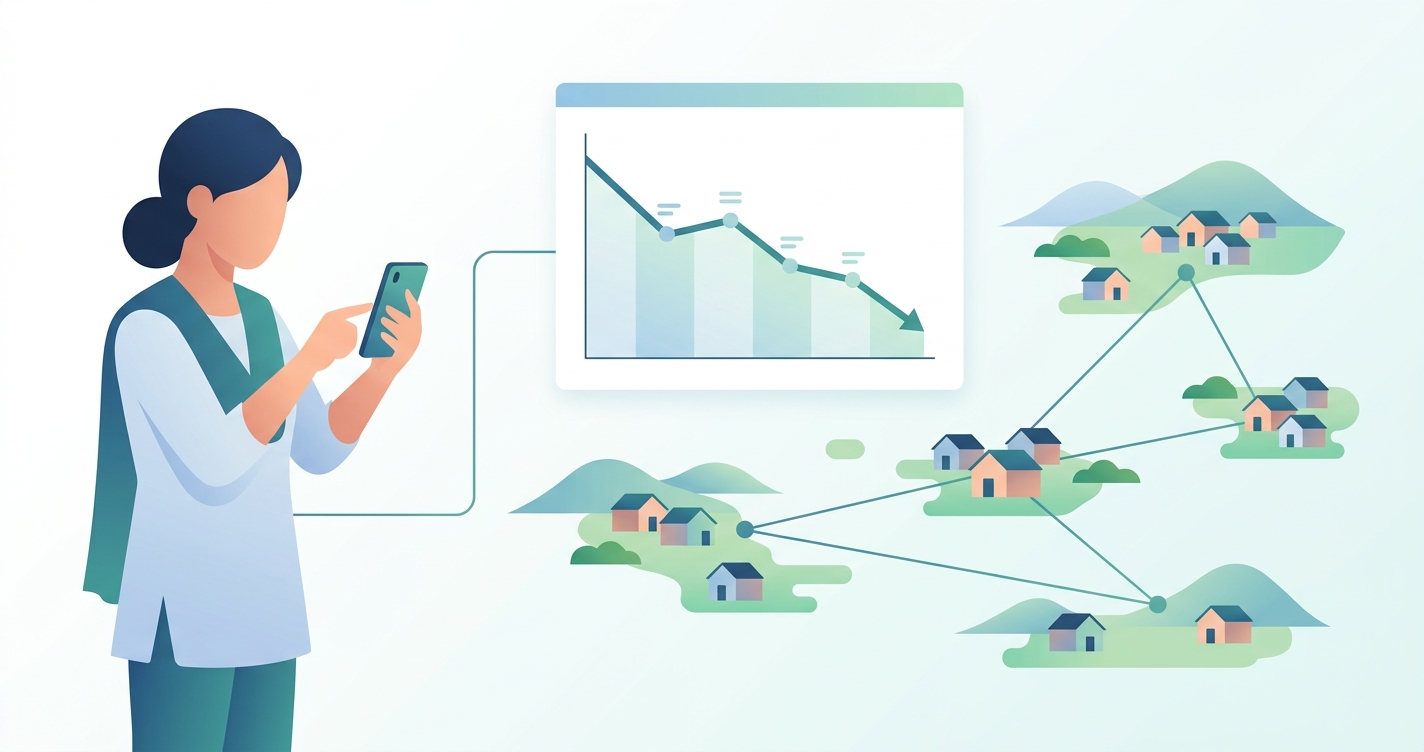
Program budgets in global health entered 2026 smaller than they have been in a decade, and the math facing implementing partners has changed accordingly. When a maternal health program loses a quarter of its donor funding mid-cycle, the question is no longer how to expand coverage but how to hold coverage steady on less money. mHealth field deployment cost reduction has become the central operational problem for USAID and PEPFAR implementers, because the technology layer is one of the few places where careful redesign can free up real money without cutting the number of people screened. The opportunity is large precisely because so many programs still carry deployment cost structures designed for a funding environment that no longer exists.
A decade of economic evaluations found that community health worker programs in low- and middle-income countries reported costs per beneficiary ranging from $1.20 to more than $26,000, a spread that points to enormous unrealized savings in how programs are designed rather than in what they deliver. (Source: scoping reviews of CHW economic evaluations 2015 to 2024, PLOS Global Public Health and BMJ Global Health, 2025)
Understanding mhealth field deployment cost reduction
mHealth field deployment cost reduction is not a single lever. It is the combined effect of decisions about hardware, connectivity, training, data systems, and staffing that each carry recurring costs over the life of a program. The reason the cost-per-beneficiary spread is so wide, as documented across the 2015 to 2024 scoping reviews coordinated by research teams publishing in PLOS Global Public Health and BMJ Global Health in 2025, is that most of the variation comes from design choices rather than from differences in the underlying health need. Two programs screening the same condition in similar districts can differ in unit cost by an order of magnitude.
For mobile health in low resource settings, budget pressure exposes the parts of a deployment that were never truly affordable, only well funded. Dedicated diagnostic devices, per-site connectivity contracts, and in-person refresher trainings all looked reasonable when grants were growing. In a contracting environment they become the first candidates for redesign. The five strategies below are ordered by how quickly they tend to release savings, from immediate hardware decisions to longer-term data architecture.
The table contrasts where the money goes under a conventional equipment-heavy deployment versus a lean, software-first model built for affordable health screening at scale.
| Cost Category | Conventional Equipment-Heavy Model | Lean Software-First Model |
|---|---|---|
| Per-worker hardware | Dedicated devices plus a smartphone or tablet | Existing smartphone only |
| Consumables and calibration | Recurring cuffs, cuffs replacement, calibration visits | None for contactless capture |
| Connectivity | Per-site data contracts, often always-on | Store-and-forward, sync on available network |
| Training | In-person multi-day, repeated annually | Blended remote plus short in-person |
| Maintenance and breakage | High; field repair logistics required | Low; consumer device replacement cycle |
| Cost to add one more worker | Steep; tied to device procurement | Marginal; mostly licensing and onboarding |
The pattern across these categories is consistent: the conventional model adds cost every time it adds a worker, while the lean model pushes most cost into one-time setup and keeps the marginal cost of scale low. That difference is what lets a fixed budget reach a larger population.
Five strategies for mhealth deployment savings
The following approaches have appeared most often in field reports and economic evaluations as drivers of mHealth deployment savings. None requires reducing the number of patients reached.
- Cut dedicated hardware where software can substitute. Every device that a community health worker carries beyond a smartphone is a procurement line, a breakage risk, and a calibration schedule. Contactless and camera-based capture methods remove consumables entirely for the measurements they cover.
- Move from always-on connectivity to store-and-forward. Many districts cannot sustain reliable connectivity, and paying for it where it does not work is pure waste. Designing workflows that capture offline and sync opportunistically removes a recurring monthly cost.
- Replace repeated in-person training with blended models. Annual in-person refreshers are expensive in per diems and travel. Short remote modules with targeted in-person practice preserve quality at a fraction of the cost.
- Share platforms across disease programs rather than running parallel verticals. The 2015 to 2024 reviews found that integrated programs covering multiple health areas tend to be more effective than single-disease deployments, and they spread fixed platform costs across more activity.
- Standardize on interoperable data systems to avoid duplicate reporting. When field data already flows into a national system, programs avoid the cost of maintaining separate dashboards and re-entry labor.
Hardware decisions that drive the largest savings
Hardware is usually the fastest place to release money because its costs are concentrated and visible. A program equipping several thousand workers with dedicated diagnostic devices commits to procurement, distribution, breakage replacement, and calibration for the full life of the deployment. Shifting measurements that can be captured on a phone to a software-only approach converts a large recurring capital line into a marginal licensing cost. This is the single change most likely to move a program from the high end of the cost-per-beneficiary range toward the low end.
Connectivity and data architecture
Connectivity costs are easy to underestimate because they arrive monthly rather than upfront. The scoping reviews of mHealth in Sub-Saharan Africa, summarized by researchers at Johns Hopkins University, repeatedly flagged operating cost and infrastructure as the barriers that keep interventions stuck in pilot phase. Programs that assume always-on connectivity often discover that the network does not exist where their workers actually operate, meaning the budget is spent on coverage the program cannot use. Store-and-forward architecture removes that assumption and the cost attached to it.
Industry Applications
HIV and TB Programs Under PEPFAR
For PEPFAR implementing partners, the screening step at first contact is where cost and coverage collide. Reducing the equipment and consumables needed at that first touchpoint lets the same field team move more people through screening per day, which is precisely the bottleneck most HIV and TB programs report. The economic evidence on HIV prevention interventions in Sub-Saharan Africa from 2019 to 2025 found that peer-delivered and decentralized models carried strong economic efficiency, reinforcing that pushing screening closer to the community and away from fixed equipment tends to lower cost per case found.
Maternal and child health
In reproductive, maternal, newborn, and child health programs, the 2015 to 2024 review reported cost per beneficiary per year ranging from $0.19 to $1,547. The low end of that range is achievable mainly where programs avoid heavy per-visit equipment and integrate routine screening into existing household visits. A lean deployment model lets maternal health programs add screening to visits that are already happening, rather than funding separate measurement events.
Multi-disease community platforms
Ministries of health increasingly want one CHW platform that serves several programs at once. Consolidating onto a shared, interoperable system spreads fixed costs and matches the review finding that integrated horizontal programs outperform narrow vertical ones. For a finance officer, this is the difference between funding one data system and funding four.
Current research and evidence
The strongest current evidence comes from the coordinated set of scoping reviews covering economic evaluations of CHW programs from 2015 to 2024, published across PLOS Global Public Health and BMJ Global Health in 2025. These reviews consistently found CHW models more cost-effective than facility-based alternatives, while also noting that few studies assess affordability for the governments and partners who must sustain the programs after donor funding ends. That gap matters in 2026, because affordability, not theoretical cost-effectiveness, is the constraint actually binding most budgets.
The mHealth-specific literature, including the Sub-Saharan Africa scoping review from Johns Hopkins University, adds an important caveat: most interventions remain in early stages, and few have published long-term cost-effectiveness data at scale. The practical implication is that programs should treat unverified vendor cost claims with caution and prioritize designs whose savings come from removing cost categories entirely rather than from optimistic projections.
The future of mhealth field deployment cost reduction
The direction of travel is clear. As donor funding tightens, the deployment models that survive will be the ones with low marginal cost per additional worker and minimal recurring hardware and connectivity obligations. Software-first, contactless capture, offline-capable workflows, and shared interoperable platforms all point the same way: toward fixed setup costs and near-flat scaling. Programs that redesign now will be positioned to absorb the next budget shock by stretching coverage rather than cutting it. The economic reviews suggest the savings are real and large; the work ahead is translating that potential into deployment designs that ministries can sustain on their own budgets.
Frequently asked questions
What is the fastest way to reduce mHealth deployment costs? Removing dedicated hardware is usually the quickest win. Hardware costs are concentrated, visible, and tied to every worker added, so substituting smartphone-based and contactless capture for dedicated devices converts a large recurring line into a marginal one almost immediately.
Does cutting costs mean screening fewer people? No. The strategies described here target how money is spent on equipment, connectivity, training, and data systems, not the number of patients reached. Done well, they let a fixed budget cover a larger population by lowering the cost of adding each additional worker.
How much do mHealth field deployments actually vary in cost? The 2015 to 2024 scoping reviews found CHW program costs per beneficiary ranging from about $1.20 to more than $26,000 for infectious disease programs, with most of that spread driven by design choices rather than the underlying health need.
Why is affordability different from cost-effectiveness? Cost-effectiveness compares value for money against alternatives. Affordability asks whether a government or partner can actually pay for the program within its budget. The reviews note that few studies assess affordability, which is the constraint most programs face in 2026.
For implementing partners rebuilding deployment budgets this year, Circadify is working on exactly this problem: a low-cost, zero-equipment contactless screening model designed to push the marginal cost of reaching one more patient toward zero. You can review deployment case studies and the broader global health work at circadify.com/blog.