Contactless Screening vs Wearables for Remote Patients
An analysis of contactless screening vs wearables for remote patient monitoring in low-resource settings, focusing on cost, battery life, scale, and compliance.
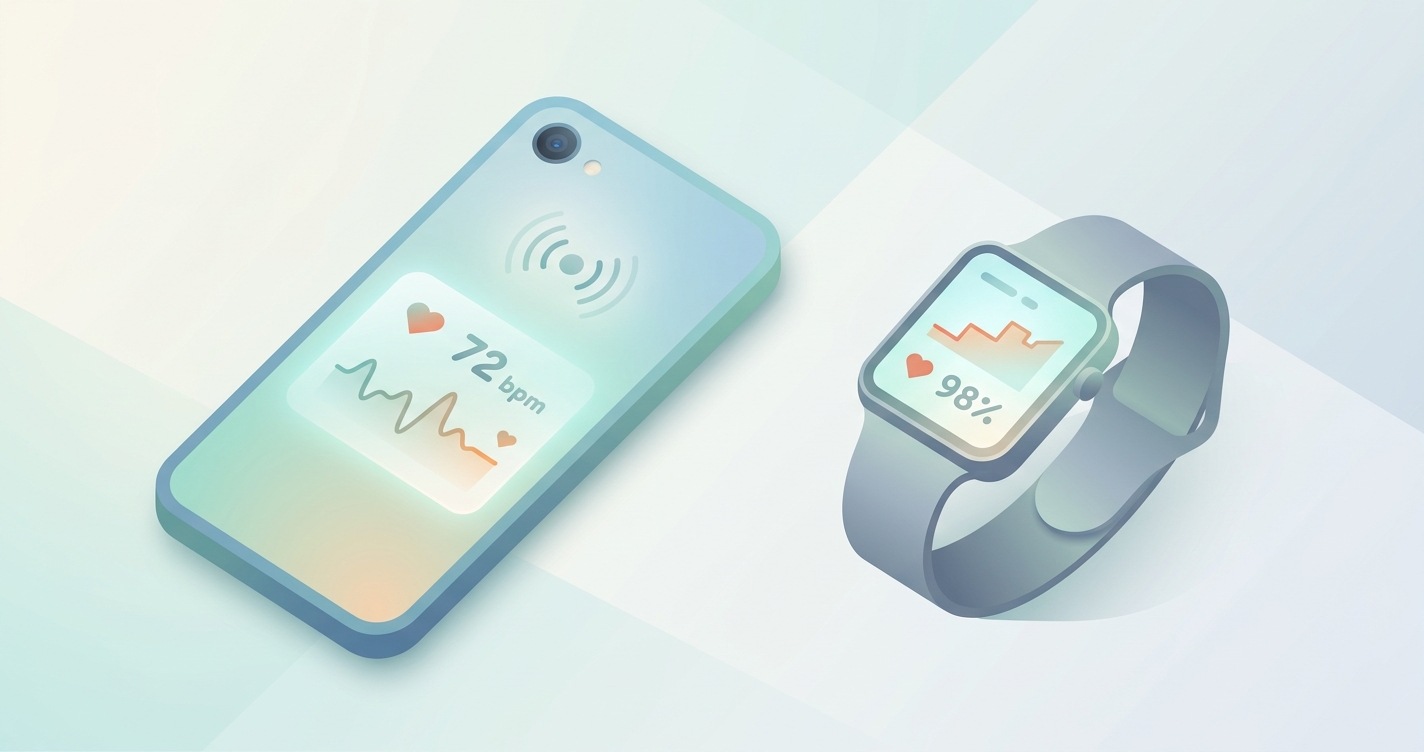
Procurement teams and global health researchers face a critical choice when designing remote patient monitoring systems: scaling hardware versus scaling software. While wristbands and smartwatches dominate consumer health in affluent markets, deploying physical devices to dispersed populations introduces logistical bottlenecks, from battery degradation to massive attrition rates. When analyzing contactless screening vs wearables for remote patients, program managers must evaluate unit costs, user compliance, and hardware longevity. In low-resource settings where charging infrastructure is unreliable, the distinction between continuous monitoring and intermittent, software-based screening becomes a central operational challenge.
"In underserved and low-resource communities, wearable device utilization hovers at just 14 percent compared to over 50 percent in general populations, largely due to prohibitive hardware costs and maintenance barriers." , National Institutes of Health Researchers, Equity in Digital Health Assessment, 2023
The core dilemma: contactless screening vs wearables
The fundamental difference between these two modalities lies in their deployment architecture. Wearable devices rely on a one-to-one operational model. Every single patient requires a dedicated unit, a dedicated power supply, and the technical literacy to operate, sync, and maintain the device. This model scales linearly, meaning that as a public health program expands from one thousand to one hundred thousand patients, the hardware procurement budget multiplies at the exact same rate.
Contactless screening, specifically utilizing smartphone camera-based photoplethysmography (PPG) or remote PPG (rPPG), operates on a one-to-many architecture. A single community health worker (CHW) equipped with a standard smartphone can capture vital signs from dozens of patients per day without attaching any physical sensors to their bodies. This shifts the operational burden from the patient to the health system. Instead of relying on a rural patient to charge a smartwatch and sync it to a network, the trained CHW manages the single piece of hardware.
The contactless remote patient monitoring market is projected to grow from $5.2 billion in 2025 to over $18.4 billion by 2032, driven heavily by the need to bypass the friction of hardware distribution. As algorithms become more efficient at analyzing subtle color changes in the human face to measure heart rate and respiratory function, the necessity for decentralized sensors diminishes.
| Feature | Wearable Monitors | Contactless (Camera-Based) |
|---|---|---|
| Deployment Architecture | One-to-one (device per patient) | One-to-many (device per CHW) |
| Marginal Cost Per Patient | High (requires individual hardware) | Near zero (software-based scaling) |
| Power Dependency | Patient-side (daily/weekly charging) | Provider-side (CHW charges phone) |
| Patient Compliance | High risk of attrition and abandonment | Minimal (passive point-in-time screening) |
| Maintenance Burden | Firmware updates across deployed fleet | Centralized app updates on CHW devices |
Key variables in low-resource operations
Implementing digital health interventions in low- and middle-income countries (LMICs) introduces environmental and systemic stressors that rarely appear in urban clinical trials. When evaluating the viability of vital signs tools for frontline workers, several critical failure points must be addressed:
- Hardware supply chains, import taxes, and procurement delays for electronic goods.
- Battery degradation in environments lacking reliable electrical grids.
- High rates of device abandonment due to user discomfort, cultural hesitancy, or technological friction.
- Data synchronization failures when rural patients lack continuous cellular or Wi-Fi connectivity.
- The logistical impossibility of retrieving, sterilizing, and redistributing smartwatches when patients cycle out of monitoring programs.
Wearables demand continuous patient compliance. If a device is uncomfortable, irritating to the skin during agricultural work, or simply forgotten on a bedside table, the data stream stops entirely. Contactless screening via a CHW's smartphone removes the compliance variable entirely. The patient merely sits for a brief, non-invasive scan during a routine home visit or pop-up clinic.
Industry applications for field operations
Different segments of global health delivery approach the contactless screening vs wearables debate based on specific programmatic goals.
Chronic disease management and triage
Non-communicable diseases, particularly hypertension and cardiovascular conditions, are rising rapidly in low-resource settings. Wearables provide continuous cardiovascular data, but the expense makes them impossible to distribute to an entire at-risk village. Contactless screening allows health workers to conduct rapid risk stratification. By using a smartphone camera to measure vital signs, a CHW can screen an entire community in a matter of weeks, identifying high-risk individuals and referring them to regional clinics without requiring a single blood pressure cuff or wearable tracker.
Maternal and postpartum health
Monitoring maternal health in remote villages requires tools that do not add stress or discomfort to the mother. Wearables can cause tactile irritation and require the mother to manage yet another task. Camera-based contactless vital signs tools allow community health workers to routinely check maternal heart rate and respiratory rate during standard check-ins. The zero-equipment approach is highly accepted because it requires no physical contact, respecting cultural boundaries and personal comfort.
Infectious disease monitoring
During infectious disease outbreaks, limiting physical contact between the provider and the patient is critical. Distributing wearables to infected populations requires strict sterilization protocols upon device retrieval. Contactless screening allows a health worker to measure respiratory rates and heart rates from a safe distance, often just a few feet away, using only the optical sensor on their mobile device. This reduces transmission risks while maintaining accurate clinical surveillance.
Current research and evidence
Clinical research increasingly highlights the operational friction of hardware-dependent remote monitoring. A 2023 study published in JCO Clinical Cancer Informatics evaluated the feasibility of wearable-based monitoring in active treatment cohorts. The researchers observed significant participant attrition, with dropout rates averaging 27% and reaching up to 65% in certain groups. The primary drivers of this attrition were technical exhaustion and discomfort with the physical device.
In low-resource environments, this attrition rate is compounded by economic factors. A comprehensive review by the National Institutes of Health found that wearable utilization in underserved communities remains exceptionally low, at just 14%, compared to the 50% to 60% adoption rates seen in higher-income populations. The upfront cost of hardware, combined with the necessity for digital literacy and reliable internet for synchronization, creates a massive equity gap.
By contrast, research into consumer-grade contactless vital signs monitors demonstrates that smartphone-based optical scanning can accurately match medical-grade devices for heart rate and respiratory rate. Because the computation happens directly on the mobile device or in the cloud via secure APIs, the quality of the screening improves iteratively with software updates, requiring no further hardware investments from the health program.
The future of contactless screening vs wearables
The trajectory of public health technology clearly favors centralized software over distributed hardware. As algorithmic accuracy improves, the justification for purchasing, shipping, and maintaining single-patient physical sensors becomes increasingly difficult to defend in budget-constrained environments.
The future of mobile health deployment relies on the "Bring Your Own Device" (BYOD) paradigm for community health workers. By transforming standard Android and iOS devices into diagnostic tools, ministries of health and non-governmental organizations can scale vital sign collection exponentially. Wearables will likely maintain a niche role in specialized clinical trials that absolutely demand minute-by-minute continuous data. However, for broad population health, early warning systems, and routine rural triage, zero-equipment software solutions will dominate the sector.
Frequently asked questions
What is the main cost difference between wearables and contactless screening?
Wearables require purchasing a physical device for every individual patient, creating massive linear costs, replacement budgets, and shipping logistics. Contactless screening uses the existing smartphones already carried by community health workers, driving the marginal cost per patient to near zero.
Do wearables provide better data than contactless methods?
Wearables provide continuous data over long periods, which is useful for highly specific cardiovascular monitoring. Contactless screening provides intermittent, point-in-time data (like a traditional clinic visit), which is generally sufficient for population triage, routine check-ups, and risk stratification without the compliance issues of continuous tracking.
How do battery constraints affect these technologies in low-resource settings?
Wearables require the patient to have access to electricity to charge the device daily or weekly. In areas with fragile power grids, this leads to high dropout rates. Contactless screening relies entirely on the community health worker's device, meaning only the provider needs to secure a reliable charging source, which is far easier to manage operationally.
Can contactless screening work without an internet connection?
Yes, depending on the software architecture. Many advanced mobile health applications are designed to process the optical data locally on the smartphone's hardware (edge computing). The vital signs data is saved offline and synchronized to national health databases once the health worker returns to an area with cellular connectivity.
For mobile health platforms and global health implementers seeking to bypass the logistical constraints of distributed hardware, Circadify is addressing this space with technology that integrates directly into existing applications. By relying on software algorithms rather than physical smartwatches, programs can capture zero-equipment vital signs directly through a community health worker's device, entirely eliminating patient-side hardware costs and battery concerns. To see how software-only solutions scale in low-resource environments, review these Deployment case studies.