Contactless Screening in Developing Nations: What It Means
How contactless screening developing nations programs use camera-based vitals to run high-volume, low-resource health checks without dedicated equipment.
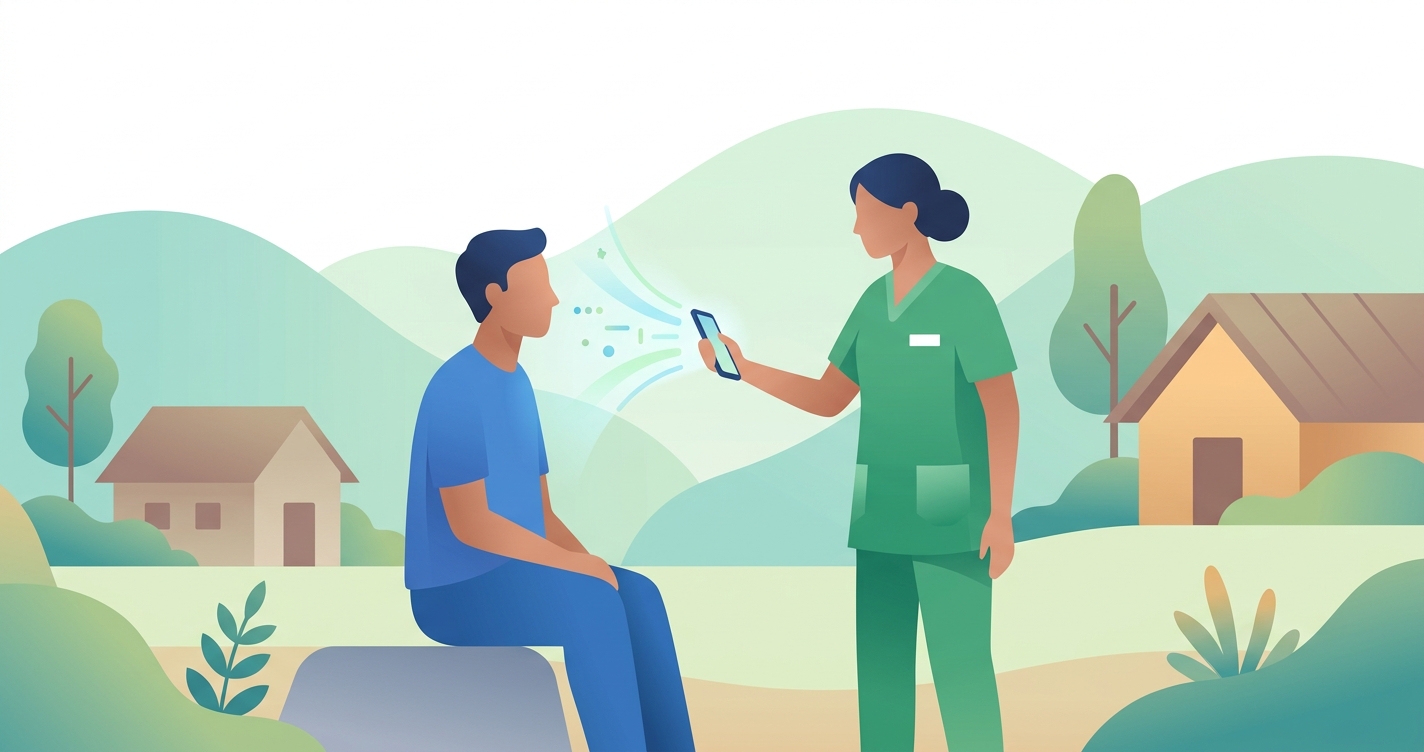
The hardest part of population health in many low-income countries is not treatment. It is the first measurement. Before anyone can be referred, counseled, or enrolled in a program, someone has to take a reading, and that single step depends on cuffs that drift out of calibration, batteries that die between villages, and consumables that run out mid-campaign. Contactless screening developing nations programs are now testing a different starting point: a camera, a phone already in a health worker's pocket, and a software model that reads physiological signals from the face and fingertip. For global health researchers and implementing partners, the question is no longer whether the signal exists, but whether equipment-free screening can carry the volume that field programs actually demand.
An estimated 1.4 billion adults aged 30 to 79 had hypertension in 2024, two-thirds of them in low- and middle-income countries, and roughly 600 million adults (44 percent) do not know they have it. - World Health Organization, 2023-2024
What contactless screening developing nations programs actually measure
Contactless screening, sometimes called touchless health screening or no-contact vitals, uses a standard camera to detect tiny color changes in skin caused by the cardiac cycle. The underlying method is remote photoplethysmography (rPPG). As light reflects off the face, blood volume in surface capillaries shifts the signal frame by frame, and a model reconstructs a pulse waveform from that variation. From the waveform, software can estimate heart rate, respiratory rate, and a set of derived indicators. No cuff touches the patient, and no probe is clipped on. The phone does the sensing.
This matters in a specific operational way. Camera-based screening removes the parts of a field workflow that fail most often: the hardware that has to be carried, charged, cleaned, calibrated, and replaced. A community health worker (CHW) who can run a check with a device they already own changes the cost structure of an entire campaign.
A systematic review of non-contact vision-based vital sign monitoring (Kolosov, Kelefouras and colleagues, University of Plymouth, 2023) reported that heart rate estimation from consumer cameras can reach high agreement with reference devices under good conditions, while respiratory rate and blood pressure estimates remain more sensitive to motion and lighting. That distinction shapes where the technology fits today: high-volume triage and risk sorting, not diagnosis.
How equipment-free screening compares to conventional field tools
The value of no-contact vitals shows up most clearly when set against the tools CHWs currently carry. The comparison below is operational, not a claim about diagnostic equivalence.
| Factor | Manual cuff and pulse oximeter | Portable electronic vitals kit | Camera-based contactless screening |
|---|---|---|---|
| Up-front cost per worker | Low to moderate | High | Very low (uses existing phone) |
| Consumables | Cuffs, probe covers, batteries | Batteries, probe covers | None |
| Calibration and maintenance | Periodic, often skipped | Frequent, specialized | Software updates only |
| Throughput per session | Limited by setup time | Moderate | High once workflow is set |
| Infection-control contact | Direct skin contact | Direct skin contact | No physical contact |
| Failure mode in the field | Drift, wear, loss | Battery, breakage | Lighting, motion, network |
| Training burden | Moderate | High | Low to moderate |
Several patterns stand out for program designers:
- The biggest savings are in logistics, not unit price. Eliminating consumables and calibration removes the recurring costs that quietly sink multi-year deployments.
- Throughput is the headline advantage. A screen that takes under a minute and needs no setup lets a single worker reach far more people per day.
- The failure modes change rather than disappear. Instead of dead batteries, the constraints become ambient light, patient movement, and intermittent connectivity.
- Contact-free workflow has real value in outbreak and crowded-clinic settings where reducing physical contact lowers transmission risk and speeds patient flow.
Industry applications
High-volume community campaigns
Mass screening events, school programs, and market-day outreach all share one problem: too many people, too little time. Equipment-free screening lets a small team run a first-pass risk sort, flagging elevated heart rate or other indicators for follow-up while everyone else moves through quickly. The goal is not to replace a confirmatory cuff reading but to decide who needs one.
Noncommunicable disease detection
The WHO reported in September 2023 that nearly half of adults with hypertension are unaware of their condition, and that over 40 countries have adopted the HEARTS technical package, enrolling more than 17 million people in treatment. The bottleneck in most of these programs is finding undiagnosed cases. Camera-based screening offers a low-friction entry point to that funnel, particularly where cuffs are scarce or shared across many workers.
Integration with disease-specific programs
Touchless health screening can attach to existing vertical programs rather than competing with them. A CHW conducting an HIV or TB visit can add a rapid vitals check at the same touchpoint, building a fuller picture without extra equipment. The marginal cost of one more reading approaches zero when the sensor is a phone the worker already carries.
Remote and disrupted settings
In areas cut off by flooding, conflict, or distance, the lightest possible toolkit wins. A screening method with no consumables and no dedicated hardware is easier to pre-position, harder to break, and simpler to replace than a kit of electronic devices.
Current research and evidence
The evidence base for contactless screening developing nations use is maturing, but it carries clear caveats. Work on smartphone-based rPPG, including evaluations of applications such as WellFie published on medRxiv, reports strong heart rate agreement in controlled conditions. A 2023 reliability study (published via PubMed) found that rPPG accuracy drops sharply at elevated heart rates and under low illumination, which are common conditions in real field work.
Three themes run through the recent literature:
- Heart rate is the most robust output. Respiratory rate, blood pressure, and heart rate variability are more fragile and more dependent on conditions.
- Skin tone, lighting, and motion introduce bias if models are not trained on diverse populations. For programs serving predominantly darker-skinned populations, dataset representativeness is a procurement question, not a footnote.
- Most validation has happened in controlled or high-resource settings. Field studies in the actual deployment environments of low-resource programs are still relatively few.
For researchers, the practical implication is to treat camera-based screening as a triage layer with measured sensitivity and specificity against a local reference, and to design pilots that report performance by skin tone, lighting, and connectivity rather than a single pooled accuracy number. Independent field validation, not vendor specification sheets, should anchor any deployment decision.
The future of contactless screening in low-resource health
The direction of travel is toward edge processing and broader physiological coverage. On-device models that run without a constant network connection would remove one of the main field constraints, letting workers screen in areas with no signal and sync later. Deep learning approaches reviewed in Frontiers (2024) are pushing toward better performance in low light and across diverse skin tones, which is exactly where current methods are weakest.
Two developments would matter most for implementers. First, transparent reporting standards so that programs can compare tools on the same terms instead of marketing claims. Second, interoperability with the data systems CHWs already use, so a contactless reading flows into the same record as everything else rather than living in a separate app. The technology will be judged less on peak laboratory accuracy and more on whether it holds up across thousands of real screenings in dust, heat, crowds, and poor light.
Frequently asked questions
Is contactless screening accurate enough to replace a blood pressure cuff?
Not as a diagnostic replacement today. The strongest evidence supports camera-based methods as a triage and risk-sorting layer, with confirmatory readings done on a reference device for anyone flagged. Heart rate estimation is the most reliable output; blood pressure and respiratory rate are more condition-dependent.
What conditions cause contactless screening to fail in the field?
Low or uneven lighting, patient movement, very high heart rates, and poor camera quality all degrade the signal. Connectivity can also be a limit if processing happens in the cloud rather than on the device. Programs should test under their own real-world conditions before scaling.
Does skin tone affect camera-based screening?
It can. Models trained mostly on lighter-skinned populations may perform worse on darker skin. Any program serving diverse or predominantly darker-skinned populations should require performance data broken down by skin tone and prioritize tools trained on representative datasets.
How does contactless screening help high-volume, low-resource programs specifically?
It removes consumables, calibration, and dedicated hardware, which are the recurring costs and failure points that derail long campaigns. That lets a small team screen more people per day using phones they already carry, reserving scarce confirmatory equipment for those who need it.
Circadify is working in this space, building zero-equipment vital signs approaches aimed at community health workers operating far from clinics. Global health researchers and implementing partners who want to see how these methods perform in real programs can review deployment case studies and the contactless screening overview in the global health section at circadify.com/blog.