Can my family's health be screened for problems without touching any equipment?
How contactless screening in developing nations lets community health workers check family vital signs with no cuffs, probes, or clinical hardware in the field.
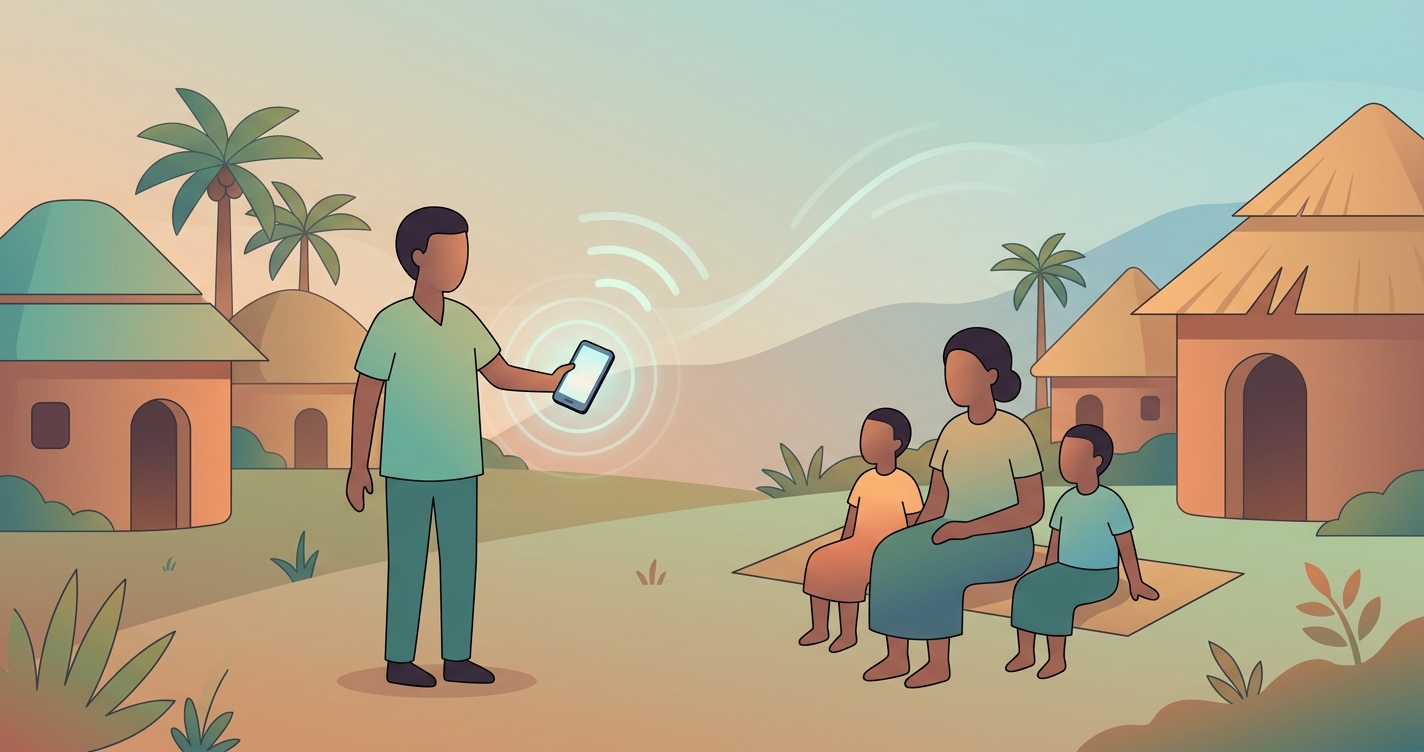
For a family living hours from the nearest health post, the question of whether anyone's health can be checked without specialized equipment is not academic. It is the difference between an early warning and a missed crisis. The premise behind contactless screening in developing nations is straightforward: if a smartphone camera can read the subtle signals a body already broadcasts, a community health worker can screen an entire household without carrying a single cuff, probe, or battery-powered monitor. For global health researchers studying how to extend coverage into the last mile, this shift from equipment-dependent to equipment-free screening reframes what a field visit can accomplish.
"Heart rate measurement via remote photoplethysmography is considerably reliable, with reported accuracies between 92% and 98% under controlled conditions," reported a 2023-2024 synthesis of smartphone rPPG studies, signaling that camera-based vital signs are no longer purely experimental.
What contactless screening in developing nations actually means
Contactless screening in developing nations rests largely on a technique called remote photoplethysmography, or rPPG. A standard phone camera records short video of a person's face. Software then detects minute color changes in the skin caused by blood flowing beneath it with each heartbeat. From that signal, algorithms estimate heart rate, respiratory rate, and in some implementations heart rate variability and oxygen saturation. No sensor touches the patient. No consumable is used. No device needs charging beyond the phone the health worker already carries.
This matters because the traditional screening kit is the bottleneck. A blood pressure cuff drifts out of calibration. A pulse oximeter needs replacement probes. A thermometer needs covers. Each item is a procurement line, a cold-chain or storage concern, and a failure point in dust, heat, and humidity. Removing the hardware removes most of those failure points at once. A review by Cheng and colleagues published in Sensors (2022) catalogued the breadth of parameters rPPG can target, while noting that motion, lighting, and skin tone remain the central engineering challenges before field-grade reliability is universal.
The honest framing is this: contactless screening is a triage and risk-stratification tool, not a diagnostic replacement. It sorts people into "looks fine" and "needs a closer look." For a health system where the alternative is no measurement at all, that sorting function carries real value.
How it compares to conventional field screening
The trade-offs become clearer when contactless methods sit beside the equipment-based and clinic-based options a program actually chooses between.
| Approach | Equipment burden | Cost per added site | Reliability concern | Best fit |
|---|---|---|---|---|
| Contactless smartphone (rPPG) | Phone only | Very low | Motion, lighting, skin tone, BP still maturing | High-volume household and community screening |
| Portable device kit (cuff, oximeter, thermometer) | Multiple devices plus consumables | Moderate to high | Calibration, breakage, supply chain | Confirmatory checks at health posts |
| Fixed clinic equipment | Full clinical inventory | Very high | Patient must travel to facility | Diagnosis and treatment initiation |
| No screening (status quo gap) | None | None | Conditions found late or never | Not acceptable, but common |
The pattern global health researchers tend to notice is that contactless and equipment-based screening are complements, not rivals. Contactless tools widen the funnel at the household level; portable and clinic equipment confirm and act on the flagged cases.
Key advantages that make the approach attractive for low-resource deployment include the following:
- Zero added hardware means a health worker can screen a whole family in one visit without unpacking or sanitizing devices between people.
- Marginal cost of screening one more person approaches zero once the phone and app are in hand.
- Hygiene improves because nothing contacts multiple patients, which matters during outbreaks.
- Training time shrinks when there is no device technique to master, only a camera to point.
- Data can be captured digitally at the moment of measurement rather than transcribed from a dial.
The recurring limitations are equally important to state plainly:
- Blood pressure estimation from a camera is not yet dependable enough for standalone screening and needs further development, as multiple 2023-2024 studies caution.
- Accuracy varies across skin tones and lighting, which demands diverse validation rather than assumptions.
- Patient movement degrades the signal, so a still, cooperative subject still matters.
Industry applications in low-resource settings
Household and family screening
The original question, whether a whole family can be checked without equipment, is exactly where contactless methods fit best. A community health worker visiting a home can capture readings for a child, a parent, and an elderly grandparent in sequence using one phone. The visit produces a digital record for each person and flags anyone whose readings fall outside expected ranges for follow-up. This turns a single field visit into multi-person screening without the logistics of carrying and cleaning shared devices.
Disease program integration
Large vertical programs are exploring contactless screening as a low-friction first touchpoint. Respiratory rate and heart rate captured passively can support symptom triage in TB and HIV program workflows, where the bottleneck is often the number of people a team can assess per day rather than the science of treatment. Reducing the friction of that first measurement lets programs screen more contacts and route them faster.
Outbreak and crisis response
When equipment supply chains break, in floods, conflict, or displacement, a hardware-free method keeps screening running. Researchers working in displacement and refugee settings have long flagged shared-device hygiene and breakage as operational headaches. A camera-based reading sidesteps both, which is why crisis-response teams are watching the technology closely.
Current research and evidence
The evidence base is growing but uneven. A 2022 review of rPPG for vital signs monitoring, published across Sensors and Frontiers in Physiology, reported strong heart rate agreement with contact sensors, with some studies citing correlation coefficients near 0.98 for heart rate and around 0.95 for respiratory rate, alongside low mean absolute errors of roughly 2 beats per minute and under 2 breaths per minute in controlled conditions. Those numbers are encouraging, but the qualifier "controlled conditions" carries weight. Field environments introduce variable light, movement, and a far wider range of skin tones than many study samples represented.
Validation work on smartphone applications, such as the WellFie accuracy study posted on medRxiv, has moved testing closer to real-world use, comparing app-derived readings against reference monitors. The consistent finding is a hierarchy of maturity: heart rate is the most reliable parameter, respiratory rate is close behind, oxygen saturation is improving, and blood pressure remains the hardest problem and the least ready for unsupervised screening.
Equity research adds a second layer. A 2023 analysis of remote monitoring access in underserved communities, published through the National Institutes of Health, found that the populations most likely to benefit from low-cost remote tools are also those most often left out of the validation data. For researchers, the implication is direct: a contactless tool is only as trustworthy as the diversity of the population it was tested on. Encouragingly, one 30-country survey found digital health literacy was often higher in lower-income countries than assumed, suggesting adoption barriers may be smaller than feared.
The future of contactless screening developing nations programs
The near-term trajectory points toward layered systems rather than a single hero technology. Contactless screening becomes the wide top of the funnel, integrated with digital health records and standard field-data platforms so that flagged cases flow automatically to a health worker's queue. Three developments are worth tracking:
- Algorithm improvements using deep learning that explicitly correct for skin tone and motion, narrowing the gap between lab and field performance.
- Tighter integration between camera-based capture and the data systems ministries already run, so screening results are not stranded on a single phone.
- Larger, geographically diverse validation studies conducted in the settings where the tools will actually be used, not only in controlled clinical environments.
The most likely outcome is not that contactless screening replaces equipment. It is that it absorbs the high-volume screening burden so that scarce equipment and clinical time are reserved for the people who genuinely need them. For a family that has never been able to get checked at all, that reallocation is the practical breakthrough.
Frequently asked questions
Can a phone camera really screen my whole family without any device touching them? Yes, for several vital signs. Remote photoplethysmography uses the camera to read heart rate and respiratory rate from skin color changes, so a health worker can screen each family member in turn with no contact. It is a screening and triage tool that flags who needs a closer clinical look, not a full diagnostic exam.
Is contactless screening accurate enough to trust? Heart rate is the most reliable, with studies reporting accuracy between 92% and 98% in controlled conditions. Respiratory rate is close behind. Blood pressure from a camera is still maturing and is not recommended as a standalone measure yet. Accuracy depends on good lighting, a still subject, and validation across diverse skin tones.
Why does this matter most in developing nations? Because the hardware itself is often the barrier. Cuffs lose calibration, probes break, and consumables run out. Removing equipment removes those failure points and drops the cost of screening one more person close to zero, which lets community health workers reach far more families.
What conditions can it help detect? Contactless screening supports early flags for cardiovascular and respiratory risk through heart rate and breathing patterns, and it is being integrated into TB and HIV program triage. It identifies people who should receive confirmatory testing rather than delivering a final diagnosis.
Circadify is building toward this exact space, zero-equipment vital signs designed for community health workers in the field. Global health teams evaluating how contactless methods perform in real deployments can review deployment case studies and field findings in the global health section at circadify.com/blog.