How Community Health Workers Screen for Hypertension Without a Cuff
An evidence-based analysis of how community health workers are using cuffless and smartphone-first workflows to triage hypertension risk in low-resource settings.
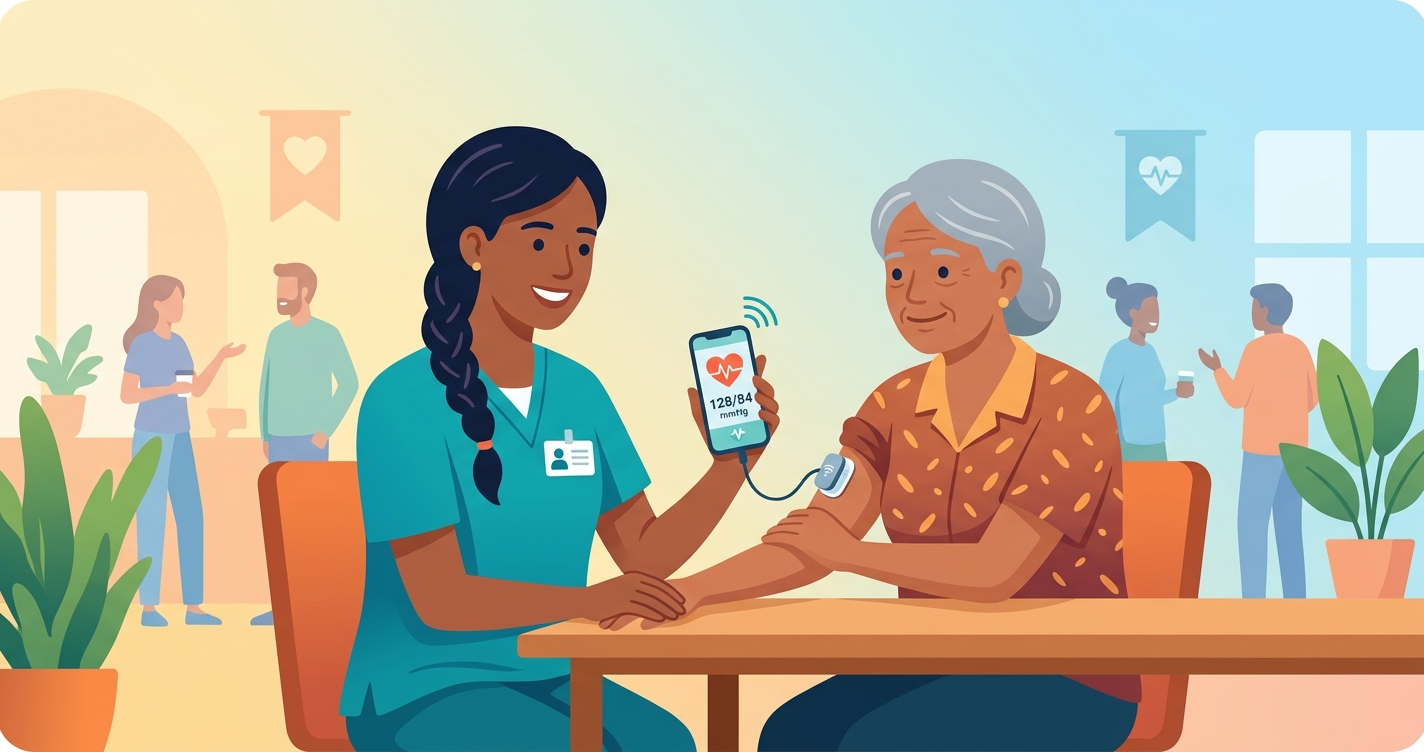
Community health workers screen hypertension without a cuff only in a very specific sense: they use smartphone-first tools to sort people into risk groups and decide who needs confirmatory blood pressure measurement, not to replace clinical diagnosis. That distinction matters. In low-resource settings, where cuffs break, calibration slips, batteries disappear, and a facility may be hours away, cuffless screening has become interesting because it reduces equipment burden at the first point of contact while still feeding patients into formal care pathways.
“Many cuffless devices have not yet demonstrated sufficient precision and reliability for clinical use.” — American Heart Association scientific statement on cuffless blood pressure devices, 2025
Community Health Workers Screen Hypertension Without a Cuff by Changing the Workflow
The old model of community hypertension screening was straightforward but heavy: send a worker into the field with a cuff, train them on positioning and repeat measurement, then build a replacement and calibration plan around the device. The newer model is lighter. A community health worker uses a phone camera, motion sensor, or pulse-wave app to identify elevated risk, then refers the person for a cuff-based reading at a clinic, outreach post, or supervisor station.
That shift is happening because the hypertension burden is still massive. The World Health Organization estimated in 2024 that 1.4 billion adults aged 30 to 79 were living with hypertension, and about two-thirds were in low- and middle-income countries. Only about 23% had the condition under control. For programs trying to reach people before stroke, heart failure, or kidney disease appear, screening coverage is the real bottleneck.
Grace Wambura Mbuthia, Karani Magutah, and Jennifer Pellowski made that point from a different angle in their 2022 BMJ Open systematic review of community health worker hypertension interventions in LMICs. Their review found that CHW-led models consistently improved blood pressure reduction, linkage to care, and treatment adherence. In other words, the worker model already works. The question is whether the tool kit can get simpler without losing referral quality.
Comparison of Field Screening Models for Hypertension
| Dimension | Traditional Cuff-Based Screening | Smartphone Risk Triage | Hybrid Workflow |
|---|---|---|---|
| Primary tool | Automated BP cuff | Camera, sensor, or pulse-wave app | Phone for triage, cuff for confirmation |
| Best use | Diagnosis and follow-up | Rapid first-pass screening | Community campaigns and stepped referral |
| Training load | Moderate to high | Lower on device handling, higher on environment checks | Moderate |
| Calibration burden | Ongoing | Minimal hardware calibration | Limited to shared cuff pool |
| Speed in field | Slower per person | Faster first-pass screening | Moderate |
| Clinical role | Measurement | Risk stratification | Screening plus confirmation |
| Main weakness | Device supply chain | Accuracy limits for diagnosis | Requires referral handoff discipline |
| Program fit | Facility or well-supported outreach | Large-scale community outreach | Most realistic near-term model |
The hybrid model is the one showing up most often in serious program design discussions. It gives health workers a low-friction front door while preserving the clinical requirement for proper confirmation.
Why Cuffless Screening Appeals in Low-Resource Settings
Programs do not look at cuffless screening because cuffs are obsolete. They look at it because field reality is messy.
- Devices get lost, damaged, or borrowed for other uses
- Different cuff sizes are hard to maintain in dispersed programs
- Calibration schedules are rarely followed outside tightly supervised pilots
- CHWs often work in homes, markets, schools, or transport hubs where set-up time matters
- Large screening campaigns need faster throughput than one-device-per-worker models allow
Tazeen H. Jafar and colleagues showed the value of the CHW channel in the COBRA-BPS trial, published in the New England Journal of Medicine in 2020. Across 2,550 people with hypertension in rural communities in Bangladesh, Pakistan, and Sri Lanka, the multicomponent intervention used community health workers for home visits, blood pressure follow-up, and lifestyle coaching. The intervention produced a meaningful drop in systolic blood pressure at the community level. The lesson was not that cuffs are unnecessary. It was that bringing screening closer to households changes outcomes.
Cuffless tools build on that same logic. They make the first interaction easier to deploy, especially when the goal is to find likely cases, not settle treatment decisions on the spot.
What the Current Research Actually Supports
The evidence for smartphone-based or cuffless blood pressure screening is promising, but it is uneven.
Ramakrishna Mukkamala, Sanjeev Shroff, and Vishaal Dhamotharan at the University of Pittsburgh reported in Scientific Reports in 2024 that a smartphone app using built-in sensors could estimate pulse pressure within roughly 8 mmHg of conventional cuff readings. That is an important engineering signal because it suggests consumer hardware can support meaningful cardiovascular screening workflows.
Still, it does not solve the entire problem. Pulse pressure is not the same as full diagnostic blood pressure measurement, and controlled-study performance does not automatically survive heat, glare, movement, older phones, or hurried field conditions.
That is why the American Heart Association's 2025 scientific statement is so useful here. It drew a firm line: cuffless devices are not yet ready to replace cuff-based measurement for diagnosing or managing hypertension. For global health implementers, that warning is not a reason to ignore the technology. It is a reason to place it correctly in the care pathway.
A realistic reading of the literature looks like this:
- CHW-led hypertension programs work well in LMICs
- Smartphone and cuffless tools can lower operational friction at the screening stage
- Referral quality matters more than novelty
- Diagnostic confirmation still belongs with validated cuff-based measurement
Industry Applications in Community Health Programs
Household Screening and Early Referral
In rural screening campaigns, the biggest gain may be reach. A CHW who can do quick smartphone-based triage during a household visit can flag people who would otherwise never travel for a routine check. That matters because hypertension is often silent until complications appear.
Maternal and Women's Health Programs
Programs focused on pregnancy and postpartum care are especially interested in low-friction cardiovascular screening. A smartphone-first workflow can help identify women who need immediate follow-up for possible hypertensive disorders, even if the confirmatory reading has to happen at a facility or with a supervisor.
Integrated NCD Campaigns
Many ministries and implementing partners are moving away from single-disease outreach. Screening for hypertension now sits beside diabetes risk, respiratory symptoms, and general cardiovascular counseling. A cuffless triage layer makes that broader package easier to run when each additional device increases cost and logistics.
Current Research and Evidence
The research base is strongest when it focuses on delivery systems rather than hype.
Mbuthia, Magutah, and Pellowski's 2022 review is useful because it looks across many CHW hypertension interventions in LMICs and shows consistent benefit in blood pressure control and care linkage. Jafar's COBRA-BPS trial is important because it demonstrates what structured community follow-up can do at scale in South Asia. WHO's 2024 hypertension update provides the population-level urgency. And Mukkamala's 2024 engineering work shows why implementers keep revisiting the possibility of cuffless triage.
Taken together, the evidence points to a narrow but practical conclusion: cuffless screening is becoming a workable first-pass tool for community programs, especially where hardware scarcity blocks coverage. It is not yet a substitute for proper blood pressure measurement.
Two other realities keep coming up in deployment conversations:
- Environmental conditions still matter a lot for camera-based measurement
- Validation across skin tones, age groups, and low-cost Android devices remains essential
- Program managers need audit trails showing when a phone-based triage result triggered referral
- Supervisors need a small pool of validated cuffs to close the loop on positive screens
These are boring details, but this is where programs succeed or fail.
The Future of Hypertension Screening Without a Cuff
The near future probably does not belong to a magical cuffless replacement. It belongs to layered workflows.
The most plausible model is a stepped pathway: a CHW uses a smartphone to collect cardiovascular signals, the app sorts people into low, medium, or high follow-up priority, and confirmatory measurement happens later in the same day or during the next facility touchpoint. That approach fits how real health systems absorb innovation. Slowly. Imperfectly. With backup plans.
If validation studies continue to improve, smartphone-first screening could do three things especially well in low-resource settings: widen coverage, reduce equipment dependence, and give supervisors better visibility into who was screened and referred. Those are meaningful gains even before the technology reaches diagnostic-grade performance.
For teams already exploring how community health workers collect vital signs in the field and zero-equipment vital signs workflows, hypertension screening is the next hard test. It forces programs to balance access, accuracy, and referral discipline all at once.
FAQ
Can community health workers diagnose hypertension without a cuff?
No. Current evidence supports cuffless tools as screening or triage aids, not as replacements for validated blood pressure measurement used in diagnosis and treatment.
Why are programs interested in cuffless hypertension screening at all?
Because cuffs create logistical drag in the field. Smartphone-first screening can expand coverage, shorten encounter time, and reduce equipment management in dispersed community programs.
What does the research say about CHW-led hypertension programs?
The strongest evidence is that CHW-led interventions improve blood pressure control, referral, and adherence in LMICs. The newer question is how smartphone and cuffless tools can make those programs easier to scale.
What is the safest way to use cuffless tools in global health programs?
Use them as the first step in a hybrid workflow: quick community triage by phone, then confirmatory cuff-based measurement for anyone flagged as at risk.
Programs across global health are looking for ways to expand screening without adding more fragile hardware. Solutions like Circadify are being developed for smartphone-based physiological screening workflows that can support those field models. For broader context on mobile-first health deployment, visit the Circadify global health blog.