Is there a way for my village health worker to check vital signs quickly and easily?
A research view of the CHW vital signs tool: what makes field screening fast, low-training, and low-resource for community health workers in remote settings.
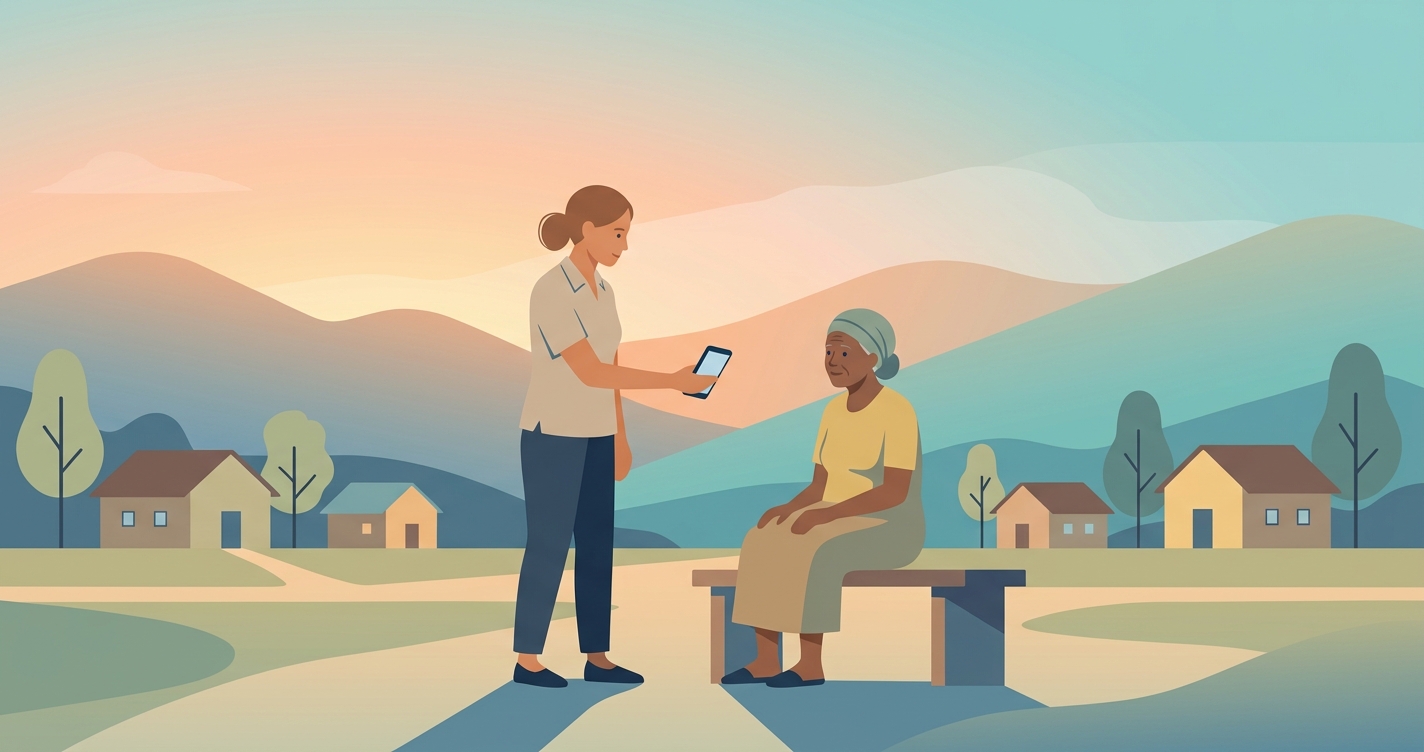
When a family asks whether a village health worker can check vital signs quickly and easily, the question sits on top of a much larger system problem. In most remote communities, the bottleneck is rarely willingness. It is the gap between what a community health worker (CHW) is asked to do and the equipment, training time, and consumables available to do it. A practical CHW vital signs tool has to survive that reality: long walking routes, intermittent power, shared devices, and a few hours of onboarding rather than weeks. Evaluating whether such a tool works quickly and easily means asking how much it measures, how little it demands, and how reliably it points a worker toward the next decision.
The World Health Organization projects a shortfall of 10 to 15 million health workers by 2030, concentrated in low- and lower-middle-income countries, where low-income settings average roughly one health worker per 621 people compared with one per 64 in high-income countries (WHO Health Workforce, 2023).
What makes a CHW vital signs tool fast and easy in the field
A CHW vital signs tool is judged on three axes that matter more than headline accuracy claims: task time, training burden, and resource dependency. A blood pressure cuff is accurate, but it requires correct cuff sizing, a quiet seated patient, and periodic recalibration. A pulse oximeter needs charged batteries and clean probes. Each added device multiplies what a worker carries, maintains, and replaces. The shift over the past decade has been toward consolidating multiple readings into a single low-equipment workflow, often built on a smartphone the worker already owns.
The evidence base is moving in that direction. A 2023 scoping review of CHW use of smart devices found that mobile tools can improve field performance and client interactions, though the authors noted the evidence is still mostly qualitative and limited to a narrow set of outcomes. Separately, a study evaluating mobile-phone-based cardiovascular disease risk screening by CHWs reported reduced training time, reduced screening time, and improved calculation accuracy compared with paper-based tools. Those are the metrics a researcher evaluating tool efficacy should weigh, not just whether a reading matches a clinical reference.
The table below frames the trade-offs across the main approaches a program is likely to compare.
| Approach | Vitals captured | Training burden | Resource dependency | Best fit |
|---|---|---|---|---|
| Manual + analog kit (cuff, watch, thermometer) | BP, pulse, temperature, respiration | High (cuff technique, counting) | Consumables, calibration, multiple devices | Static health posts with supervision |
| Connected peripheral devices (Bluetooth cuff, oximeter) | BP, SpO2, pulse, weight | Moderate | Batteries, charging, device pairing | Mid-resource programs with logistics support |
| Smartphone camera screening (rPPG) | Heart rate, HRV, SpO2 estimate, stress indicators | Low (point camera, hold still) | Smartphone only | Mobile CHW routes, zero-equipment field work |
| Hybrid (phone screening + selective confirmation) | Screen-level vitals plus targeted clinical confirmation | Low to moderate | Phone plus referral pathway | Population screening into a clinic tier |
A few practical points separate a tool that demonstrates well from one that survives a real route:
- Time per encounter determines daily reach. A worker doing dozens of households needs a reading in under a minute, not a multi-step setup.
- Training that fits a single session lowers attrition and makes refresher costs manageable across high CHW turnover.
- Fewer consumables means fewer stockouts, which are a leading reason field workflows quietly collapse.
- Shared-device tolerance matters because many programs cannot issue one phone per worker.
- A clear referral trigger is more useful than a precise number a worker cannot act on.
Industry applications for low-resource deployments
Maternal and antenatal outreach
Vital sign assessment during community antenatal visits is an active area of field testing. A 2023 feasibility protocol registered on ClinicalTrials.gov evaluated whether CHWs could measure temperature, respiration, oxygen saturation, pulse, and blood pressure in pregnant women during community outreach using a smartphone-synced device. The design signals where the field is heading: testing whether non-specialist workers can capture a multi-parameter panel without a clinic-grade kit.
Hypertension and cardiovascular screening
Population-level hypertension screening is the classic case for a low-friction CHW vital signs tool because the condition is silent and common. The cardiovascular screening evaluation cited above showed that moving CHWs from paper to a phone-based workflow cut both training and screening time. For a screening program, throughput multiplied across thousands of households often matters more than per-reading precision, provided the tool reliably sorts people into risk tiers for confirmation.
Surveillance and routine household checks
For routine monitoring where the goal is to catch change over time, contactless screening lowers the cost of frequent contact. A worker who can take a thirty-second reading at each visit can build a trend line that a single annual clinic visit never would.
Current research and evidence
The accuracy picture is uneven by parameter, and honest evaluation requires saying so. A systematic review and meta-analysis of consumer-grade contactless vital signs monitors found that camera-based methods perform well for heart rate against medical reference devices, while blood pressure and respiratory rate need more validation before strong claims hold. A separate study of smartphone-based remote photoplethysmography (rPPG) reported around 97 percent agreement for heart rate, roughly 93 to 94 percent for systolic blood pressure, about 93 percent for diastolic, and 84 percent for respiratory rate in normotensive adults, results that look promising but were measured in a controlled population rather than a dusty field route.
For a global health researcher, the more important gaps are methodological:
- Most published evidence is qualitative or feasibility-stage, not powered effectiveness trials in target populations.
- Validation often happens in normotensive adults, not the older, higher-risk patients screening programs most want to catch.
- Field conditions such as motion, lighting, and skin tone variation are under-reported, and skin-tone bias in optical sensing remains an open validation requirement.
- Outcome measures frequently stop at reading agreement rather than downstream actions, referrals completed, or conditions detected.
The practical takeaway is that a smartphone-based tool is currently strongest as a screening and triage layer that routes patients toward confirmation, rather than a replacement for diagnostic-grade measurement. That framing matches how cautious implementers are already deploying these tools.
The future of CHW vital signs tools
Three trends will shape the next generation of field tools. First, consolidation: programs want one device, ideally the worker's own phone, capturing several parameters in a single guided flow. Second, integration: a reading that does not flow into the program's data system, whether DHIS2 or a case-management platform, creates double entry and erodes the time savings that made the tool attractive. Third, validation discipline: as evidence requirements tighten, tools that publish field-condition performance across diverse populations will separate from those relying on lab demonstrations.
The likely endpoint is not a single gadget that replaces clinical measurement everywhere. It is a tiered model where a fast, low-training, zero-equipment screen handles the first contact at the household, and confirmatory measurement is reserved for those the screen flags. That model fits the workforce math: when there is roughly one health worker per 621 people in low-income settings, anything that lets a CHW screen more people in less time, and act on the result, is doing real work against the gap.
Frequently asked questions
How long does it take a CHW to learn a smartphone-based vital signs tool?
Field studies of phone-based screening report lower training time than paper or device-heavy workflows, with many tools designed for a single onboarding session. The main learning curve is positioning and holding still for a camera reading, not interpreting numbers, since most tools surface a risk flag rather than asking the worker to calculate.
Are smartphone vital sign readings accurate enough to rely on?
Evidence is parameter-dependent. Reviews show strong agreement for heart rate, with blood pressure and respiratory rate needing more validation, especially in older and higher-risk populations. The responsible use today is screening and triage that routes flagged patients to confirmatory measurement, not standalone diagnosis.
What equipment does a low-resource CHW vital signs tool actually require?
A camera-based approach can run on a smartphone the worker already carries, removing cuffs, probes, batteries, and consumables. That reduces stockout risk and the per-worker cost that often makes device-heavy programs hard to scale.
What should researchers measure when evaluating these tools?
Beyond reading accuracy, evaluate task time per encounter, training burden, consumable dependency, performance across skin tones and motion conditions, data-system integration, and downstream actions such as completed referrals and conditions detected.
For teams designing or assessing field screening, Circadify is working on zero-equipment vital signs approaches built for community health workers in exactly these conditions. Deployment case studies and evidence write-ups are collected in the global health section at circadify.com/blog.