How can my child's health be monitored daily without ever leaving our village?
How a CHW vital signs tool on a basic phone lets community health workers monitor children at home, cutting travel and closing follow-up gaps in rural programs.
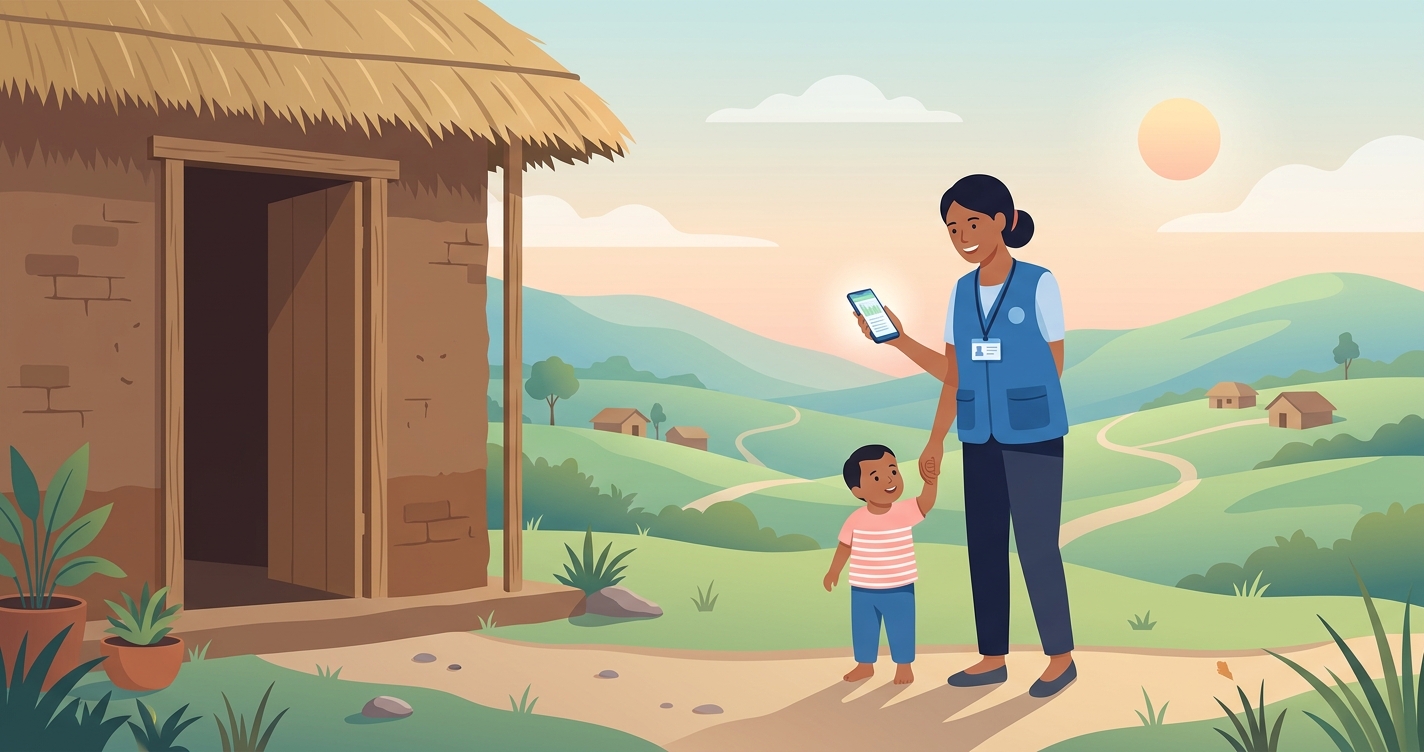
For families living hours from the nearest health post, the hardest part of caring for a sick child is rarely the diagnosis. It is the journey. A caregiver who suspects fever, fast breathing, or dehydration faces a choice between a full day of lost wages and a long walk, or waiting and hoping. A CHW vital signs tool, running on the phone a community health worker already carries, is starting to change that calculation. Instead of pulling families toward a distant clinic, the monitoring comes to the doorstep, repeated as often as the child's condition requires. For USAID and PEPFAR implementers measuring cost per contact and follow-up completion, this shift from facility-bound to community-based monitoring is one of the more practical efficiency gains available in the current portfolio.
A March 2024 multi-country survey of community health workers, published in PLOS Digital Health, found consistent positive associations between training on digital tools, the use of those tools, and CHWs' own belief that the tools improved the care they delivered.
What a CHW vital signs tool actually does in the field
The phrase covers a range of approaches, but the common idea is simple: equip a frontline worker to capture a child's basic health signals during a routine home visit, store them on the device, and sync them to a program database when a signal is available. The most familiar versions pair a smartphone app with a small peripheral. The most recent versions push further, using the phone's own camera and sensors to estimate signs such as heart rate and respiratory rate with no extra hardware to lose, charge, or replace.
This matters because the bottleneck in child health programs is usually not the science of treatment. It is the friction at the first point of contact. A 2023 feasibility study of vital sign assessment by community health workers during antenatal outreach, registered on ClinicalTrials.gov, tested a smartphone-synced device for pulse, respiratory rate, SpO2, blood pressure, and temperature, with the explicit aim of bringing measurement to people who would otherwise go unmeasured. The same logic applies to children: a sign captured at home is worth more than a more precise sign that never gets taken because the family could not travel.
A useful way to frame the decision for implementers is to compare the monitoring models a program can choose between.
| Monitoring model | Travel burden on family | Frequency possible | Equipment cost per CHW | Best suited for |
|---|---|---|---|---|
| Facility visit only | High (hours of travel) | Low (monthly or less) | None for CHW | Confirmatory care, treatment |
| CHW with standalone devices | Low | Medium | Moderate to high (cuffs, oximeters, batteries) | Programs with strong supply chains |
| CHW with phone plus peripheral | Low | High | Moderate (peripheral upkeep) | Mixed-connectivity districts |
| Zero-equipment CHW vital signs tool | Low | High (daily if needed) | Low (phone only) | Dispersed, hard-to-reach villages |
The bottom row is where the operational appeal concentrates. When a tool needs only a phone, the recurring costs that quietly sink pilots, replacement cuffs, oximeter probes, calibration, spare batteries, shrink toward zero. A 2024 review of digital health for rural settings repeatedly named cost of devices as a primary barrier to CHW adoption, which is exactly the line item a zero-equipment approach removes.
Key practical advantages reported across field deployments include:
- Monitoring can repeat as often as a child's condition warrants, rather than waiting for the next scheduled clinic day.
- Caregivers avoid lost income and transport costs, which improves consent and return rates.
- Readings are time-stamped and tied to a household, building a longitudinal record instead of isolated snapshots.
- Workers carry less, which reduces theft, breakage, and the logistics of charging multiple devices off-grid.
- Abnormal readings can trigger referral only when needed, keeping scarce facility capacity for genuine cases.
Industry applications for implementers
Integrated child health and nutrition programs
Daily or near-daily monitoring fits naturally into management of childhood illness at the community level. A worker visiting a household can record respiratory rate to support pneumonia danger-sign screening, temperature trends during a fever episode, and recovery markers after treatment. Researchers have also developed smartphone-based child screening tools that estimate nutritional status and even infant breathing rate, extending the same device into growth and acute-illness surveillance.
HIV and TB program continuity
For PEPFAR implementers, the monitoring logic maps onto retention and adherence. A CHW vital signs tool gives a structured, repeatable reason to visit a household between facility appointments, which is precisely where children on treatment are most likely to be lost. The contact captures health signals and, just as importantly, keeps the family connected to the care system without a clinic trip each time.
Outbreak and seasonal surge response
Because the marginal cost of an extra reading is near zero, programs can intensify monitoring during malaria season or a diarrheal outbreak without procuring new equipment. The same workforce simply increases visit frequency, and supervisors watch aggregated trends through the program database.
Current research and evidence
The evidence base has matured from anecdote toward measured effect. A scoping review of community health worker use of smart devices for health promotion, indexed in JMIR, documented growing adoption alongside recurring constraints: training gaps, weak technical support, and intermittent connectivity. These are implementation problems, not proof that the model fails, and they point to where program design effort should go.
USAID's Digital Health Position Paper for 2024 to 2029 sets the strategic backdrop. It calls for a deliberate move away from fragmented pilots toward country-led, interoperable, sustainable systems, and it identifies remote monitoring as a mechanism to reduce patient travel while extending the reach of frontline workers. The 2024 PLOS Digital Health multi-country CHW survey adds the human layer, showing that workers who are trained on digital tools tend to use them and tend to believe those tools improve care, an adoption signal that procurement-led programs often underestimate.
The honest caveat is measurement validity. Smartphone-derived signs must be evaluated against reference devices before a program relies on them for clinical decisions, especially in pediatric ranges where normal values shift with age. Treating early-stage tools as triage and trend instruments, rather than diagnostic replacements, keeps the model both useful and defensible.
The future of community-based child monitoring
The direction of travel points toward fewer accessories and richer software. As phone cameras and on-device processing improve, more signals become estimable without peripherals, which strengthens the case for zero-equipment deployment in the most dispersed settings. Three shifts are worth watching:
- Tighter integration with national health information systems, so a household reading flows into district dashboards without manual re-entry.
- Edge processing that works offline first and syncs later, matching the reality of intermittent rural connectivity.
- Decision support that helps a CHW act on a reading, flagging danger signs and prompting referral, rather than only recording numbers.
For implementers, the planning question is shifting. It is no longer whether a phone can support child monitoring at home, but how to embed it in supervision, data flows, and referral pathways so the daily contact a family wants becomes a sustainable part of the system.
Frequently asked questions
Does daily monitoring really need a visit every day? No. The value is the option. A child recovering from pneumonia or managing a chronic condition may warrant frequent checks for a short window, while a stable child needs far fewer. A zero-equipment tool makes high-frequency monitoring affordable when it is clinically warranted, without forcing it as a default.
Are smartphone-based readings accurate enough for children? They are best treated as triage and trend tools, not diagnostic replacements. Any CHW vital signs tool should be validated against reference devices in the relevant pediatric age ranges before a program uses it for decisions, and abnormal readings should route to confirmatory care.
What happens where there is no mobile network? Well-designed field tools capture and store readings offline, then sync when a signal returns. This offline-first behavior is essential in the dispersed villages where the model delivers the most value.
How does this reduce program costs? It removes recurring device costs (cuffs, probes, batteries) and shifts spending toward training and supervision. It also cuts the indirect costs families bear, transport and lost wages, which raises follow-up completion and reduces missed cases.
For USAID and PEPFAR implementers weighing how to extend monitoring into hard-to-reach villages without expanding equipment budgets, Circadify is building toward zero-equipment vital signs capture for community health workers in exactly these field conditions. You can review deployment case studies and the broader global health evidence base at circadify.com/blog.