Is it safe to wait out chest tightness when the hospital is a day's drive?
In remote settings, chest tightness presents a critical triage challenge. Exploring how mobile health tools can assist when no hospital is nearby.
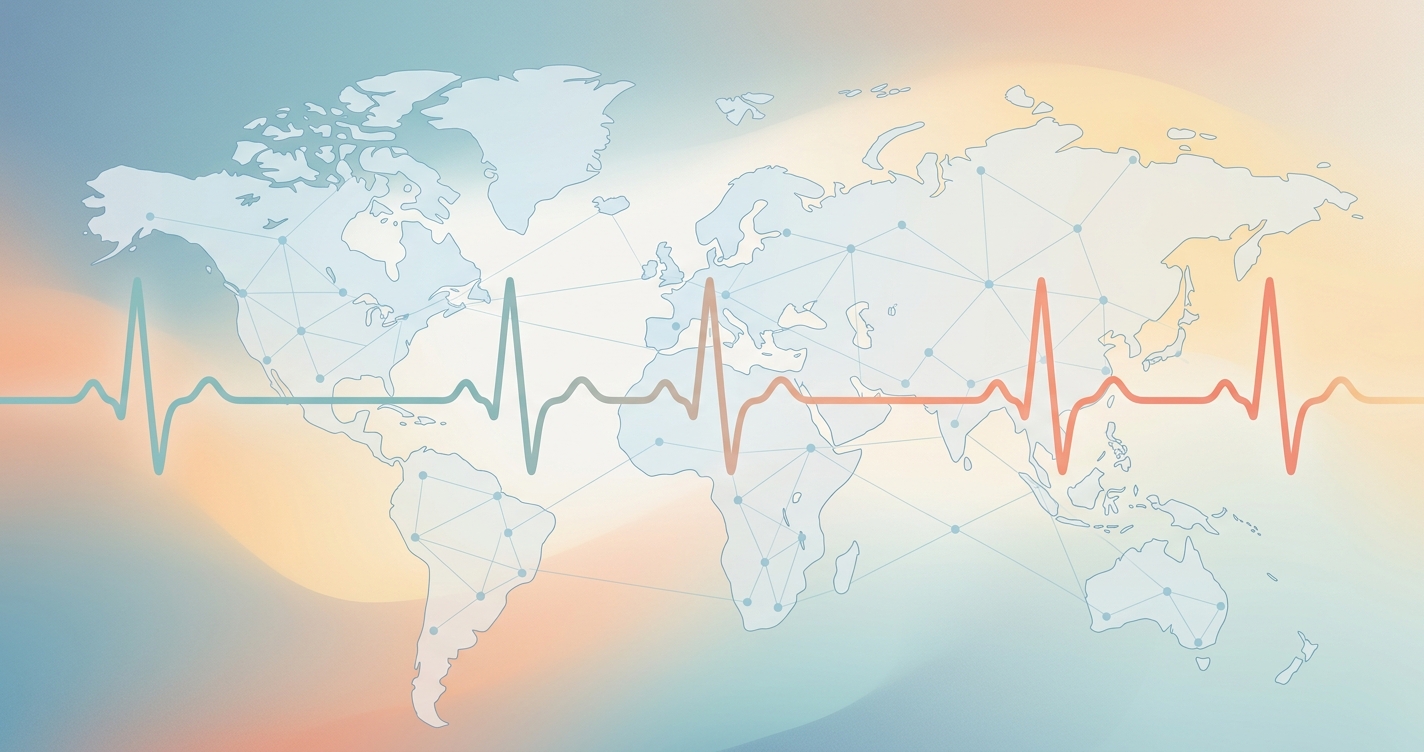
For a significant portion of the world's population, the question of what to do about chest tightness is not about which hospital to drive to, but whether a hospital is reachable at all. When the nearest clinic is a full day's journey away, symptoms that would trigger an immediate emergency call in a well-resourced area become a complex and dangerous judgment call. This scenario, where individuals experience chest tightness with no hospital nearby, represents a critical failure point in global health delivery. The decision to wait, to travel, or to seek local, non-clinical advice can have life-or-death consequences, often resting on incomplete information and logistical impossibilities. The gap between the onset of symptoms and access to care in these settings is not just a matter of miles, but of mortality.
"In 2022, rural adults aged 25 to 64 experienced a 21% relative increase in cardiovascular death rates compared to 2010, while urban areas in the same age group saw only a 3% increase. By then, rural adults were dying from cardiovascular disease at a rate 1.5 times higher than their urban counterparts."
The challenge of triage for chest pain in remote settings
Chest tightness is a symptom, not a diagnosis. It can originate from a dozen sources, ranging from the benign (muscular strain, anxiety) to the critical (acute myocardial infarction, pulmonary embolism). In a clinical setting, a healthcare provider uses a combination of patient history, physical examination, and diagnostic tools, an electrocardiogram (ECG), blood tests for cardiac enzymes, and imaging, to differentiate the cause and determine the urgency. In a remote village or a field deployment, these tools are absent. This makes the challenge of chest tightness no hospital nearby one of information scarcity. A community health worker (CHW) or a local aid worker, often the first and only point of contact, is left to make a high-stakes assessment without the necessary equipment. The result is often a binary, and unfavorable, choice: either overburden a distant and hard-to-reach facility with a non-emergency case, or risk a fatal outcome by advising a patient with a true cardiac event to wait. Research has repeatedly shown that delays in care are a primary driver of poor outcomes for cardiovascular events. A systematic review published in PubMed noted that rural patients with acute myocardial infarction consistently face higher mortality rates than urban patients, a disparity directly linked to delays in diagnosis and treatment.
| Parameter | Traditional Clinical Triage | mHealth-Assisted Field Triage |
|---|---|---|
| Initial Assessment | In-person at a clinical facility by a nurse or doctor. | At the point of contact by a CHW or field worker. |
| Tools Required | 12-lead ECG machine, pulse oximeter, blood pressure cuff, cardiac enzyme lab tests. | A single smartphone with a dedicated application. |
| Key Vital Signs | Heart rate, blood pressure, oxygen saturation, ECG waveform. | Heart rate, respiratory rate, heart rate variability (HRV) via photoplethysmography (PPG). |
| Time to First Data | Hours to days, depending on travel time to the facility. | Seconds to minutes, at the patient's side. |
| Personnel | Trained medical professionals (nurses, physicians). | Community health workers with task-specific training. |
| Data Integration | Data entered into a hospital's Electronic Health Record (EHR) system. | Data can be uploaded in real-time to a central platform like DHIS2 or CommCare for remote supervision. |
Industry Applications
Global health implementers are increasingly turning to mobile health (mHealth) platforms to address this triage gap. Rather than trying to replicate a hospital in every village, the strategy is to equip frontline health workers with tools to gather better data and make more informed decisions.
Role of community health workers (chws)
CHWs are the backbone of this strategy. They are trusted community members who can be trained to use simple, smartphone-based applications to conduct preliminary screenings. When a patient reports chest tightness, the CHW can use a phone to measure key vital signs. This data, while not a substitute for a clinical diagnosis, provides objective information that can be used to stratify risk. It transforms the CHW's role from a subjective observer to a frontline data collector, enabling a more structured and evidence-based approach when there is chest tightness no hospital nearby.
Integrating with national health information systems
The data captured by these mHealth tools does not have to exist in a vacuum. Leading programs focus on integrating these field-level data streams into national health information systems like DHIS2. When a CHW measures a patient's vital signs, the data can be automatically synced to a district or national dashboard. This allows for remote supervision by trained clinicians who can review the data, identify high-risk patients, and advise the CHW on the appropriate next steps, whether it's immediate evacuation, referral to a local health post, or monitoring at home. This approach supports individual patients while also providing ministries of health with real-time population health insights.
Current research and evidence
The shift towards smartphone-based screening is supported by a growing body of research. The core technology often involves photoplethysmography (PPG), a technique that uses the smartphone's camera and flash to detect changes in blood volume in the fingertip. From this signal, it is possible to calculate not just heart rate, but also respiratory rate and heart rate variability (HRV), a measure of autonomic nervous system function that can be altered during cardiac stress.
- A study published in Frontiers in Physiology validated the use of smartphone PPG for measuring resting heart rate, finding strong correlation with ECG data.
- Research in the Journal of Medical Engineering & Technology by researchers such as Giuseppe V. de-Guzman and their teams (2020) has demonstrated the feasibility of extracting reliable HRV parameters from smartphone PPG signals, paving the way for more nuanced cardiac assessment outside the clinic.
- Multiple studies have explored the accuracy of camera-based vital signs monitoring, noting that while challenges like motion artifacts exist, the technology is sufficiently reliable for risk stratification and triage in low-resource settings.
This evidence base is critical for ministries of health and implementing partners who need to validate the efficacy of these tools before deploying them at scale.
The future of remote cardiac triage
The continued evolution of smartphone sensor technology and machine learning algorithms promises to further enhance the capabilities of remote triage. Future mHealth platforms may incorporate AI-driven risk scores that analyze vital sign patterns in conjunction with patient-reported symptoms to provide an immediate probability of a serious cardiac event. This could provide CHWs with even more powerful decision support. Furthermore, as these platforms become more widespread, they will generate vast datasets that can be used to refine treatment guidelines, improve pandemic preparedness, and inform health policy in low- and middle-income countries.
Frequently asked questions
What are the most common non-cardiac causes of chest tightness? Common causes include anxiety or panic attacks, acid reflux (GERD), muscle strain from coughing or injury, and respiratory conditions like asthma or pneumonia. Differentiating these from cardiac causes without clinical tools is the primary challenge in remote settings.
How can mobile health tools help when there is chest tightness no hospital nearby? mHealth tools empower local health workers to capture objective vital signs like heart rate, respiratory rate, and heart rate variability. This data provides a more reliable basis for a remote clinician or an algorithm to assess risk and guide the worker on whether to initiate emergency transport or to monitor the patient locally.
Are smartphone-based vital signs a replacement for a doctor? No. These tools are for triage and risk stratification, not diagnosis. Their purpose is to solve the "information scarcity" problem in the field, helping to ensure that limited transport and clinical resources are used for the patients who need them most. They augment, rather than replace, clinical judgment.
The work of improving health outcomes in the world's most remote places involves solving complex logistical and informational challenges. Circadify is actively working with global health partners to deploy validated, zero-equipment mobile health solutions that empower frontline workers to make better decisions. To see how these tools are being used in the field, you can review our deployment case studies and research at circadify.com/blog.