8 Conditions a CHW Vital Signs Tool Can Flag Fast
Examine how a CHW vital signs tool helps frontline workers detect high blood pressure, low oxygen, and irregular heart rates in low-resource environments.
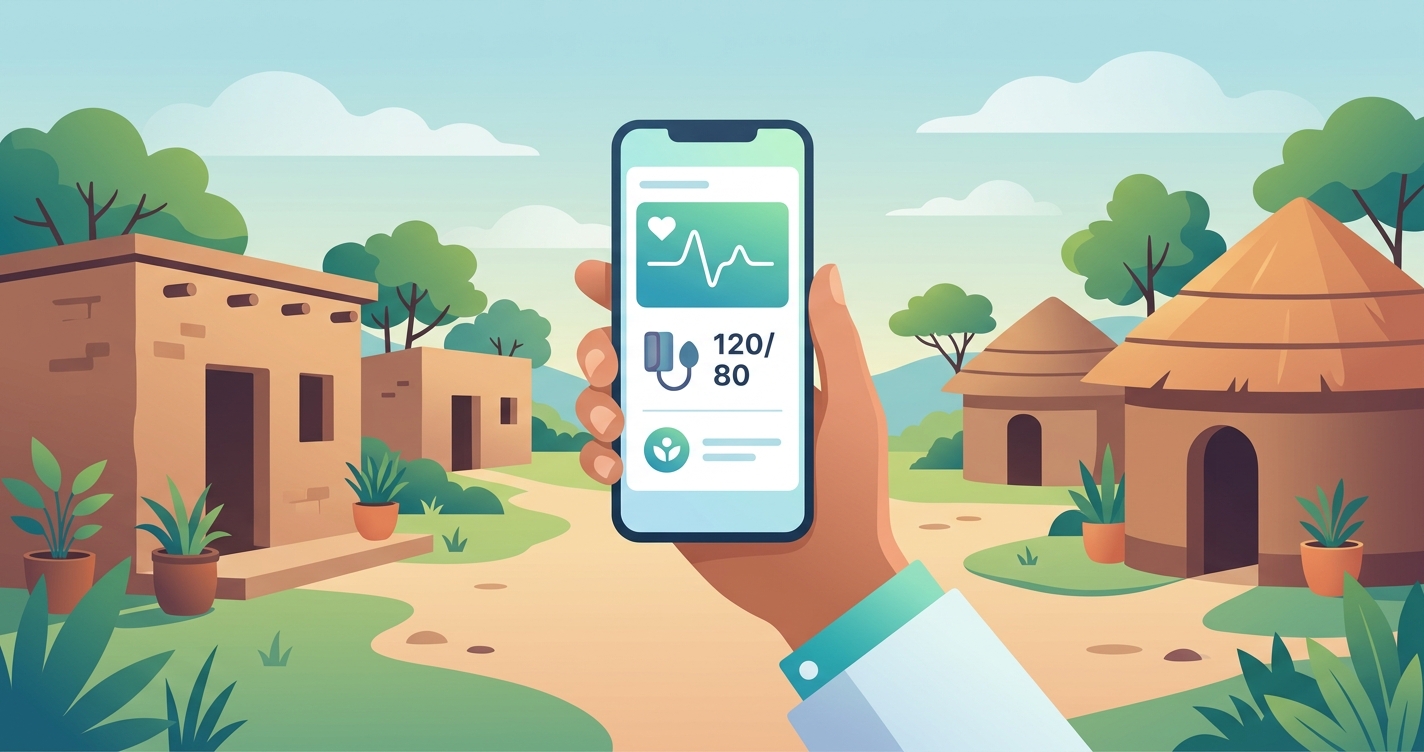
Equipping community health workers in low-resource settings has historically been an exercise in logistical compromise. Ministries of health and global implementing partners face constant pressure to expand the diagnostic capabilities of frontline staff without expanding the physical hardware they carry across difficult terrain. A modern CHW vital signs tool changes this operational arithmetic by turning standard mobile devices into active screening instruments. By utilizing built-in smartphone cameras and motion sensors, these software applications enable rapid physiological measurement at the point of care, entirely independent of traditional cuffs, clips, and specialized clinical monitors. This transition from physical hardware to algorithmic measurement is fundamentally restructuring how remote population health is managed.
"The bottleneck in rural healthcare delivery is no longer data transmission, but data acquisition. When a smartphone can measure cardiovascular activity as effectively as a peripheral sensor, the entire model of community screening changes."
- Dr. Walter Karlen, Mobile Health Researcher, University of British Columbia
The shift toward hardware-free diagnostics
When frontline teams rely on peripheral hardware, procurement budgets are rapidly consumed by shipping, calibration, and replacement costs. Standard blood pressure cuffs lose calibration after months of being carried in backpacks. Portable pulse oximeters rely on mechanical springs that break and batteries that are difficult to source in rural villages. A CHW vital signs tool eliminates these barriers by centralizing diagnostic capacity within the mobile devices that field workers already possess.
This transition represents a critical step for organizations managing wide-scale mobile health deployments. By moving the diagnostic mechanism from a physical sensor to a software algorithm, global health programs can deploy screening capabilities at a fraction of the traditional cost.
| Feature | Physical Clinical Equipment | Software-Based Measurement |
|---|---|---|
| Logistics | Requires complex supply chains | Deployed via digital download |
| Maintenance | Needs regular calibration | Updated via software patches |
| Consumables | Batteries, cuffs, probes | None required |
| Scalability | Cost increases per user | Highly scalable infrastructure |
| Data Entry | Manual transcription required | Automated digital logging |
The operational advantages of this software-first approach extend beyond basic cost savings. Moving to device-agnostic screening provides several measurable improvements for field teams:
- Reduces the physical load on frontline workers traveling long distances on foot or bicycle.
- Standardizes data collection by writing measurements directly into central health information systems.
- Lowers the barrier to entry for large-scale population screening programs in remote regions.
- Mitigates cross-contamination risks inherent in shared physical cuffs and contact probes.
- Eliminates the downtime associated with waiting for replacement hardware to arrive through rural supply chains.
8 conditions a CHW vital signs tool can flag fast
The transition to digital screening allows frontline workers to identify physiological anomalies long before a patient reaches a formal clinic. The following eight conditions represent the most common targets for software-based vital signs assessment in low-resource settings.
1. high blood pressure (hypertension)
Systolic hypertension is a silent driver of mortality in developing nations, where the burden of non-communicable diseases has steadily risen. Traditional screening requires community health workers to carry bulky sphygmomanometers that are prone to mechanical failure. Software-based screening allows field workers to capture pulse pressure wave data using smartphone sensors, sorting patients into high-risk categories for clinical referral before critical cardiovascular events occur.
2. low blood oxygen (hypoxia)
Detecting hypoxemia early is essential for managing severe respiratory conditions, particularly childhood pneumonia. By measuring the absorption and reflection of light through the capillary bed via a smartphone camera, field applications can identify low oxygen saturation. This allows workers to immediately prioritize the most vulnerable patients for oxygen therapy and emergency transport, bypassing the need for fragile peripheral oximeters.
3. elevated respiratory rate (tachypnea)
Counting breaths manually in a noisy, distracting environment is prone to severe user error. Digital vital signs tools analyze the periodic movement of the chest or the modulation of the heart rate signal to accurately calculate respiratory rate. This provides a highly reliable metric for lower respiratory tract infections, replacing the traditional mechanical timers that have historically guided acute respiratory infection protocols.
4. abnormal heart rate (tachycardia)
A resting heart rate consistently above normal limits often indicates underlying systemic issues, ranging from severe dehydration due to diarrheal diseases to thyroid dysfunction or internal bleeding. Automated counting through a smartphone interface provides an instant, objective metric for the worker to record, removing the variability associated with manual pulse palpation.
5. Irregular Heartbeat (Arrhythmia)
Atrial fibrillation and other irregular rhythms are notoriously difficult to catch in rural populations that lack access to continuous monitoring or electrocardiograms. Advanced photoplethysmography algorithms can detect variations in pulse intervals over a brief observation period, alerting the community health worker to irregularities that require advanced clinical follow-up.
6. preeclampsia risk indicators
Maternal health programs in low-resource settings struggle with the logistics of routine prenatal checks. Because carrying heavy blood pressure cuffs to remote maternal visits is challenging, many warning signs are missed. By tracking trends in resting heart rate and algorithmically estimated blood pressure over multiple visits, digital screening tools help identify pregnant women at risk for severe hypertensive disorders.
7. autonomic nervous system stress
Heart rate variability offers deep physiological insights into the autonomic nervous system and overall systemic stress. Software tools can track these micro-fluctuations in pulse timing, giving global health researchers and clinicians a new data layer to understand the chronic disease burden, malnutrition impacts, and environmental stressors in remote populations.
8. systemic infection proxies
While a smartphone camera cannot directly measure core body temperature, significant systemic infections usually present with concurrent spikes in resting heart rate and respiratory rate. A modern CHW vital signs tool captures this combined physiological response, acting as an early warning mechanism for fever-inducing illnesses like malaria, dengue, or general sepsis, ensuring rapid triage.
Current research and evidence
The shift from experimental concepts to validated field tools is well documented in recent clinical literature, proving that mobile devices can meet the rigorous demands of global health deployment. In 2023, researchers at the Medical Research Council/Uganda Virus Research Institute (MRC/UVRI) Uganda Research Unit published findings demonstrating that smartphone-based photoplethysmography could accurately measure heart rate and oxygen saturation in rural Ugandan populations (Nakasi et al., MRC/UVRI, 2023). This validation confirms the viability of replacing peripheral hardware with optical algorithms in environments where traditional equipment fails.
Further research focusing on cardiovascular metrics has expanded the capabilities of standard mobile devices. In 2024, a team led by bioengineering professor Ramakrishna Mukkamala at the University of Pittsburgh's Swanson School of Engineering developed an Android application utilizing existing smartphone sensors, such as accelerometers and touch sensors, to measure pulse pressure (Mukkamala, University of Pittsburgh, 2024). This work specifically targets the global burden of systolic hypertension in underserved populations, proving that ubiquitous consumer hardware can reliably detect cardiovascular anomalies when paired with sophisticated data processing.
The future of remote screening in low-resource settings
As mobile processing power increases and smartphone camera sensors become more advanced, the performance gap between hospital-grade hardware and field-ready software continues to close. Implementing partners and global health ministries are increasingly prioritizing digital-first measurement strategies to stretch limited procurement budgets.
The ultimate goal of this technology is to equip every frontline worker with a complete diagnostic suite that requires zero mechanical maintenance, relies on zero physical consumables, and operates entirely offline in disconnected villages. By integrating these optical and mechanical sensor algorithms directly into existing mobile data collection platforms, health organizations can build highly resilient, infinitely scalable screening programs.
Frequently asked questions
How does a smartphone capture pulse data without a cuff?
The primary method is photoplethysmography (PPG). A smartphone camera detects micro-variations in light absorption or reflection on the skin as blood volume changes with each cardiac cycle. Advanced algorithms isolate these subtle color shifts to calculate pulse rate and oxygen saturation.
Can these platforms operate in areas with no cellular network?
Yes. Many diagnostic applications engineered for global health are designed with edge computing capabilities. They process all physiological data locally on the device processor and store the results securely until network connectivity is restored for central synchronization.
Does software replace the need for clinical diagnosis?
Software-based measurement tools are not intended to replace definitive clinical diagnoses or hospital-grade monitors. Instead, they act as rapid triage and screening mechanisms, allowing community health workers to objectively allocate scarce clinical resources and referral transport to the patients who require urgent care.
What hardware specifications are required for field devices?
Modern vital signs algorithms are highly optimized to run on standard, low-cost Android devices commonly procured for global health initiatives. As long as the device features a functioning camera and a basic processor capable of running standard mobile health data collection tools, it can typically support software-based physiological screening.
Organizations designing the next generation of mobile health deployments must carefully evaluate how algorithmic software can alleviate physical hardware constraints. Circadify is actively addressing this space by developing modular diagnostic architecture for digital health implementers operating in challenging environments. To see how these principles are applied in the field, explore our latest deployment case studies at circadify.com/blog.