
6 Lessons From Failed mHealth Pilots in Low-Resource Settings
A research-based review of failed mHealth pilots in low-resource settings, including lessons on financing, interoperability, governance, and frontline workflow design.
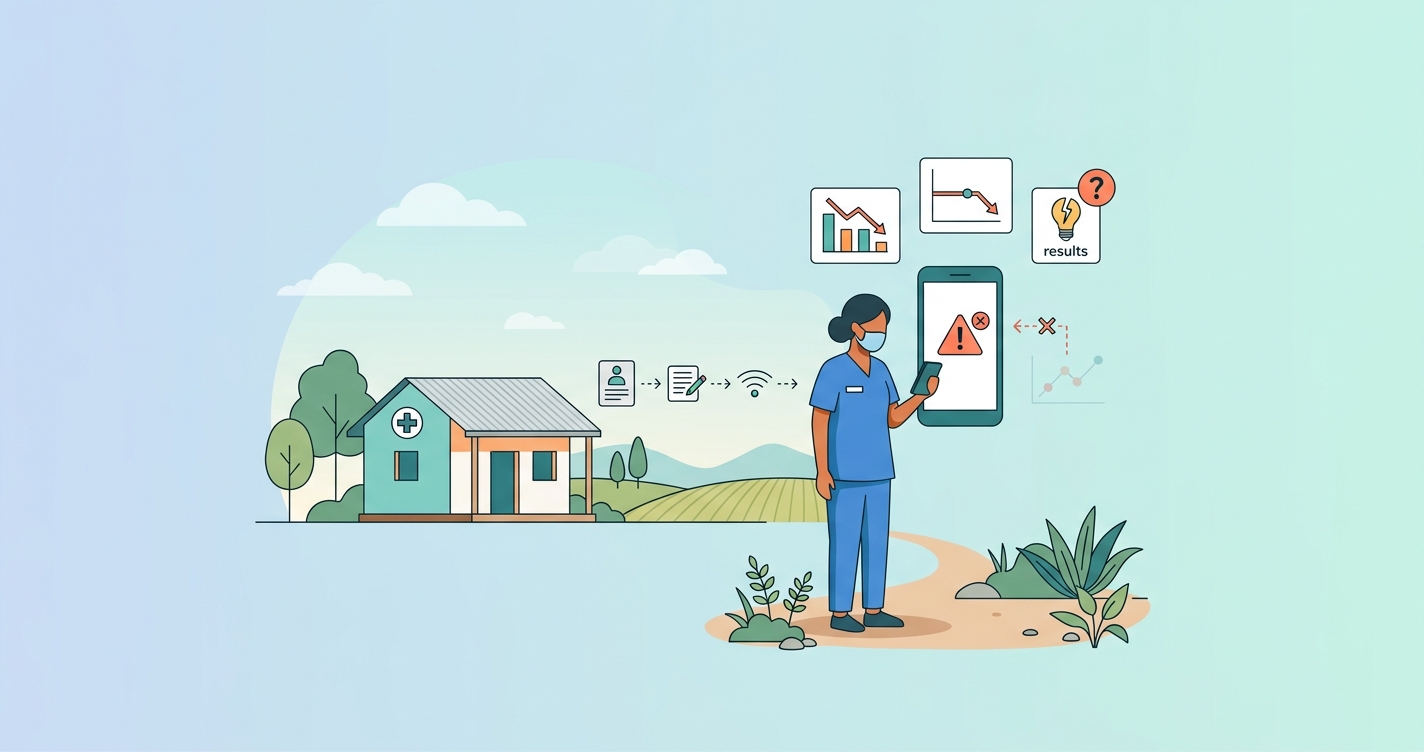
6 Lessons From Failed mHealth Pilots in Low-Resource Settings
Failed mHealth pilots in low-resource settings rarely fail because frontline teams do not see the need. They fail because promising tools are asked to survive weak connectivity, donor timelines, fragmented reporting systems, and procurement models that reward novelty more than durability. In global health, the hard part is usually not proving that a mobile tool can work in one district. It is building something that ministries, implementing partners, and community health programs can still run after the pilot budget disappears.
"Pilotitis" remains one of digital health's most persistent problems: strong pilots appear, but few interventions become durable national systems. — synthesis from BMJ Global Health and WHO digital health guidance, 2019-2025
Failed mHealth pilots in low-resource settings usually break in the same six places
The phrase "failed mHealth pilots in low-resource settings" covers many program types, from maternal health apps to CHW decision support and outbreak reporting. Yet the failure patterns are surprisingly consistent. Reviews summarized by the World Health Organization, BMJ Global Health, and PATH's Digital Health Global Goods work point to the same structural gaps: weak country ownership, poor interoperability, thin financing plans, and solutions designed around the demo rather than the daily workflow.
| Failure pattern | What it looks like in practice | Why pilots stall | What stronger programs do instead |
|---|---|---|---|
| Donor-only financing | Tool works during grant period, then usage drops | No budget line for devices, support, or hosting | Build public or long-term operating budgets early |
| Weak policy alignment | Pilot reports upward to donor, not into ministry systems | Program remains parallel to national strategy | Tie design to ministry priorities and reporting rules |
| Poor interoperability | CHWs enter data twice across app and HMIS | Extra burden kills adoption and data quality | Map workflows into DHIS2, EMRs, and standards-based exchange |
| Connectivity assumptions | Pilot works in cities but not remote catchment areas | Rural teams cannot sync reliably | Use offline-first design and delayed sync rules |
| Thin training and supervision | Tool is handed out once with minimal follow-up | Usage decays after launch wave | Budget for coaching, supervision, and refreshers |
| No path beyond pilot metrics | Success is measured only by download or screening counts | Decision-makers cannot justify scale-up | Track service impact, workflow fit, and system costs |
A useful lesson here is that mHealth programs usually fail as operating systems, not as software prototypes.
1. Financing cannot end where the pilot begins
Many mHealth pilots are launched with enough money to procure handsets, pay implementers, and generate a polished evaluation. That is often enough to prove feasibility, but not enough to create continuity. Research on digital-health scale-up in low- and middle-income countries repeatedly notes that interventions which depend entirely on short-term donor support struggle once maintenance, retraining, data hosting, and support costs shift back to local teams.
That matters because the most expensive phase is often not the pilot. It is the scale-up phase, where device replacement, integration work, supervision, and governance become recurring rather than experimental costs.
- Pilot grants buy momentum, not sustainability
- National scale requires operating budgets, not just innovation funds
- Procurement plans have to include devices, connectivity, support, and updates
2. If a pilot sits outside government workflow, it usually stays there
The WHO's guidance on digital interventions for health system strengthening and its broader digital health strategy have been consistent on one point: digital tools have to fit national systems, not bypass them. When a pilot is designed around donor reporting needs alone, it may generate attractive dashboards but still fail to matter to district health offices, ministry planners, or public financing teams.
The lesson from the literature on scaling digital health in LMICs is not simply "involve government." It is more specific: align indicators, governance, and reporting pathways from the beginning. Programs that remain parallel almost always become temporary.
3. Interoperability is not a technical add-on
PATH's Digital Health Global Goods Maturity Model and multiple reviews on scale-up treat interoperability as a maturity issue because it determines whether a tool can move from project to system. In low-resource settings, duplicate entry is more than an inconvenience. It is a direct tax on frontline labor.
If CHWs or nurses have to enter data once into a pilot app and again into DHIS2 or facility records, the app becomes an extra task rather than a labor-saving one. That is where adoption erodes.
Industry applications where interoperability decides success
Community health worker programs
CHW programs need screening, referral, follow-up, and supervisor review to live in one workflow. If household visits are captured in one tool while national reporting lives somewhere else, the pilot may produce data but not operational value.
Maternal and child health
Maternal health workflows usually expose system weakness quickly. Missed referrals, delayed postpartum follow-up, and duplicate records become visible when digital tools cannot connect with district reporting or facility care pathways.
TB, HIV, and chronic care follow-up
Longitudinal programs are especially sensitive to fragmentation. If screening events cannot link to follow-up, treatment, or escalation workflows, the pilot measures activity without proving continuity of care.
Current research and evidence
The evidence base around failed mHealth pilots in low-resource settings has become much clearer over the last decade.
A BMJ Global Health analysis on moving beyond pilotitis argued that many digital health interventions show early promise but fail to reach national durability because the bottleneck is institutional integration, not just technical feasibility. The core message is uncomfortable but useful: success depends on policy fit, stakeholder alignment, and long-term health-system capacity as much as on the application itself.
The WHO's recommendations on digital interventions for health system strengthening reached a similar conclusion. Digital tools can support registration, decision support, telemedicine, and data exchange, but implementation depends on infrastructure, usability, governance, and sustained support. In other words, ministries cannot buy their way into durable digital transformation with software alone.
PATH's Digital Health Global Goods Maturity Model adds another important frame. It emphasizes governance, country ownership, technical architecture, and community adoption as signs that a digital tool is ready for broader use. That is a helpful corrective to pilot culture, where maturity is often confused with short-term excitement.
The research on digital health scale-up in LMICs also keeps returning to a few practical conclusions.
- Country ownership is a scale-up requirement, not a nice-to-have
- Offline-first design matters because remote deployment is where equity is tested
- Interoperability determines whether a tool reduces work or creates more of it
- Training and supervision affect actual usage far more than launch-day enthusiasm
- Evaluation must include workflow and financing outcomes, not just user counts
4. Offline-first design is a strategy, not a feature list item
A large share of failed pilots are quietly urban pilots. They are described as national or rural innovations, but the actual workflow assumes steady power, stable mobile data, and quick technical support. Once the program moves into remote districts, the interface may still work, but the operating model does not.
For mHealth field deployments, offline-first design means more than caching forms. It means deciding how records sync, how conflicts resolve, what happens after missed uploads, and how supervisors see delayed data. Programs that think through these details are far more likely to survive beyond the first geography.
5. Training decay is one of the biggest hidden failure modes
A common pilot pattern is heavy launch support followed by light-touch maintenance. Initial adoption looks strong. Six months later, usage becomes inconsistent because staff turnover, device changes, and workload pressures were not planned for.
That finding shows up across digital health implementation literature: training has to be continuous enough to survive real workforce conditions. In CHW and district programs, supervision is often the missing bridge between tool rollout and durable use.
| Program approach | First 90 days | After 12 months |
|---|---|---|
| Pilot-heavy launch, minimal follow-up | Strong usage spike | Sharp drop in consistency |
| Moderate launch with supervisor support | Slower start | More stable adoption |
| Embedded training plus refreshers | Higher operating effort | Best chance of sustained use |
6. Measuring the wrong success metric creates false confidence
Some pilots are labeled successful because they enrolled many users, captured many records, or produced attractive dashboards. Those metrics are useful, but they do not answer the real scale-up question: did the intervention improve workflow, decision-making, referrals, or reporting enough to justify long-term investment?
A mature evaluation framework looks at service continuity, reporting burden, time savings, supervisor visibility, and cost-to-operate after donor support declines. That is the point where many pilots stop looking like products and start looking like unfinished systems.
The future of mHealth scale-up after pilot failure
The future of mHealth in low-resource settings will probably belong to programs that are intentionally less glamorous at the start. They will spend more time on governance, indicator mapping, integration, and offline workflows before declaring success. That may slow pilots down, but it raises the odds that they can survive ministry review, budget scrutiny, and district-level realities.
This is also where smartphone-based, low-equipment screening can become more valuable. The strategic benefit is not just digital measurement. It is reducing peripheral hardware, simplifying logistics, and fitting more easily into existing frontline workflows. Solutions like Circadify are being brought to market for this kind of field deployment model, especially where programs need flexible smartphone-based screening without adding a large equipment burden. For broader deployment context, visit Circadify's global health coverage.
If there is one lesson that cuts across the evidence, it is this: the opposite of pilot failure is not a better pilot. It is a better path to ownership, interoperability, and routine use.
Frequently Asked Questions
Why do mHealth pilots fail to scale in low-resource settings?
They usually fail because financing, governance, interoperability, and frontline workflow design were not built for long-term operation. The software may work, but the surrounding system does not.
What is pilotitis in digital health?
Pilotitis describes the pattern where many digital health projects are launched and evaluated, but very few become sustainable parts of national health systems.
Why is interoperability so important for mHealth programs?
Because programs scale only when data can move into existing health information systems without duplicate entry. If frontline teams have to document the same work twice, adoption usually falls.
What should funders and ministries evaluate beyond pilot metrics?
They should evaluate recurring costs, workflow burden, supervision needs, offline performance, integration with national systems, and whether the tool remains useful after the initial grant period.
For related reading, see our analysis of mobile health in low-resource settings, how smartphone screening integrates with DHIS2, and scaling from pilot to national program.